City to commission impact study on data center water usage
GEOFFREY WOEHLK/THE FORUM
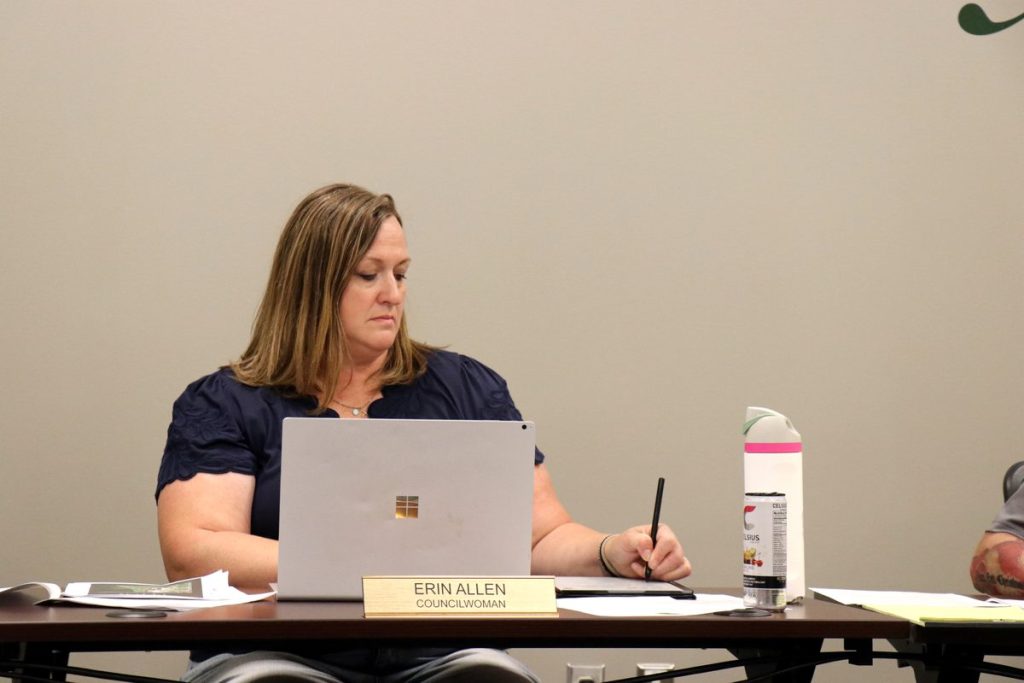
City Council member Erin Allen takes notes during Monday’s regular council meeting. Allen said she wants HDR Engineering to perform an impact study using original research without relying on the feasibility study released recently by Nodaway County Public Water Supply District No. 1.
MARYVILLE, Mo. — The city of Maryville plans to commission an impact study to analyze the potential effects of water usage by the proposed White Cloud Acres data center project, and Mayor John McBride said he supports a suggestion for local elected officials to participate in a joint town hall to discuss the project with residents.
Impact study
Near the end of Monday’s regular City Council meeting, City Manager Ryan Heiland recapped an independent feasibility study commissioned by the PWSD No. 1 board and carried out by third-party firm Lamp Rynearson. The study was paid for by Scale Microgrids, the developer of the hyperscale AI data center project, and overseen by local firm White Cloud Engineering and Construction. The report analyzed water resources available for the data center and its accompanying natural gas power plant.
Heiland confirmed the report’s analysis, including that many questions remain unanswered and will require discussion and coordination among the city, PWSD No. 1 and the data center developer. The study’s recommendation was to purchase wastewater from the city of Maryville for cooling equipment at the data center and at the on-site power plant, and send the power plant’s wastewater back to the city of Maryville’s wastewater treatment facility after pretreatment at the data center site.
Another option presented in the feasibility study was for the data center to simply buy potable water from PWSD No. 1. Council member Bryan Williams pointed out that even if the city refuses to sell wastewater to the data center, PWSD No. 1’s existing contract with the city would allow the rural water district to draw more than enough water to supply the data center. Currently, PWSD No. 1 draws about 600,000 gallons per day, Heiland said. The contract allows up to 1 million gallons per day. The remaining 400,000 gallons per day would be more than enough to supply the data center, according to figures from the feasibility study.
“So potentially, they could take water for the data center whether we want them to or not,” Williams said. “So we have no say in that. So now, it’s basically we’re trying to mitigate the potential impact to the city and our infrastructure and our resources.”
The council agreed that an impact study looking at the potential effects on the city’s water resources is the best next step. McBride suggested that the city look for a contractor to carry out the study which does not already have a relationship with the city. But council member Erin Allen said that the city’s longtime water consultant, HDR Engineering, might have better insights into the city’s situation because of how intimately the company has been involved in the city’s water operations since 2020. She also said that because of how quickly the data center developer would like to move on the project, HDR may be the quickest option as well.
“We need our own study; we need someone contracted to help us, and I think that needs to happen ASAP,” Allen said.
Heiland said he would contact HDR about moving ahead with an impact study.
Allen specified that HDR should not rely on the Lamp Rynearson feasibility study for any information and should instead do their research independently from that document. While she said she understood the value of the feasibility study for its specific purpose, “it is also based on a wide variety of inputs that still seem up in the air.”
“You’re still bouncing numbers off the wall for today, tomorrow, three years from now — take it out, put it in, it’s this, it’s that — and that’s contributing to the stress on our community, because they want answers,” Allen said. “They want us to give answers. They’re mad at us for not giving answers, and I don’t know how to give an answer I don’t have the answer for. So it’s like, I can empathize.
“Everybody stands up here and says, ‘We’re mad we don’t have answers.’ We’re mad we don’t have answers too, just so you’re aware. We can’t wait to give you one.”
Joint public meeting
For more than an hour to start Monday’s meeting, residents spoke against the proposed data center, none to louder applause than Nina Wiederholt, a former elementary science teacher in Maryville. Wiederholt said that the effect of the data center on the environment has stirred her to action with the opposition group Nodaway Says No.
“I’ve not been part of a protest since I was in college in 1973. Gee whiz,” she said. “I’ve got the shirt to go right along with some of the people right here now. … That shirt is me. I want to ‘say no’ to this group. Please do what you can. Please stop it. It’s for our kids.”
Nancy Zeliff, the first speaker during the public comment period, read a statement asking for the joint meeting — a request repeated by multiple speakers.
“The citizens of Maryville, Nodaway County and customers of the Public Water Supply District No. 1 are requesting a public meeting where all three — council, board and commission — are available to answer these questions and others which would be asked,” Zeliff said. “Not your lawyers, not Scale Microgrids and their contractors who were at the Mozingo meeting.
“You, the elected officials, are those who should be addressing citizens and constituents. It’s your duty to the city, the county and the residents.”
Later speakers also mentioned that they would like members of the Nodaway County Health Center Board of Trustees to be involved at a town-hall-style public meeting.
The council did not directly answer questions, although occasionally answered a yes or no to a few that were easily and quickly answered. That is typical of public comment periods of local government meetings, although some bodies have found it more difficult than others not to respond directly to constituents. During a similar hourlong public comment period at the PWSD No. 1 board meeting on June 15, for example, consultant Brock Pfost ended up in a lengthy question-and-answer session once opening the door to one or two answers.
That policy has frustrated many residents who attend the meetings hoping for some kind of feedback from elected officials, further feeding the anger many of them have expressed that they feel left out of the process.
“I guess people are just trying to figure out what the next steps are, and … everywhere we go, no one will talk to us,” said Jennifer Gillespie, who lives near the site of the proposed data center. “So how are we supposed to have any questions (answered)? You guys won’t even look at us. I don’t understand what’s happening. As I told the rural water board, all you guys live here. And everywhere we go, you guys are acting like you guys don’t live here with us.”
Later in the meeting, council member Allen — who reminded attendees several times and even another council member that the meeting was not an open discussion — acknowledged that she “probably frustrated some people in the crowd.” She said that although she did not necessarily disagree with many of the concerns raised, she would like to see more education about how to engage with the council.
“There is a reason there is a City Council and there is a reason there is a city agenda. And there is a way to conduct business and there is a way to ask questions, and it is not in the public comment section,” she said. “I’d like to potentially put together some community education on how City Council meetings go so we don’t look like the bad guy up here. I know that there’s a lot of emotion around this subject, and if you were sitting up here, I think it would be easier to understand.”
After the meeting, Mayor McBride said he does sometimes find it difficult to keep from getting into a back-and-forth with members of the public who are looking for some kind of answers.
“It’s tough,” he said. “I’ve got my own thoughts on (the data center project), and you’ve just got to be diligent about that. I’m trying not to let my opinions interfere with the process. I’m looking at collecting information, just like you are.”
McBride said he would support a joint public meeting with other local government entities to get everyone in one place and answer as much as possible.
“I would be all for that,” he said. “I would not be opposed to that at all. Because I feel like that might be a better venue to get questions answered and get the people that we need to be there.”
However, he also said he was happy that so many residents from around the county felt they could come to the City Council with their concerns and engage in a public meeting.
“I think it’s a blessing to be able to provide that, at least some kind of outlet,” McBride said. “It might not be the most productive as far as getting stuff answered, but it at least gives a forum for people to get what’s on their chest off, and then we know those concerns. It’s just so hard to figure out what is what.”
GEOFFREY WOEHLK/THE FORUM
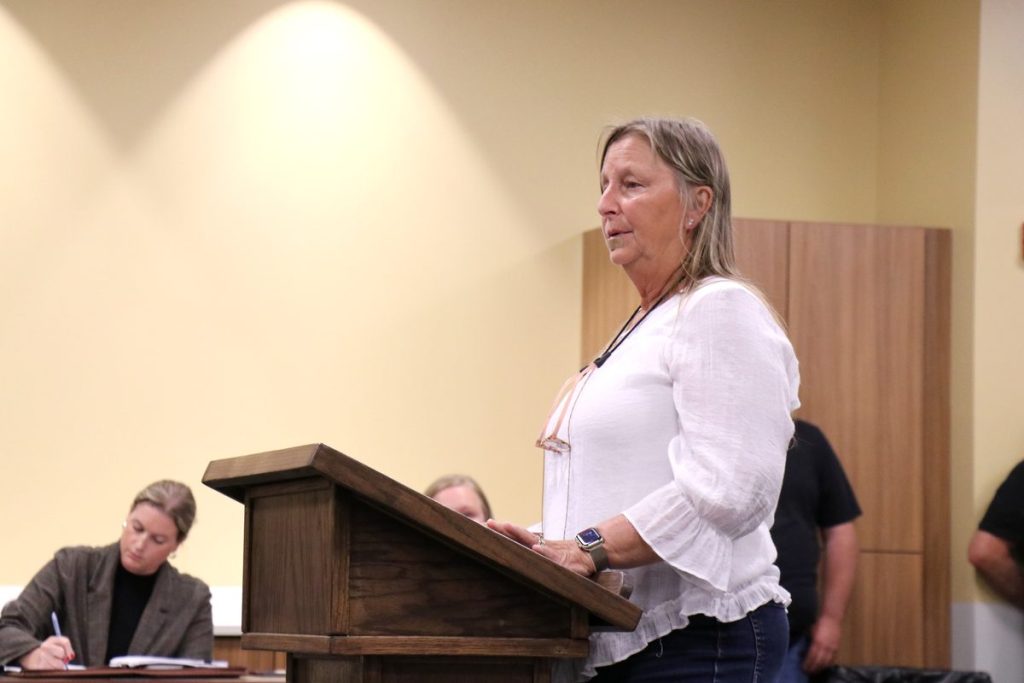
“We’re your people, and we hope that you guys will take care of us,” said Mary Mizera in her remarks to the Maryville City Council on Monday. The city’s role in the potential data center development has become more prominent since a feasibility study released last week suggested that the most sensible option for the data center to acquire cooling water is to purchase wastewater from the city of Maryville.
GEOFFREY WOEHLK/THE FORUM
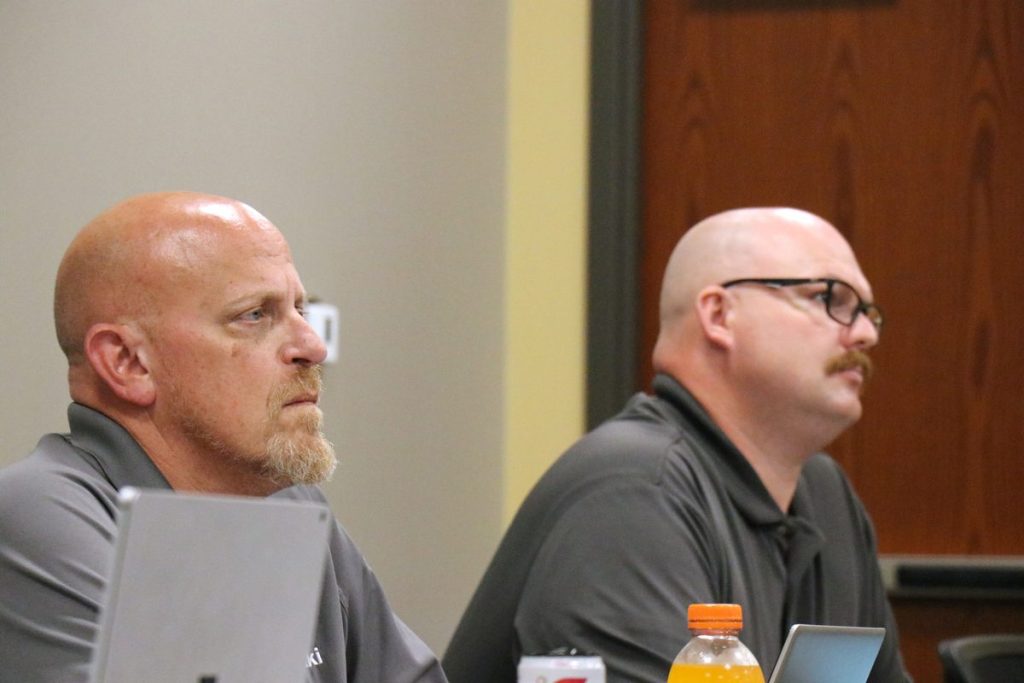
Maryville Mayor John McBride, left, and City Council member Bryan Williams listen to residents voice their concerns about the White Cloud Acres data center project during Monday’s regular meeting. McBride told The Forum after the meeting that he tries to keep his own opinions about the data center out of the way as he focuses on gathering as much information as he can.
GEOFFREY WOEHLK/THE FORUM
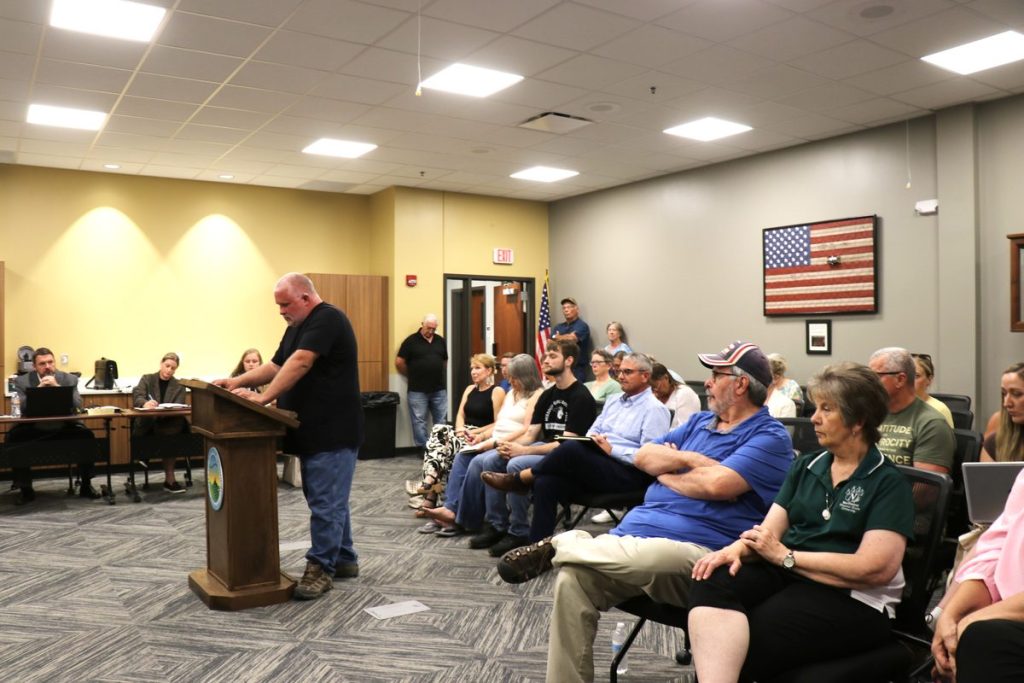
Scott Wilson, a backup water operator in Bolckow, speaks to the Maryville City Council during its regular meeting on Monday. Wilson was one of several area residents who spoke against the White Cloud Acres data center project during more than an hour of public comments.