PWSD No. 1 releases draft study on data center water
LAMP RYNEARSON
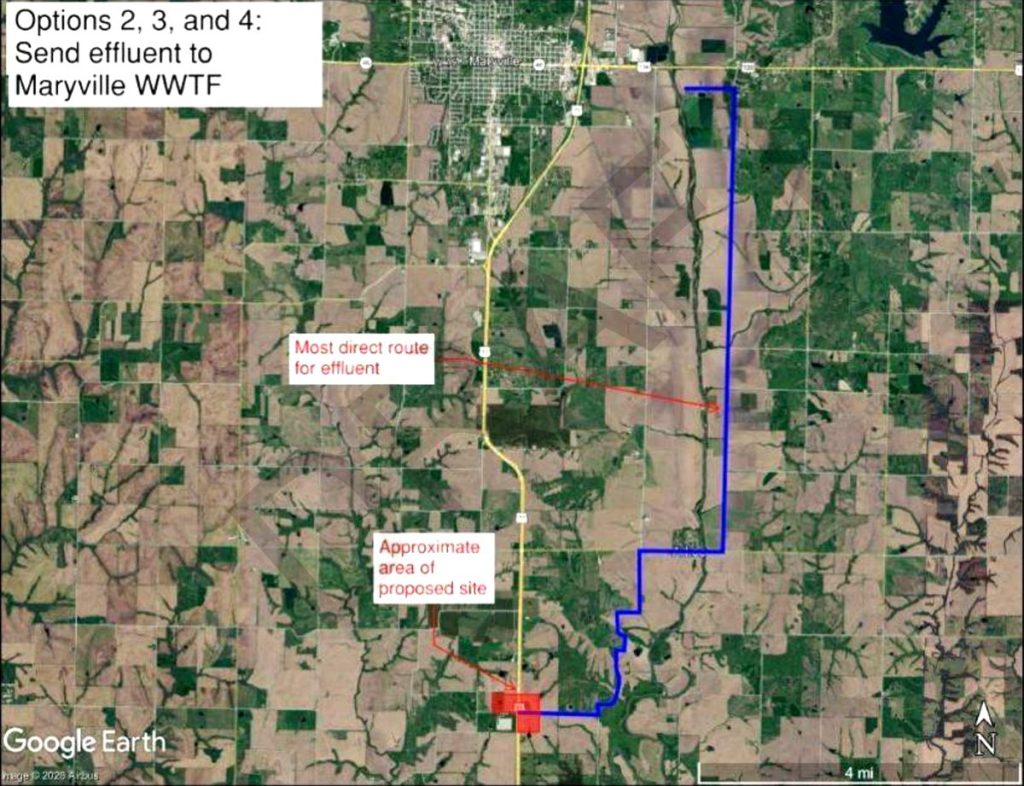
A Google Earth map shows recommendations made in a draft study produced for Nodaway County Public Water Supply District No. 1 of water options available to accommodate the White Cloud Acres data center project. The report recommends the data center site procure potable water from PWSD No. 1 and wastewater from the city of Maryville for cooling, and sending pretreated wastewater generated by the site back to the Maryville Wastewater Treatment Plant.
MARYVILLE, Mo. — A draft of a feasibility study released Tuesday by Nodaway County Public Water Supply District No. 1 sheds some light on water options available to the White Cloud Acres data center project.
The study, produced by Kansas City firm Lamp Rynearson and overseen by White Cloud Engineering and Construction, provides an overview of what options are available for the data center project to draw and dispose of water, mostly for cooling the equipment at the hyperscale facility that will power AI products. The report is still in draft form, but was released “in the interest of transparency and public awareness,” the PWSD No. 1 Board of Directors said in a joint statement that begins the report.
According to the study, the data center project, including a planned natural gas power plant at the site, would require an average of 70,000 gallons per day of cooling water. That would mostly be used for “emissions control at the power generation facility,” according to a memo from Kimley-Horn and Associates, the firm working with the data center developer, Scale Microgrids, on water-related issues at the site. The memo was sent to The Forum Wednesday by a spokesman for Scale.
The site would also require about 12,000 gallons per day of potable water for domestic use. Down the line, if the project footprint expands to a “full buildout,” the feasibility study estimates the data center site could use an average of 100,000 gallons of cooling water per day.
The report recommends that the data center developer source the potable water for domestic use from PWSD No. 1, and the wastewater for cooling from the city of Maryville. The report further recommends pretreating wastewater produced on-site before sending it back to the Maryville Wastewater Treatment Plant.
The study estimates that the facility will produce 35,000 gallons per day of wastewater at 70,000 gallons per day of cooling water. If the facility site expands to using 100,000 gallons per day of cooling water, the wastewater generated would also go up to about 50,000 gallons per day, the report noted.
According to the Kimley-Horn memo, when the wastewater is received by the data center site, about 25 percent will be discarded during the treatment process that makes the water usable for cooling. That 25 percent would be rerouted to a tank onsite along with removed salts and minerals before being sent back to the Maryville Wastewater Treatment Plant. The 75 percent remaining would be used for the cooling systems, mostly at the power plant and only occasionally for the data center cooling system.
“The closed-loop cooling fluids are not part of the wastewater sent back to the (wastewater treatment facility),” the memo stated.
The 35,000 gallons per day figure also includes domestic wastewater produced, like water from sinks and toilets.
During an open house earlier this month, contractors involved in the project’s design said no wastewater would be produced by the closed-loop cooling system except during periodic flushes of the system, which would happen once every few years.
The Kimley-Horn memo agreed with the recommendations of the feasibility study.
The feasibility study also outlines next steps, recommending that PWSD No. 1, the city of Maryville and the data center user begin discussions around who will pay for the needed infrastructure and “how funding responsibilities may affect water and sewer rates.” Those discussions should also include more information from the data center user about the quality of the wastewater the site may produce and from the city of Maryville about its existing wastewater in order to better estimate costs of pretreatment, the report noted.
“The best solution for the project and the community is a combined strategy utilizing potable water from PWSD No. 1 for domestic use and reclaimed water from the Maryville WWTF for industrial use,” the memo stated. “This approach minimizes use of potable water from PWSD No. 1 and supports sustainable reuse practices. By utilizing this solution, the project will not draw water from new surface sources or new wells.”
The study, which has not yet been finalized, breaks down the potential options into two groups: Water supply and wastewater treatment.
Water supply
The study looked at potential sources of both potable water and wastewater in the region, including getting treated water from PWSD No. 1, using onsite wells, drawing water directly from the One Hundred and Two River, purchasing wastewater from the city of Maryville, and combining wastewater from Maitland and Barnard.
Connecting to the existing PWSD No. 1 system would be the easiest option, the report concluded. Getting water straight from the city of Maryville was also considered, but would be far more costly.
Additionally, the report briefly examined the possibility of digging onsite wells, but test wells would need to be dug to figure out if it is a realistic option.
“Though this water source option would incur the lowest capital cost, it is unknown whether local aquifers could even meet the water demands of the industrial user,” the report stated.
Drawing water directly from the nearby One Hundred and Two River is another possibility, but would come with a high cost. According to the report, the river sees about 64 to 193 million gallons flow through it per day, which would be more than enough to accommodate the needs of the data center.
But under that scenario, the data center site would need its own water treatment facility, which would be expensive. The study was unable to determine just how expensive because Lamp Rynearson did not have enough information on the water quality needed for the site’s cooling systems or the precise quality of water in the One Hundred and Two.
In addition to sourcing wastewater from the city of Maryville, the study also briefly looked at combining wastewater from the ANR Pipeline Company’s Maitland Compressor Station and the city of Barnard’s wastewater treatment facility. But the study determined that even combined, those facilities would not meet the data center’s demand.
Ultimately, the report concluded that getting potable water for domestic use from PWSD No. 1 and wastewater from the city of Maryville for cooling makes the most sense.
The Maryville Wastewater Treatment Plant discharges 2.6 million gallons of wastewater into the One Hundred and Two each day as a monthly average, according to the report, which would easily cover the needs of the data center. The report notes that the river has a “flow range” of 100 to 300 cubic feet per second under normal conditions. The wastewater plant contributes 4 cubic feet per second to the total flow, “and therefore could be fully allocated elsewhere without disrupting ecosystem services.”
Wastewater treatment
The report states that the data center site is expected to generate approximately 35,000 gallons per day of industrial wastewater, which according to Kimley-Horn, would come from the process of reclaiming wastewater for use mostly at the on-site power plant.
One option to dispose of the wastewater is to discharge it directly into the One Hundred and Two River, which is where the city of Maryville discharges its wastewater after it is treated to meet regulatory standards. Similarly, the wastewater from the data center site would need to be treated as well, which would require building a wastewater treatment facility.
The report couldn’t estimate how expensive or feasible that would be because Lamp Rynearson did not have enough information about what kind of treatment the wastewater would need. That information would inform what kind of treatment facility would be needed and how expensive it might be to build.
Another option would be to send untreated wastewater back to the Maryville Wastewater Treatment Plant. But the report noted that the extra fees incurred for sending untreated wastewater may outweigh the cost of operating a wastewater plant at the data center site in the long run. It also might be too much untreated wastewater for the Maryville plant to handle, but the report stated a more detailed study would be needed to know for sure.
The report additionally mentioned the possibility of building a new wastewater treatment facility in collaboration with the city of Barnard. But that would ultimately be complicated and expensive, the report noted.
The study recommended sending pretreated wastewater to the city of Maryville instead. That would mean locating a pump at the data center site and infrastructure capable of pretreating the wastewater that would then be sent to Maryville for further refinement.
The report did mention briefly the possibility of the wastewater being transported to another site entirely, but did not study the option.
During an open house earlier this month, materials from Scale Microgrids, the data center developer, said that wastewater produced during periodic flushes of the closed-loop cooling system would be put into “isolated holding tanks and hauled by licensed contractors to a Missouri DNR-approved industrial wastewater facility.” This is different from the 35,000 gallons of wastewater that would be produced per day from the reclaimed wastewater process.
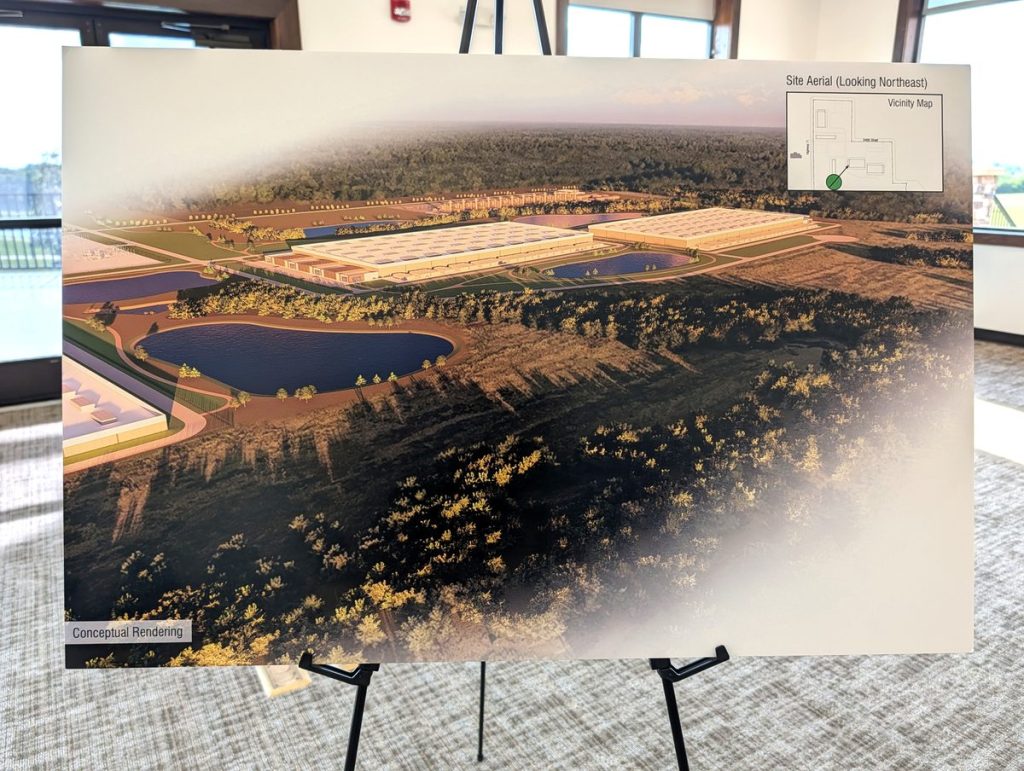
SCALE MICROGRIDS
A conceptual rendering shows the White Cloud Acres data center site from above looking northeast.