Community members organize against data center
GEOFFREY WOEHLK/THE FORUM
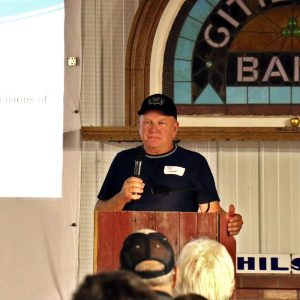
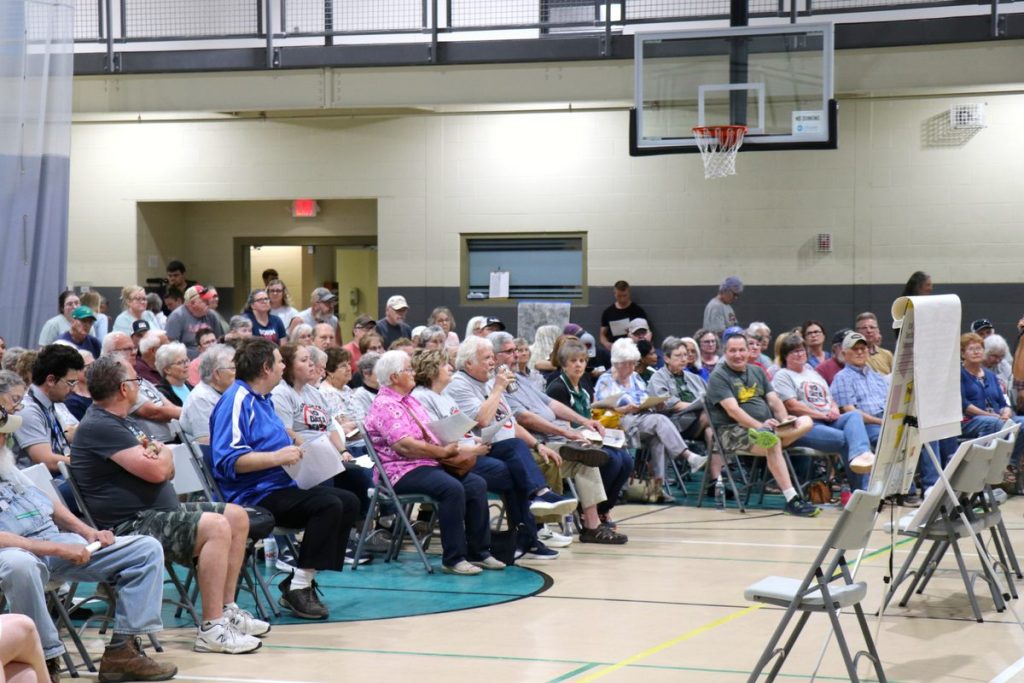
Around 200 people gathered in the Maryville Community Center gym on Tuesday evening to attend an informational session hosted by Nodaway Says No, which opposes the proposed White Cloud Acres data center project.
MARYVILLE, Mo. — Around 200 people on Tuesday evening attended a second informational meeting opposing the proposed White Cloud Acres data center project.
Held at the Maryville Community Center, the event followed on from a May 21 meeting at the Salem Church near Pumpkin Center. The Tuesday meeting was hosted by the opposition group Nodaway Says No.
“We are an organization led by a multigenerational base of farmers, teachers, business leaders, moms and lifelong locals with deep ties to the community organizing to stop AI data centers from stealing and exploiting our land,” said Holly Caviness, one of the group’s organizers, in a restatement of the group’s mission statement. “It is essential to our community that we ensure there are stronger protections for our drinking water, air quality, personal privacy, jobs, utility costs.
“This is not a fight over advancing technology. This is a fight over power and who should and should not have it in the communities we live in.”
Jennifer Gillespie, a property owner in the proposed project area, said during an emotional plea that she was opposed to the project because of what she believes will be generational consequences for the environment.
“You do not have a soul in you if you drive and see all the timber and all the wildlife that this is gonna destroy,” she said. “Not only that, all of us that live out in the country and want to hand this down to our kids, our grandkids — this fight is not for us, it is for our future generations, if we do not want to have our children get sick because of a data center.”
Multiple property owners from around the project area spoke during the meeting, many focusing on the potential health effects of the data center and the associated natural gas power infrastructure that would at least partially power the facility. Air and noise pollution were of particular concern.
Without much information from Scale Microgrids, the project’s developer, the community members have had to cobble together what information they can from public sources.
One of the major areas lacking solid information is how much water will be used in total by the project — both by the data center itself and the accompanying natural gas power plant — and the possible effects on the water supply.
Numerous speakers on Tuesday sought answers to those questions and warned that there was no way to really know the true effects on health and water availability beforehand.
Maryville and county officials have said previously that Scale plans to use wastewater sourced from the city of Maryville to cool the data center’s equipment in a closed-loop system. Unlike many older data centers, the closed-loop system at White Cloud means it would draw less water daily — recycling the water in its system — and that the water would not be exposed to air, limiting the water lost to evaporation to very small, incidental amounts.
City Manager Ryan Heiland told the Forum in April that utilizing wastewater is a relatively new idea for data center cooling, but has been done previously, especially in areas of the southwest where water is scarcer, like in Arizona.
Under that scenario, the data center would purchase Maryville wastewater, and then pay the city to process the excess wastewater from the facility. Heiland said at the time that the Missouri Department of Natural Resources, which regulates water and wastewater standards, was pleased with the plan.
Call for regulations
Donna Tompkins said she had just begun building a new home in March, which she later learned would be near the project site.
“We all agree landowners should sell to whoever they want to,” she said. “But something of this magnitude coming in and destroying our resources should have some regulation.”
Tompkins was one of several speakers on Tuesday who expressed frustration and exasperation with local and state officials, from the county commission to state legislators to Gov. Mike Kehoe, for enabling data center developments with very little regulatory restrictions to protect communities.
State Rep. Jeff Farnan, who said he could not support the project until more research has been done, had repeated a similar line earlier on Tuesday at the Greater Maryville Chamber of Commerce’s Legislative Coffee event, saying that he had only heard about the data center project about six weeks ago and was trying to learn as much as he could.
“But I can tell you, they’re gonna keep saying that until it’s built,” said Maryville resident Sadie Tengelsen during Tuesday’s Nodaway Says No meeting. “They’ll keep saying, ‘I don’t know, I don’t know enough details, we don’t know enough, we’re unsure how big it is’ — all that — until it’s done, because that’s just them stalling for time.”
Billy Mires said he is frustrated that state legislators have been unwilling to regulate data centers when as a rancher, he regularly deals with state rules — which he said are in place for a reason.
“Because the state tells me where I can put a fence,” he said. “The state tells me what kind of fence that is, how far I have to space those posts. The state tells me where I can put a building in relation to my neighbor’s or in relation to a road. The state veterinarian can put me in jail for animal cruelty if I don’t do a good job raising my cattle. … All under state control and not local; those are state rules to us the ranchers.
“So why is it so difficult for the state to put some commonsense rules in place for a data center when we do it for the ranchers that are only trying to do a good job?”
He also took issue with the possibility of tax abatements for the project, whose developer, Scale Microgrids, is owned by EQT, one of the largest private equity firms in the world.
“Why are we going to give a company that’s got over $250 billion in assets a tax break over me or you for 78 jobs?” Mires said.
The company has not asked about tax abatements yet and is unlikely to since Scale is not the end user of the facility, the county commissioners have said. Instead, the company that eventually uses the facility — likely one of the major hyperscale companies like Amazon, Google, Meta or Microsoft — would request and potentially receive an abatement.
Overall, the group’s leadership outlined a broad list of goals that it wants to accomplish at the local and state levels:
- No tax abatements for hyperscale AI data centers.
- Zoning laws in rural Nodaway County that create strong regulations for hyperscale AI data centers.
- Strong protections for utility rates, water quality and air quality.
- Protections against AI surveillance.
- Community input and full transparency on the hyperscale AI data center and all future AI data center projects.
- Independent environmental impact studies.
- Strong job and union protections for workers who could be affected by automation, specifically in the manufacturing sector.
- A moratorium on AI data centers in Nodaway County until proper protections are in place.
The group has begun organizing teams to tackle different focus areas in an attempt to force local elected officials to listen and take action.
Gillespie, the landowner, said she hoped more people would join and help put a stop to the data center. She said she could not understand why neighbors have signed agreements with Scale to option their land.
“They are selling their soul to the devil for money,” she said. “That is it. It is greed.”
Greed, she said, was driving the whole enterprise, at the expense of the Nodaway County community.
“They don’t care about us,” Gillespie said. “They don’t care if they make us sick, they don’t care if they kill us, they don’t care if they kill the wildlife, and they truly will destroy God’s creation — all of us. It is not gonna stop.
“Everyone needs to wake up.”
GEOFFREY WOEHLK/THE FORUM
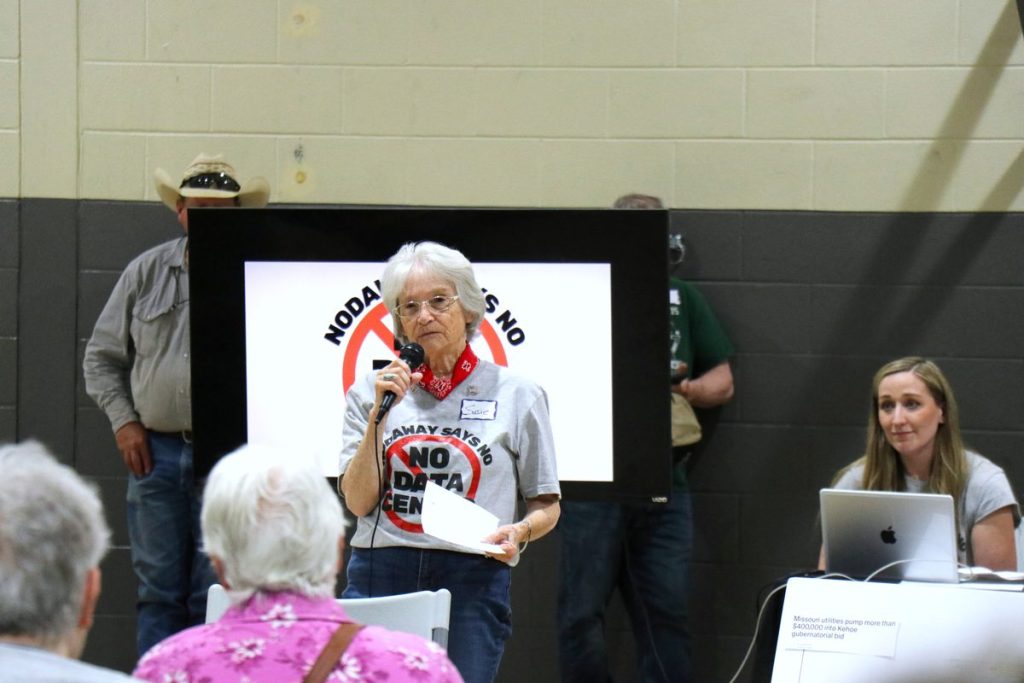
Landowner Susie Strauch said she is concerned about the potential health effects of a data center near her land. “I’ll be gone,” she said. “I’m 80 years old, so, it’s not gonna bother me that much. But our family — our kids, our grandkids and our great-grandkids.”
GEOFFREY WOEHLK/THE FORUM
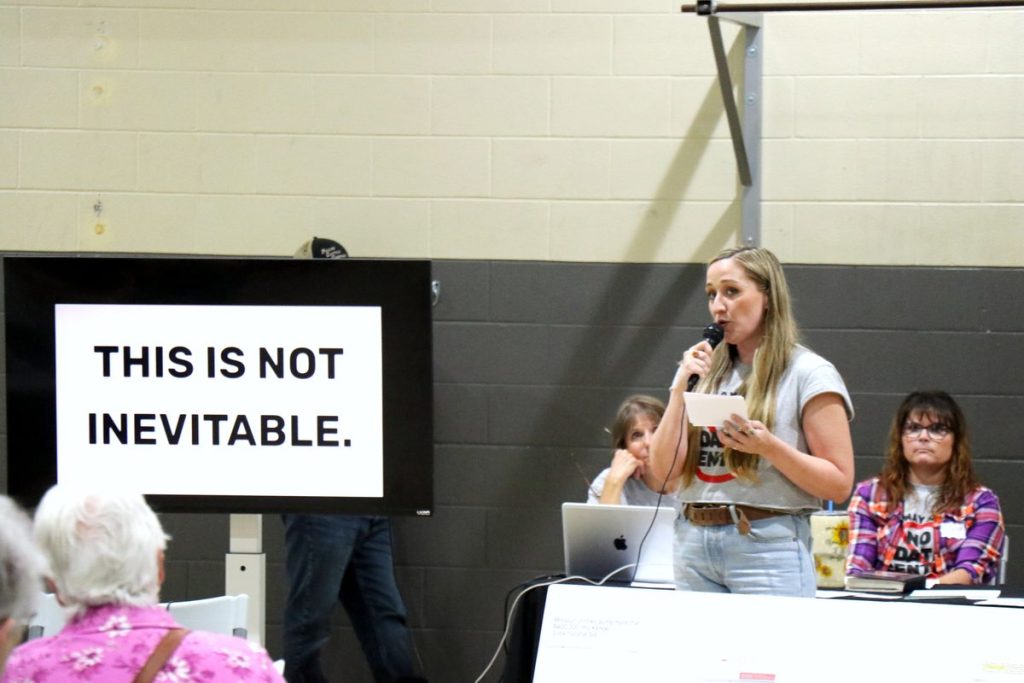
Holly Caviness, one of the organizers of Nodaway Says No, outlines how to get involved with the group during Tuesday’s meeting.