Conservation Dept. cuts Mozingo crappie limit
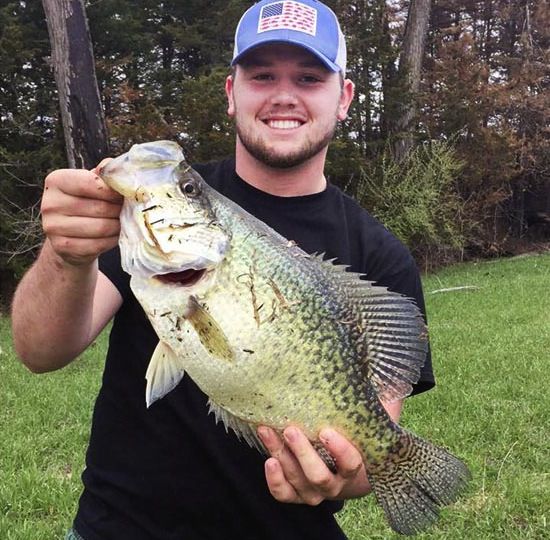
FILE PHOTO
Northwest Missouri State University football player Spencer Phillips shows off a trophy-size crappie he caught at Mozingo Lake back in April. Heavy fishing pressure over the past three years has led the Missouri Department of Conservation to reduce the crappie creel limit at the city-owned lake to 15 from the statewide standard of 30. The possession limit of 60 fish remains unchanged.
Crappie anglers at Mozingo Lake have noticed a distinct fall-off over the last couple of years in the number of fish they’re reeling in, and the Missouri Department of Conservation is working to do something about it.
Earlier this summer, MDC, which manages the Mozingo fishery — known as perhaps the hottest fishing spot in northwest Missouri — cut the lake’s creel limit for crappie from the state standard of 30 fish to 15.
Other crappie regulations remain unchanged. The overall possession limit is still 60, and no size limit was imposed.
MDC Fisheries Management Biologist Tory Mason, who helps manage the Mozingo fish population, said the decline in crappie action is directly related to heavy pressure over the past two or three years.
“It just seemed that anglers kind of got on top of them and took out about two years of fish,” Mason said.
Mason added that he’s been getting complaints for some time about the lake being “fished out” as far as crappie are concerned, and that those comments have been confirmed by electric-shock fish counts conducted by the agency several times a year.
Shock sampling doesn’t kill fish, Mason said, but merely stuns them so that they float to the surface where they can be counted. MDC conducts the tests in the same places at the same times each year and uses the results to extrapolate fish populations across the entire 1,000-acre lake.
But Mason said he didn’t need science to tell him Mozingo crappie numbers were in decline.
“I fish the lake myself and have for 14 years,” he said, “and obviously it’s not the same crappie fishery it used to be.”
But there is some good news for what many consider to be one of the best eating fish around.
Mozingo still has plenty of small crappie, Mason said, and the lake remains a fertile, nutrient-rich lake with good growth rates.
“What’s missing is a lot of three-year-old fish,” he said, referring to crappie around 10 inches in length, the size most anglers are after.
Also, unlike pure sport fishermen casting for bass or walleye — who are often wont to practice catch-and-release — crappie anglers are predominantly “harvest oriented,” Mason said. What they catch, they tend to keep and eat.
He continued that fishing pressure on crappie is especially severe in early to mid-May when the fish come in close to shore in order to spawn. That makes them prey to both boat-borne anglers and fisherfolk casting from shore.
“We just need to protect those up and coming year classes,” Mason said. “There are plenty of small fish in there that are ready to come through.”
Given Mozingo’s continuing strength as a fertile reservoir with strong nutritional resources, Mason said he is convinced the lower creel limit will allow crappie numbers to rebound. On other fronts, he said the city-owned lake’s populations of walleye, bass, bluegill and channel catfish remain strong — especially walleye.
“The walleye fishery has never been better, and it’s on its way to bigger things,” Mason said. “It’s amazing. We doubled our (electronic shock) catch rates this year.”
Counts are also strong for bass, even though anglers may not be catching as many as they would like.
Mason said this is likely due to a surging gizzard shad population, which for a bass amounts to a steady diet of T-bone steak.
“We’re seeing really good stuff when we sample,” he said. “But they’re tight lipped. I think they’re just full.”
Ironically the proliferation of shad — the result of undesirable self-stocking by anglers — has hurt the bluegill fishery. When bass eat more shad, they don’t eat bluegill, which forces those fish to compete among themselves for limited nutritional resources.
There are still plenty bluegill in Mozingo, Mason said, “but they are not as big as they used to be. The size structure is lacking due to the shad.”
As for catfish, the species, like walleye, is stocked annually with individuals of catchable size, meaning that their numbers remain stable and even increase somewhat over time.
“You know, it’s just a great fishery,” Mason said of the 22-year-old reservoir. “There is always a boom phase with a new lake — new being around 15 years — and our job is to preserve that boom. At Mozingo we’ve been able to do that.”
The lake’s continued good fishing, he said, is due to a number of factors, including the fertility of land making up the watershed, rapid growth of weeds along the shore and MDC efforts to create brush piles and other aquatic habitat.