City looks to address e-bike, e-scooter safety
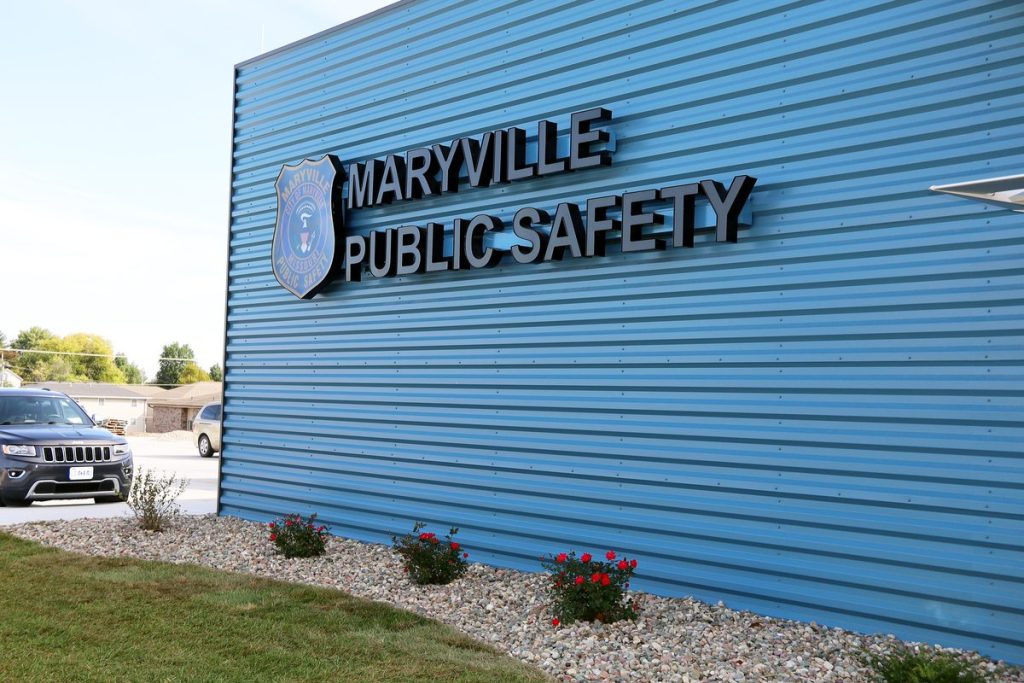
FORUM FILE PHOTO
Maryville Council file public safety building
MARYVILLE, Mo. — Following a spate of accidents and complaints, the city of Maryville will look at how to address the growing use of electronic bicycles and scooters, especially by minors.
During the City Council’s regular meeting on Monday, Maryville resident Stephanie Ann Neal told the council that when she was driving downtown recently, she nearly collided with an electric scooter whose rider darted into the roadway from the sidewalk.
“Because of that speed and the fact that he was on a pedestrian path, he was nearly invisible until he was right in front of my car,” she said.
She asked the council to more stringently regulate the operation of e-bikes and e-scooters and provide more education to the public.
Later in the meeting, council members shared their own anecdotes about close calls and concerns.
“I’d venture to say probably everybody in this room’s probably had one either dart in front of them or veer out in front of them or something at some point in time, or seen them fly by on your street,” said Mayor John McBride.
City Manager Ryan Heiland said that the devices have become more and more of a safety issue in Maryville lately.
“When school got out, we did see a brief uptick in accidents with these,” Heiland told the council. “We saw, I don’t know, maybe five of these in about five days, something like that. … That really kind of heightened that this potentially could be a growing issue in the community.”
Council members generally agreed that public education would be the best and fastest first step. Beyond that, though, things could get more complicated.
Federal regulators break down e-bikes into three classifications: Motors in class 1 and 2 e-bikes shut off once the bike reaches 20 mph, while motors on class 3 e-bikes continue providing assistance to the rider up to 28 mph.
E-BIKE CLASSES
Federal and other agencies generally divide e-bikes into three groups.
Class 1
Equipped with a motor that provides assistance only when the rider is pedaling and ceases to provide assistance when the bicycle reaches the speed of 20 mph.Class 2
Equipped with a motor that may be used exclusively to propel the bicycle and that is not capable of providing assistance when the bicycle reaches the speed of 20 mph.Class 3
Equipped with a motor that provides assistance only when the rider is pedaling and that ceases to provide assistance when the bicycle reaches the speed of 28 mph.SOURCE: U.S. DEPARTMENT OF THE INTERIOR
Currently, class 1 and 2 e-bikes are treated by Missouri law like any other bicycle, though some municipalities have added their own more restrictive regulations. Operators of class 3 e-bikes must be 16 or older.
Enforcing those laws, though, is already challenging, said Maryville Police Chief Mike Stolte. During Monday’s meeting, Stolte said it’s difficult to tell without a close inspection which class of e-bike someone is riding, and whether the rider is 16 or, say, only 15.
On top of that, Missouri law does not specifically address e-scooters, which can reach comparable speeds but are often operated by the youngest riders.
But Stolte said he agreed that more public education would help.
“I think (parents should) talk to their kids and say, ‘Look, you’re on this, you need to obey the stop sign and stoplights just like a regular vehicle,’” he said.
Council member Erin Allen said she was strongly in favor of more public education, and proposed perhaps using school resource officers employed by the city of Maryville at the Maryville R-II School District to conduct annual safety programs with middle schoolers.
But while she said she was in favor of public education to get kids to be safer, she did not want to discourage kids from activities that get them out of the house.
“I think that there’s a lot of danger with a kid on their phone for seven hours a day in their house, even if it’s not physical danger,” she said.
E-bikes and e-scooters can be that kind of activity, Allen said.
“I love the fact that there is something technologically that is appealing, that is getting our kids to set their phones down and leave their house and go operate around the community,” she said.
Because of that, she does not support adding more restrictions at the city level.
“I’m personally not interested in getting out ahead of the state of Missouri on this when we normally (follow) their lead when it comes to traffic ordinances,” she added.
Heiland said that city staff will start working on options for public education and gather more information on what other cities have done to address similar issues.
Boat slip policy
Also during Monday’s meeting, Steve Reed, who lives just outside of Maryville, asked the council to reconsider its policy at Mozingo Lake Recreation Park that allows only overnight guests at the park to rent boat slips.
Reed, who said he has lived in Nodaway County for 62 years, said he became disabled in 2019 and is unable to easily get his pontoon boat into and out of the lake. But his 11-year-old son loves to go fishing, he said, and they try to make it out as often as possible.
Ideally, Reed said he would like to leave his boat on the water because he can’t get it into the lake on his own.
“I get asked every day by an 11-year-old boy, ‘Why can’t we go to the lake?’” Reed said.
He’d like to rent a boat slip for a couple of months or so.
However, the city only allows overnight parking of boats by overnight guests at the park, like those staying in cabins or at a campsite.
Heiland said the rationale is that there are only 41 boat slips on the lake, while there are more than 100 RV campsites alone. Visitors to the park often come to boat on the lake, which means many would like to dock their boats when they come.
Council member Dannen Merrill suggested the city could at least look into the cost of building a few boat slips that would be available for disabled people or other local boaters. And council member Benjamin Lipiec suggested that since the slips are often unoccupied Monday through Thursday, the city could look at the feasibility of at least opening up who can rent them during those days. But he acknowledged that would bring enforcement issues trying to ensure that the boats are removed in a timely fashion.
Heiland said staff will look at some options that might help accommodate boaters like Reed and present them to the council at a later date.
Other City Council notes
- The council heard from a few members of Nodaway Says No, a group opposed to the proposed White Cloud Acres data center. One of the leaders of the group, Nancy Zeliff, presented the council with a list of questions compiled from attendees of a public meeting held by the group in May and asked council members to report back at a later date with what questions they are able to answer.
- Overlay work on Phase II of the South Main Corridor Improvement Project began Monday. Throughout the work, a pilot car will be used to help guide traffic through the work zone. Heiland said the work should be done by the end of the week.
- Heiland said the pavilion for the ongoing downtown pavilion project is expected to be delivered later this week.
- The downtown alleyway project is substantially complete, Heiland said. All murals will be completed by the end of the month.
- The contractor handling the city’s rebranding effort, Locality Studios, is hosting a public meeting to gather feedback from 4:30 to 7 p.m. on Thursday at the Maryville Community Center.
- Jordyn Greenhaw, director of Mozingo Lake Recreation Park, said the city was awarded a 50-50 matching grant from the Lions Clubs International Foundation for $99,636 to build an all-inclusive playground near “The Point” at the park. Work will likely begin in the fall, she said. The city applied for the grant in January.
- The council approved a $29,693.26 agreement with Midwest Mobile Radio Services for the purchase and installation of radio console equipment for dispatch operations at the Northwest Regional Communications Center.
- Council members approved a $12,250.27 agreement with Cogent Inc. to rebuild a scum pump at the wastewater treatment plant.
- The council approved a $68,600 agreement with David E. Ross Construction to repair aeration basin mixers at the wastewater treatment plant.
- According to city documents, the city is in the process of purchasing a property adjacent to City Hall after meeting the seller’s $250,000 asking price. The added property would likely be used to expand office space from the cramped and aging City Hall.
- The council reappointed Cara Colville, Scott Kuhlemeyer and Ashley Strickland to the Maryville Public Library Board of Trustees to thee-year terms ending June 30, 2029, and appointed Shelbie Wooten to a vacant seat for a term beginning July 1, 2026, and ending June 30, 2028.
- Council members approved a request by Joey Wagner to close South Saunders Street from East South Avenue to the top of the hill from 8 a.m. to 4 p.m. on Saturday, June 27, for a neighborhood barbecue and vintage car display.
- The council approved a request by Mark Hendrix to close West Third Street between Ray and Grand streets from noon to 11 p.m. on Saturday, July 4, for a neighborhood block party.