Canada geese head south as temperatures finally fall
BRANDON CARTWRIGHT/MOZINGO LAKE RECREATION PARK
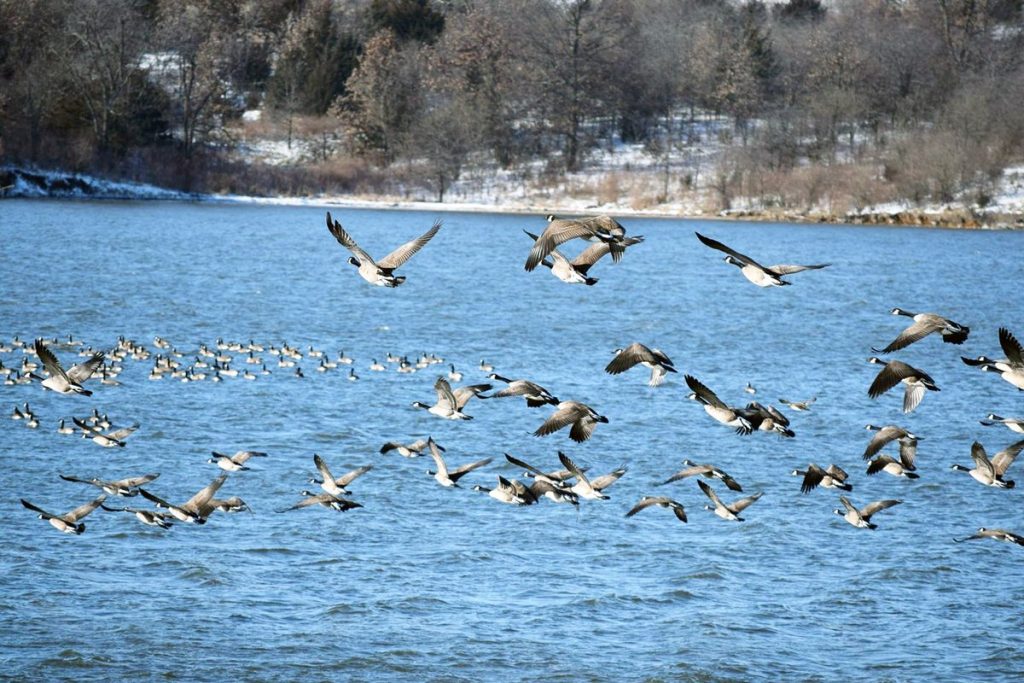
Canada geese in Nodaway County have stayed in the area longer than usual due to relatively warm weather through December and the first few days of January. However, Conservation Agent Christine Campbell said the recent cold snap means a majority of the waterfowl will soon be heading south if they haven’t already.
After an extended stay in Nodaway County, Canada geese are finally heading south for the winter as single-digit temperatures begin freezing the lakes and ponds where the flocks have been resting.
Nodaway County Conservation Agent Christine Campbell said she didn’t see as many migratory birds in the area at this time last year because there wasn’t any open water left.
“But this year the migration is slower than normal,” Campbell said.
The Missouri Waterfowl and Habitat Survey described 2015 as a “different and atypical year” due to mild weather across the Midwest. Waterfowl migration was reported nearly two weeks behind schedule, and the only thing that kept birds moving was widespread flooding.
From Jan. 4-8, Campbell assisted in a survey of waterfowl and eagles. The information, including statewide population data, is to be submitted to the U.S. Fish and Wildlife Service later this month.
“I was glad to have some open water to count a few birds,” said Campbell, noting that the majority of Canada geese in Nodaway County were to be found at the reservoir adjoining Maryville’s drinking water treatment plant.
Squaw Creek National Wildlife Refuge near Mound City draws even more Canada geese because it contains a bigger body of water and has been around long enough for the animals to mark it as a rest stop.
Tom Meese, a wildlife biologist for the Missouri Department of Conservation, said that over time an increasing number of waterfowl may choose to stop at Mozingo because of the 1,000-acre reservoir’s proximity to row crop fields where the birds can scavenge for food.
“Weather really is a key factor for that, though,” Meese said.
Although beautiful, Canada geese can be a nuisance, and according to Meese three people were attacked by the birds in the Kansas City metro area over the past year. He said such incidents are in part due to overcrowding of the species in urban areas.
Even when it gets cold, running water from fountains and streams can attract Canada geese because it doesn’t freeze as quickly.
In populated areas, the geese often find ready food sources and may not migrate at all. As the birds mate and hatch young the goslings imprint and often remain behind, eventually breeding as well.
In a few years, a pair of geese can produce as many as 50 offspring. That many Canada geese in one place can cause a serious negative impact, since the birds kill grass, which can lead to soil erosion. In addition, Meese said, geese defecate about every seven minutes.
“That doesn’t just make a mess — it’s dangerous, too,” he said. “It leaves the area covered in goose crap, which has coliform bacteria and E. coli.”
So far, Campbell said, Maryville has been spared such problems. She said she occasionally encounters a stubborn bird on Mozingo’s Sechrest 18 golf course, but that nuisance geese aren’t nearly the issue here they are in southern Missouri.
Because Canada geese are federally protected, local landowners who are having problems with geese should call the Missouri Department of Conservation, which can provide a list of best practices for dealing with the situation.
“Right now the birds are a big attraction in northwest Missouri,” Campbell said. “I encourage anybody to come out and see them.”
In addition to Canada geese, Campbell and Meese said the Maryville area is hosting more Snow geese this year because the birds are overpopulating parts of Canada and Alaska, a situation that has damaged habitat for other wildlife but is creating expanded opportunities for hunters and bird watchers further south.