Mozingo ‘blob’ signals high water quality
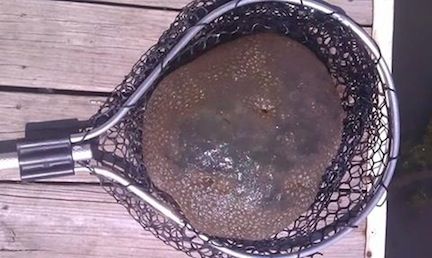
This large colony of microscopic Bryozoa was recently found by the Morrow family of Maryville on the northwest shore of Mozingo Lake near the equestrian RV camping area. According to marine scientists, the presence of such creatures often indicates a high level of water quality.
It was ooey and gooey and gross looking and reminded the person who found it of “The Blob,” the cheesy1950s horror movie that turned out to be an early break for a young actor from Missouri named Steve McQueen.
But just what was it, exactly, that Karis Morrow found lurking in the moss along the northwest shore of Mozingo Lake?
Well, it might not have been pretty to look at, but the large jelly-like mass turned out to be a large colony of Bryozoa, tiny creatures that bode well for the lake’s water quality and the overall health of its ecosystem.
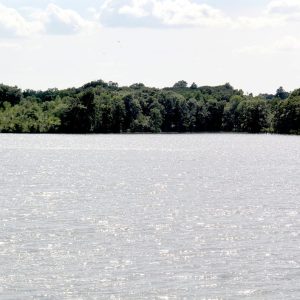
Morrow and her husband, Adam, along with the couple’s two young sons, found the organisms — several clusters of them in fact — just off the equestrian camping area dock. It’s a part of the 3,000-acre city-owned “recreation park” that is far less developed than the lake’s south end, which is home to an 18-hole golf course and a large RV campground.
“We were fishing off the equestrian dock, and we saw several of them in the moss,” Morrow said. “The cool thing was that we could actually see a bunch of moss inside of it. It wasn’t really transparent, but you could sort of see through it.”
Intrigued, and perhaps a little foolhardy, the Morrows scooped up the colony in a fishing net and examined it on land.
“I immediately thought of the old movie ‘The Blob,'” Morrow said. “It wasn’t moving, but I was careful when I picked it up. Actually I was expecting it to deflate when I pulled it out.”
She added that the greenish-gray mass was heavier than expected, comparing its heft to a gallon of milk, which weighs just over 8 pounds.
After the family examined the gelatinous mass, they returned it to the water and returned home both mystified and fishless.
“We didn’t catch a single fish,” Morrow said. “They weren’t biting, and my 5-year-old was not happy.”
But what the Morrows did catch may have been far more significant than a trophy bass. Turns out that the presence of Bryozoa is a very good thing for Mozingo Lake, which serves as the primary water supply for Maryville and several other Nodaway County communities.
Like mussels and other “filter feeders,” Bryozoa gradually cleanse the aquatic environment they feed in. Also, their presence usually indicates clean water to begin with.
According to the Missouri Department of Conservation, Bryozoa are microscopic aquatic invertebrates that live in colonies. The colonies of different species take various forms, but most attach to a structure such as a rock or submerged branch.
Some colonies, like the ones observed by the Morrow family, consist of rounded, jellylike masses. Others resemble antlers or moss (bryophyte means “moss animal”).
Although most bryozoans are marine, one class, Phylactolaemata, lives in freshwater. The particular species the Morrows found was probably an example of Pectinatella magnifica.
About 20 other species occur in North America, according to MDC, and usually prefer the quiet water of lakes, ponds, and swamps, though some live in streams.
Most colonies reach their largest size in late summer and fall, which is when people most often notice them.
Though the colony the Morrows discovered may have appeared to be eating moss, that was not really the case. The tiny creatures actually have mucous-coated tentacles that trap diatoms and other microscopic organisms, which are then swept into to the mouth by tiny hairs.
Freshwater bryozoans are harmless, though they occasionally clog water pipes and sewage treatment equipment. Others are parasitized by types of invertebrates that can cause kidney disease in salmon and similar types of fish. Fortunately, that’s not a problem in a primarily bass-and-bluegill lake like Mozingo.
Though common enough, it’s still not clear to biologists how bryozoans are related to other invertebrates. Probably, according to MDC, they evolved from a marine worm.
Fossil bryozoans first appear in Cambrian rocks, or around 530 million years ago, which is rather late in the fossil record. They probably existed earlier, but in soft forms that didn’t secrete chalk-like calcium carbonate.
Bryozoa fossils are common in Missouri, according to the MDC website. Such fossils generally have characteristic lacy or screw-like shapes.
EDITOR’S NOTE: Much of the scientific information for this article was taken from mdc.mo.gov.