Scale Microgrids answers power, water questions at open house
GEOFFREY WOEHLK/THE FORUM
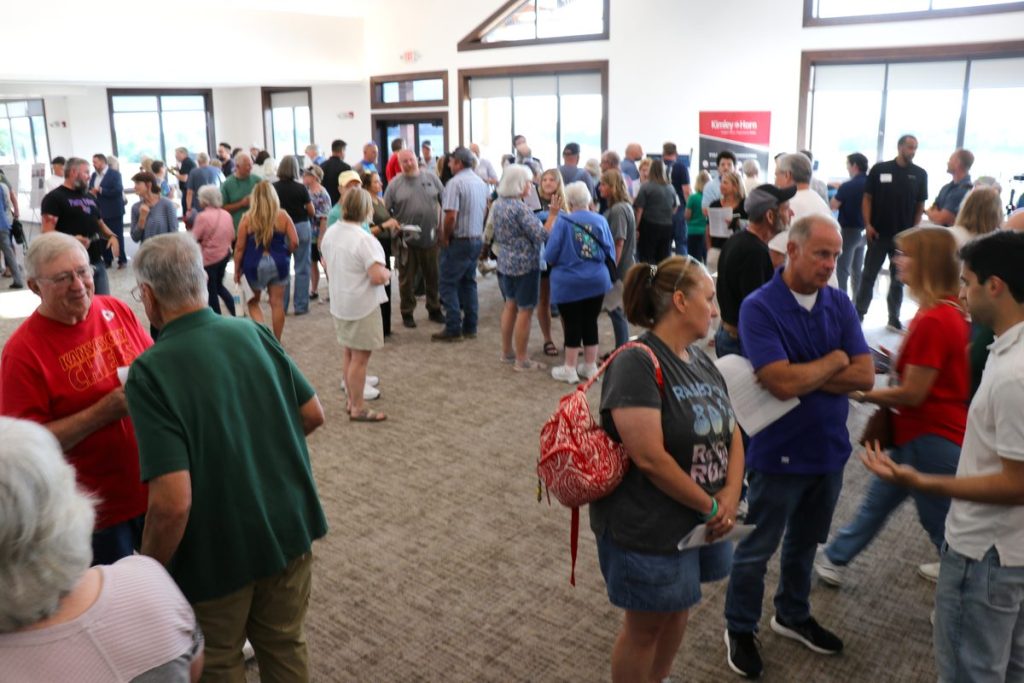
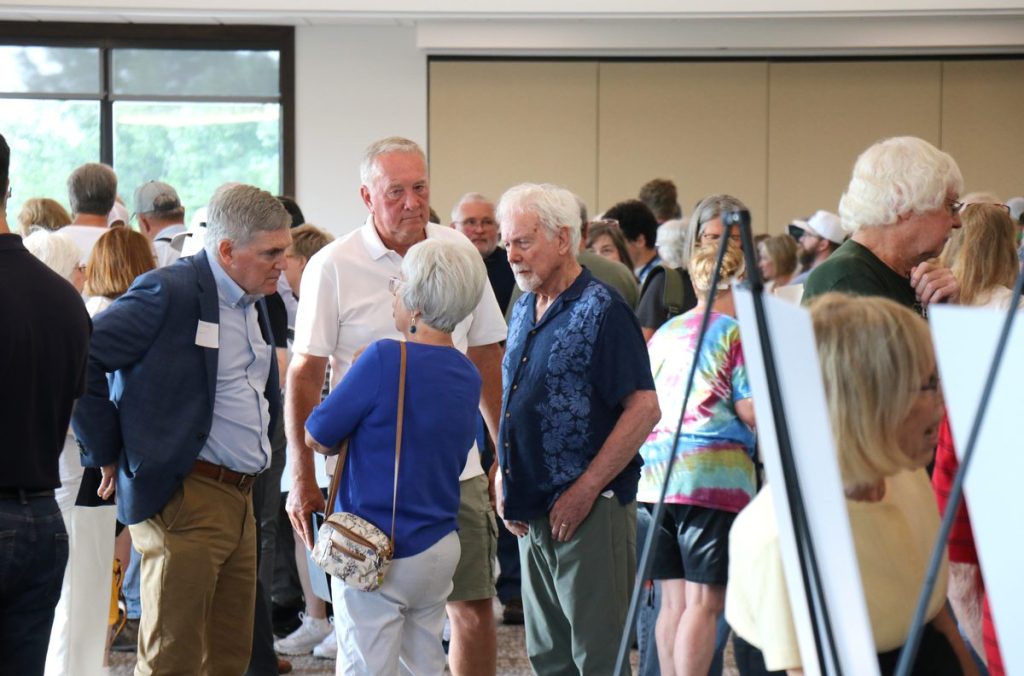
Hundreds of people packed the Mozingo Event Center on Wednesday evening to learn more about the proposed data center project at an open house hosted by developer Scale Microgrids.
MARYVILLE, Mo. — Scale Microgrids, the developer of the White Cloud Acres data center project, held an open house on Wednesday evening to share details with and answer questions from the public.
Water
Hundreds of community members poured through the Mozingo Event Center on Wednesday to talk with subject area experts from contractors working on the project and representatives from Scale. The top concern from attendees was the facility’s use of water, according to Dan Scheffler, Scale’s vice president of development, data centers.
According to materials provided by the company and contractor Kimley-Horn and Associates, the data center’s closed-loop cooling system would exclusively use wastewater to cool the hardware on site. A “closed-loop” means that no water would leave the system during normal operations, including by evaporation.
Instead, approximately 1.5 million gallons of wastewater, which Scale hopes to source from the city of Maryville, would run through pipes, drawing heat from the rows and rows of processors producing heat. The water would then cycle to the top of the building, where chillers on the roof would cool the coils containing the now-hot water. The water would then loop back to the servers, absorbing more heat and repeating the cycle.
Scheffler said that the only time when the facility would need a refill would be during regular preventative maintenance on the physical system, which he said would necessitate replacing about 30 percent of the water every three years. The wastewater drained during that process would be put into “isolated holding tanks and hauled by licensed contractors to a Missouri DNR-approved industrial wastewater facility,” according to materials from the open house.
The wastewater used by the data center would otherwise be discarded after treatment at the Maryville Wastewater Treatment Plant.
“We can’t use it unless it’s been used by the community,” he said.
Scheffler said that to his knowledge, the White Cloud Acres data center would be the first in the state to use recycled wastewater for cooling.
White Cloud Engineering and Construction, an unrelated local company that has long been a consultant for Public Water Supply District No. 1, is overseeing a study conducted by Lamp Rynearson, Kansas City civil engineering and surveying firm, to determine the feasibility of multiple options PWSD No. 1 is looking at to provide water to both the data center and the unrelated Mullin Creek Natural Gas Plant, a natural gas power plant set to be built by Evergy across the highway from the data center site.
A handout distributed at the open house written by Brock Pfost, president of White Cloud Engineering and Construction, said that the data center has requested a little under 100,000 gallons of potable water per day. Most of that water would be used for the natural gas power plant Scale plans to build on-site. Evergy is requesting about 90,000 gallons per day from PWSD No. 1.
According to the handout, the study will look at the feasibility of providing both projects with potable water and of what would be necessary to bring wastewater from the city of Maryville to the data center project. The final decision could involve a cost-share partnership for Evergy and the data center. The study will also look at the possibility of Scale drawing water from the One Hundred and Two River in a standalone project that would not involve input from PWSD No. 1, the handout stated.
The study is completed in draft form and should be ready for public release sometime in mid-June. After that, the district board will decide on a course of action by July 1. Permitting and legal agreements with the Missouri Department of Natural Resources would be finalized by April of 2027 and construction on whatever new improvements the board decides on would begin in late 2027 to be operational by early 2028, the handout stated.
Power
For the first time, Scale also detailed its power plans for the data center. The company plans to construct a 600-megawatt natural gas power plant at the site that would be enough to completely power the 600-mW data center when both are running at peak capacity.
However, Scheffler said the plant would run only an average of 2 to 4 hours per day. The data center would otherwise use the public utility grid through a partnership with Evergy.
Evergy representatives were present at the open house and said local ratepayers would not see increases in their rates because of the data center. A handout from Evergy pointed to a large-load tariff in Missouri that forces large users of power like data centers to pay more for their share of electricity and pay a particular minimum even not using any.
But rates are likely to be indirectly affected by the project and others like it.
As a legal monopoly, Evergy’s customer rates must be approved by the Missouri Public Service Commission. One of the major factors in future rate increases is expected to be the construction of new power plants.
Prior to last year, Evergy and other utilities could not charge customers for in-progress construction. Gov. Mike Kehoe, whose successful gubernatorial campaign and related political action committees received more than $400,000 from electric utilities including Evergy, signed a bill last year that utility companies had lobbied hard for changing that policy. Days after the state legislature passed the bill, Evergy announced the new natural gas plant in Nodaway County. David Campbell, Evergy president and CEO, specifically cited the passage of the bill as an important factor in the project.
The chair of the Public Service Commission, Kayla Hahn, publicly supported the bill and said it would help Missouri attract major data centers by expanding the available power for potential projects.
“We don’t want to be losing any football teams, Googles, Metas or gas plants to Kansas,” Hahn said at the time.
Scheffler said access to power was one of the key factors that led the developers to target Nodaway County.
The Consumers Council of Missouri estimated the law will result in household rates rising by an average of $1,115 per year across the state.
Scale would continue to operate the power plant, Scheffler said, though the data center would be operated by a hyperscale company.
Pollution
Potential water, air and noise pollution were a few of the biggest environmental concerns raised by some against the data center.
A Kimley-Horn representative said water pollution would not be an issue because of the closed-loop cooling system, which would not release any water. The water would also be completely isolated within pipes.
No literature or displays at the open house focused on air pollution, which would come from the accompanying natural gas plant. Scheffler said that the plant would have to meet regulatory standards enforced by the Environmental Protection Agency and the Missouri Department of Natural Resources.
He also said that water injected into the turbines would reduce the emissions profile of the facility by 97 percent.
As for noise pollution, Scale committed to keeping the data center at under 50 decibels at all times, though the company did not detail where that measurement would be taken. The Occupational Safety and Health Administration estimates a moderate rainfall is about 50 decibels.
A decibel meter measuring the noise level in the open house venue at the Mozingo Event Center consistently showed over 75 decibels.
Tax revenues
Scheffler said Scale plans to request a 10-year, 50-percent abatement on both real and personal property taxes for the project.
“The tax abatement is a structure to keep Nodaway County competitive with other areas,” he said.
Scheffler pointed to the 70 percent commissioners in Montgomery County are reportedly planning to offer Google for a $15 billion data center, and the between 75 and 95 percent the county is offering Amazon, though those abatements are only on personal property taxes, not real property. Scheffler said the biggest expense of the White Cloud Acres project will be the $4 billion worth of equipment to run the data center.
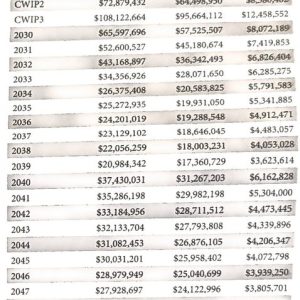
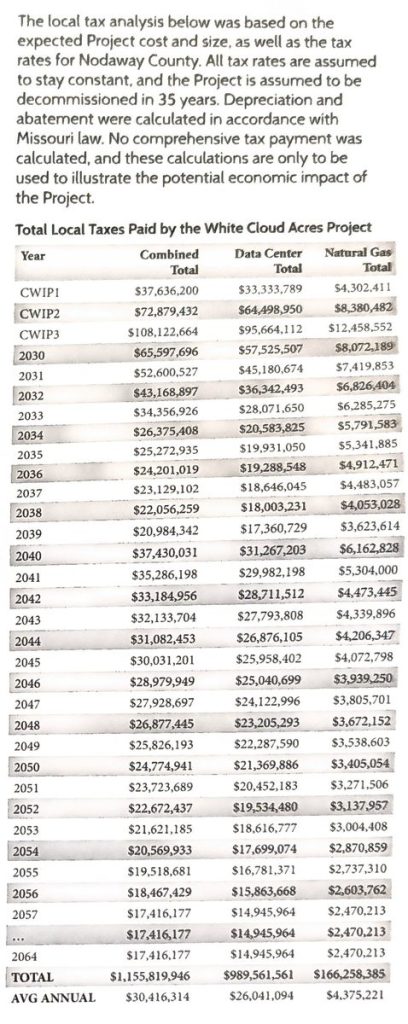
A handout at the open house produced by Strategic Economic Research, a firm that is often engaged by developers of wind, solar and transmission projects, laid out that over an anticipated 35-year life, the data center and the natural gas plant built as part of the project would produce an average of more than $30 million in tax revenues under the structure proposed by Scheffler.
The tax revenue schedule also assumes construction would begin in 2027. In that scenario, tax revenues would peak in 2029, before the facility is completed, with more than $103 million in revenues, the analysis showed. Scheffler said that would primarily come from personal property taxes levied on equipment like processors and servers.
However, Scheffler said that even if Nodaway County offered no abatement, Scale would move forward with the data center project anyway. He noted that if the taxes were paid without an abatement agreement, the revenues would have to go where they are required by law, rather than allowing the county to spread those revenues to other taxing districts, including other school districts.
Why Nodaway?
Nodaway County, Scheffler said, is a prime location for the planned data center because of the combination of available land, water and power infrastructure. The data center, which will be built across from a new natural gas power plant, will not have to go far for a transmission line connection or to connect to a natural gas pipeline, for example.
Another asset, he said, is that Nodaway County is roughly in the center of a triangle of Des Moines, Iowa; Omaha, Nebraska; and Kansas City, Missouri, which are hubs for what are called “edge” data centers.
Internet infrastructure across the country is connected through a series of different networks. Edge data centers are farther away from the center of the network and close to population centers at the edges.
When a user in Maryville, for example, visits a webpage, the user’s phone or computer sends a request to view the page. Where the website is hosted affects how quickly the page loads. If the site is hosted in New York, it would take longer for someone in Maryville to view the page than someone on Long Island.
Edge data centers cache data, like websites, at locations across the country, reducing the time it takes to get a response. So instead of requesting the page from New York, a Maryville user might be routed to a data center Kansas City or Omaha instead, making the page, video or app load faster.
That’s more important in some cases than in others, Scheffler said.
“If you open up Google Maps, you wanna know when to turn right,” he said. “That’s latency. You want that now.”
But getting an answer from, say, ChatGPT, he said, isn’t needed as quickly, so low latency isn’t as high a priority.
The AI data center in Nodaway County would be handling those kinds of demands. That means locating the facility in Nodaway County, which normally would not be a great spot for a data center because it isn’t very close to any population centers, makes more sense, and the fact that it is roughly similar distances from three edge data center hubs is a plus.
“So artificial intelligence opened up opportunities for communities like Nodaway,” Scheffler said.
Timeline, hyperscaler, jobs
Scheffler said that if there are no setbacks, a three-year construction process could begin in the first quarter of 2027 with an eye toward the data center coming online in early 2030. He called the White Cloud Acres data center one of the company’s “flagship” projects.
As has been indicated previously, Scale would not run the data center. Instead, a hyperscale AI company would take over operations. Scheffler said Scale is looking to attract a “Fortune 10 company” for the project. The only AI hyperscalers in the top 10 of the Fortune 500 companies are Amazon, Alphabet (the parent company of Google) and Apple.
He did not name the company, but said the hyperscale partner would need to get involved early on in the process, likely within the year.
Hundreds of jobs would be created during construction, according to the Strategic Economic Research analysis. That analysis also indicated 77-78 ongoing, on-site jobs would be created once the data center began operations. Another display said the data center would create more than 130 full-time jobs, but that appeared to include off-site jobs that would not necessarily be local.
Scheffler highlighted positions in security and maintenance, including for local contractors that could be used to maintain the heating and cooling, electrical, plumbing and the specialized cooling systems.
He also said that the company could work Northwest Missouri State University to create a program designed to turn out candidates for jobs in more high-tech fields that the data center would need, but acknowledged that would be a long-term goal.
SCALE MICROGRIDS
An analysis by Strategic Economic Research indicated that over an anticipated 35-year life, the data center and the natural gas plant built as part of the project would produce an average of more than $30 million in tax revenues with a 10-year, 50-percent abatement on property taxes.
GEOFFREY WOEHLK/THE FORUM
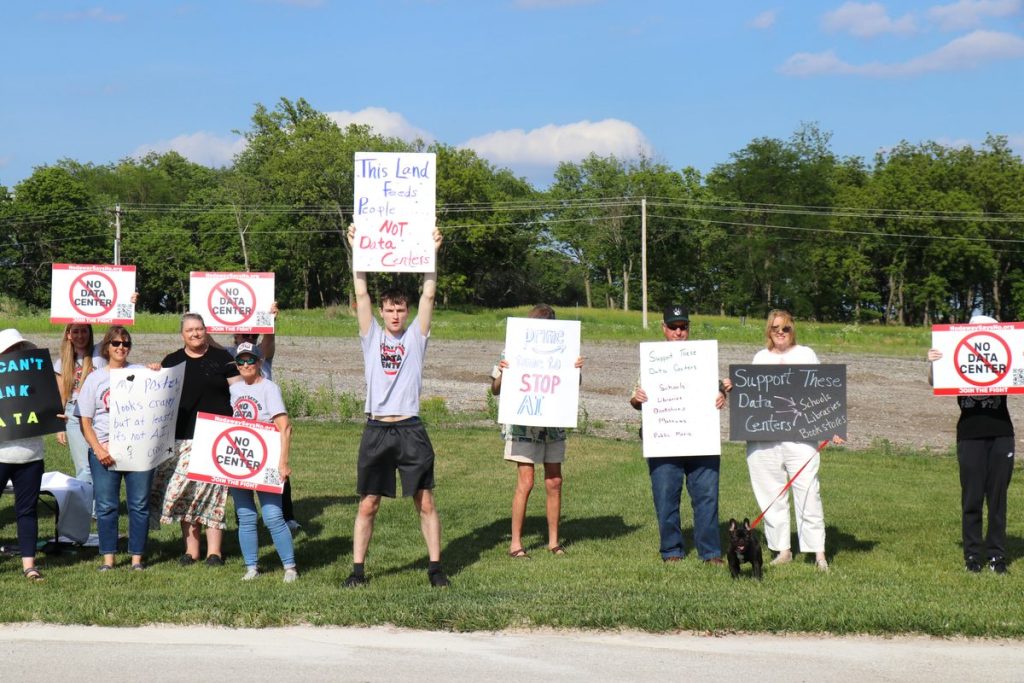
Members of Nodaway Says No, which opposes the data center, protested outside the Mozingo Event Center on Wednesday ahead of the open house hosted by Scale Microgrids.
GEOFFREY WOEHLK/THE FORUM
Nodaway County Commissioner Scott Walk was one of several local public officials who attended Wednesday’s open house hosted by Scale Microgrids to give more information about the company’s proposed data center project.