Spike Speaks: It is time for MSHSAA to corral its coaches


By JON DYKSTRA The Forum
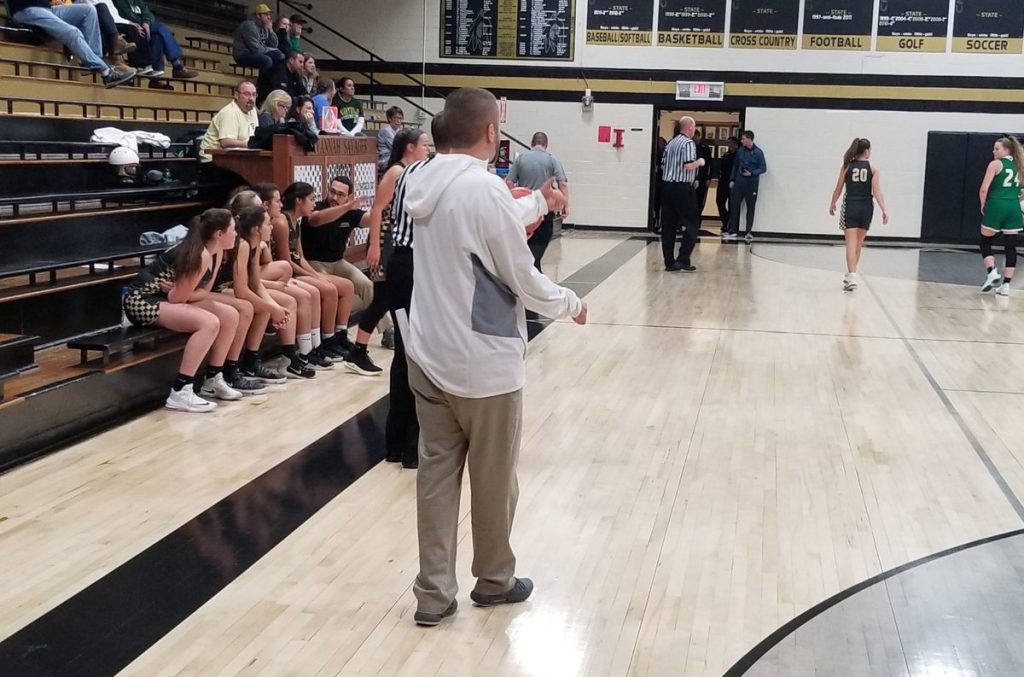
Savannah coach Aaron Cooper wanders onto the court during Saturday’s fifth-place game of the Savannah Tournament while action is happening on the other end. Cooper often remains on the court even when action returns to his side of it.
I remember growing up in Iowa and as a high school basketball player, our coach would always be excited to play in Missouri because when we would, he’d get to stand and move around the sideline a bit.
In Iowa, coaches are required to sit on the bench at all times during a game, so the opportunity to move around to avoid an official in the way or walk down the bench to talk to a player getting ready to go into the game or just leaving it makes sense, but like all rules it seems like this one can be abused and lead to an unfair advantage.
MSHSAA extended the coaches box last year to 28-feet which runs from the baseline toward mid-court. The premise of that was to allow it to be easier for a coach to talk to his players on the court.
In my first year covering the Midland Empire Conference full time, it was obvious that different coaches used this new rule in different ways as some stayed close to the bench or even stayed seated most of the time. Most of the coaches moved up and down the coaches box with the action but were very aware to stay off the court.
There were a few exceptions though and Savannah girls coach Aaron Cooper was one of them. Despite plenty of room to stand on the sideline, Cooper hardly left the court.
Last season, I noticed it but assumed with tight games in every matchup, he had just gotten caught up in the moment and was just trying to give extra direction to his players. However, in Saturday’s blow-out victory for the Spoofhounds, I noticed him on the court even more.
Being on the court isn’t ideal but if you are up by your bench, not many plays are drawn up to get the ball 30 feet from the basket on the sideline so the effect on the game is minimal. Cooper is nowhere near his bench when he stands though, he is right next to the baseline.
The reason this presents problems is obvious. Every basketball team has plays where a player runs the baseline or pops out to the corner. The corner-three is the shortest three-pointer in basketball and when, for half the game, a coach can stand in the opposing team’s corner and basically take that shot away unless a player runs into him to force a referee’s hand into doing something about it.
No high school girls basketball player is likely to be willing to run into a grown man that they don’t know so it results in no one going to the corner on the sideline with the benches. I’m sure this isn’t the intention of coaches like Cooper who tend to wander out there, but regardless, it is what happens.
Shortening the coaches box so it doesn’t completely extend to the end line would solve that problem and it certainly wouldn’t hamper a coach’s ability to communicate with his/her players if they are simply 10 feet from the baseline. Hopefully MSHSAA looks into this rule during the offseason.
NOTE: Cooper was the example I chose to use for this column because he seems to spend the most time on the court and I just witnessed him doing it on Saturday, but he is far from the only offender.

Jon Dykstra