Call for no data center tax abatements picks up steam
SCALE MICROGRIDS
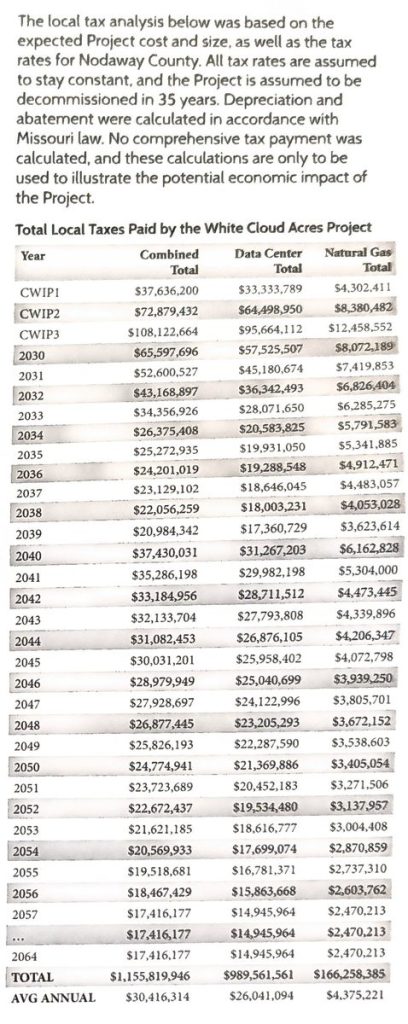
An analysis by Strategic Economic Research indicated that over an anticipated 35-year life, the data center and the natural gas plant built as part of the project would produce an average of more than $30 million in tax revenues with a 10-year, 50-percent abatement on property taxes.
MARYVILLE, Mo. — An informational community meeting Monday hosted by Nodaway Says No highlighted the group’s opposition to any kind of tax incentives for the White Cloud Acres data center project.
The opposition group’s broad platform has long called for no tax abatements for the proposed data center that would be built about 8 miles south of Maryville along U.S. Highway 71. But the well-attended meeting held at the Maryville Community Center on Monday evening brought the issue to the forefront — by far the biggest and most frequent applause broke out when speakers said they opposed any tax incentives.
Nodaway County Assessor Rex Wallace was one such speaker. Since the project first surfaced, he has taken issue with the expectation by the developer, Scale Microgrids, that it should receive a significant tax abatement, and had questioned why the company believed its annual property tax payments — even with a 50-percent abatement — would peak at only a little more than $108 million on what will be a $6 billion facility, including an adjacent natural gas power plant.
During Monday’s meeting, Wallace said he figured out that most of the equipment inside the data center would be classed as computers, which depreciate very quickly on assessors’ valuation tables. At an open house in June, Dan Scheffler, Scale’s vice president of development for data centers, said that by far the project’s biggest expense would be the $4 billion worth of equipment. If it were taxed like commercial property, Wallace said, the tax bill should be $140 million a year. Instead, a table presented by Scale in June shows that, including the natural gas plant, the combined annual tax amount would never get close, and would average a little over $30 million per year across a 35-year lifespan.
The county commissioners have said that they would consider issuing Chapter 100 bonds as a tax incentive if the project moves forward. That would allow the county to have some say in regulating how the facility operates, which Wallace acknowledged.
“I’m not for Chapter 100s, I’m not for 385s, I’m not for PILOTs (Payments in Lieu of Taxes), I’m not for TIFs (Tax Increment Financing) — I think everybody should pay their damn fair share of taxes. I do,” Wallace said. “But, and there is a but, if there’s ever gonna be any way of controlling these folks — whether the lights are too bright, whether the pollution is getting too bad, whatever it might be — if you can’t get a government agency up there to get involved, the county would have some sort of mechanism to say, ‘Hey, you need to fix this, you gotta do something different, you gotta do something better,’ and there’s ways of holding them accountable. That’s the only reason on God’s green earth I’d even consider it.”
Chapter 100 bonds are issued through a state program that essentially allows a local government, through an agreement with a major job creator, to assume ownership of a company’s property and then lease the property back to the company. That exempts the property from taxes since it is now owned by a local government. In exchange, the company then pays a lower amount to “rent” their property from the local government. The bonds can be used for both personal and real property, and the program requires a minimum 50-percent abatement.
The proposed tax revenue schedule presented by Scale shows a 50-percent abatement on both real and personal property.
The Chapter 100 program would also allow the county to distribute the revenue more widely. The commissioners have said, for example, that they would want to distribute some funds to every public school district in the county. With no tax abatement, only the South Nodaway R-IV School District would see the tax revenue since the data center would be in its district.
Scheffler told The Forum in June that even if no abatement is offered, the company would still move forward with the project.
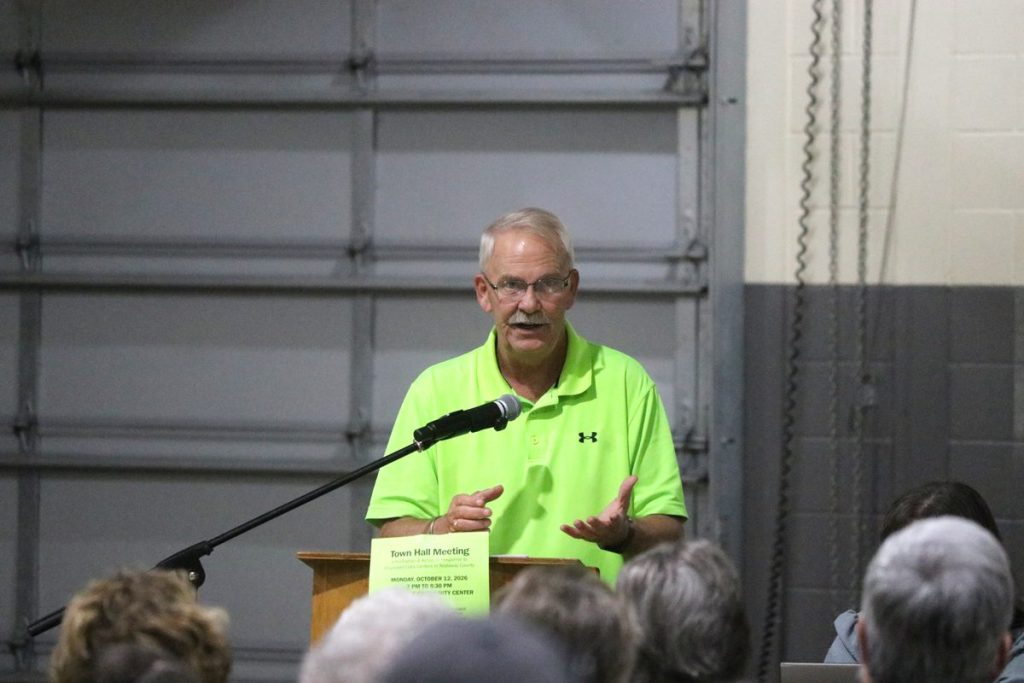
GEOFFREY WOEHLK/THE FORUM
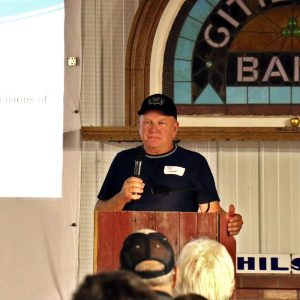
Nodaway County Assessor Rex Wallace speaks during an informational meeting held by Nodaway Says No on Monday at the Maryville Community Center. Wallace explained why the anticipated tax revenue from the proposed White Cloud Acres data center project would not be as high as from most facilities.