Commission reviews health report related to data center
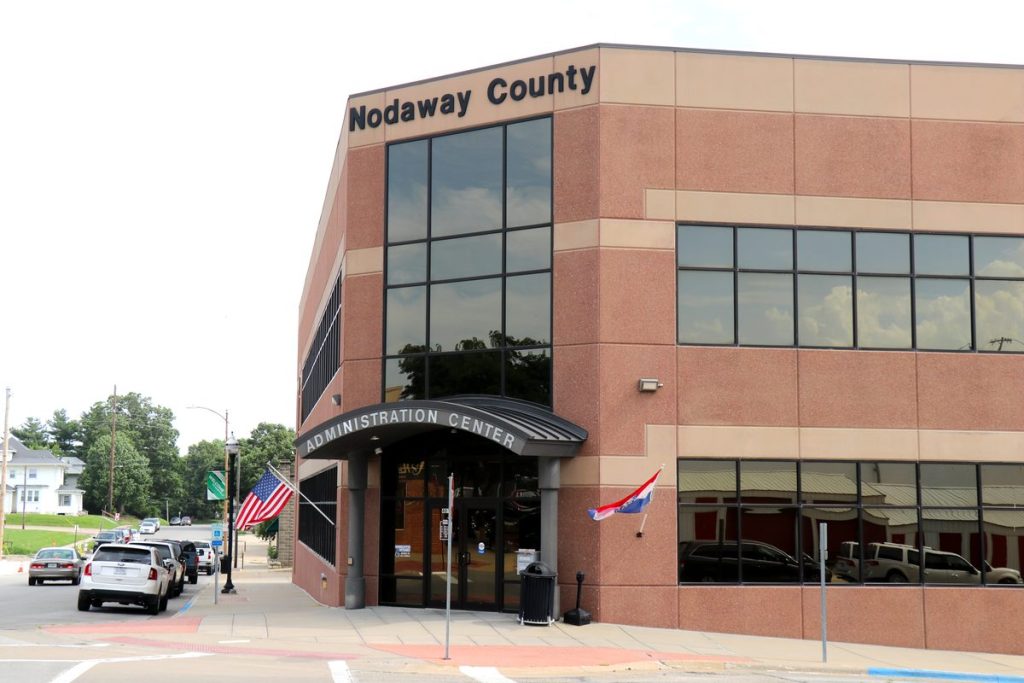
GEOFFREY WOEHLK/THE FORUM
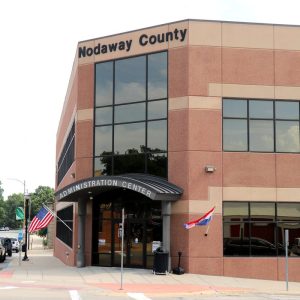
Nodaway County Administration Center building
MARYVILLE, Mo. — A Nodaway County Health Center report estimates the health-related costs from the proposed White Cloud Generating natural gas power plant project in the hundreds of thousands of dollars in the first year. But overall, the highly interpretable data in the report is unlikely to sway anyone on either side of the divisive data center project.
Tom Patterson, Nodaway County Health Center administrator, presented his analysis to the Nodaway County Commission on Tuesday after the commission had requested that he weigh in on possible health effects of the proposed White Cloud Acres data center project. In his report, Patterson focused on two areas: air pollution produced by the proposed 600-megawatt White Cloud Generating natural gas power plant that would be co-located with the data center, and the effects of noise on livestock. Air pollution and noise pollution have been two of the most common topics brought up by residents with concerns about the data center project.
Air pollution
For air pollution, Patterson used the figures in a construction permit submitted by White Cloud Generating to the Missouri Department of Natural Resources along with two other similar natural gas power facilities. He fed those figures into the CO-Benefits Risk Assessment Health Impacts Screening and Mapping Tool — or COBRA — maintained by the Environmental Protection Agency.
COBRA draws on a massive database of reports from multiple agencies to model the potential health effects of changes in air pollution anywhere across the contiguous 48 states. The tool is intended to be used by local officials looking to estimate the health and associated economic impact of clean energy solutions, but can be used to model the opposite as well.
Patterson’s report averaged the proposed emissions from three natural gas power facilities that submitted applications to DNR — a 450-MW facility, a 550-MW facility and the White Cloud facility which would produce up to 600 MW — focusing on four emission types: particulate matter of 2.5 micrometers or smaller, sulfur oxides, nitrogen oxides and volatile organic compounds, or VOCs. All four of the figures used in Patterson’s calculations were higher than the estimates submitted by White Cloud Generating in its application to DNR.
The results estimated a cumulative cost of between approximately $300,000 and $700,000 in the first year for Nodaway County residents due to detrimental health effects of the air pollutants. The Forum ran a scenario through COBRA using only the figures submitted by White Cloud Generating and achieved similar results.
However, Patterson cautioned that the tool was not designed for exact predictions, but to help local officials get a general idea of where a project would make the biggest impacts. The tool does not take precise location into account, assuming that the hypothetical emitter is in the center of the county, he said.
In areas with very small populations, like Nodaway County, the statistical modeling used by COBRA is also stretched to its limit.
The report, for example, estimates a change in total emergency room visits for respiratory issues to increase by 0.031 in the first year. Many of the results are very small fractions because the software uses statistics that hold true on larger scales of hundreds of thousands of people, rather than the just over approximately 20,000 people in Nodaway County.
COBRA calculates the monetary value in 2023 dollars based on healthcare costs and research into the willingness to pay to avoid a certain health endpoint. For example, the emergency room visits scenario above carries an overall price tag of $49 based on reports used in the model that take into account how much the average person is willing to spend to address that health issue.
The largest effect in the modeled results is in the incidence of total asthma symptoms, such as coughing, shortness of breath and chest tightness. That total, according to the report, would rise by an estimated 14.16 statistical incidents in the first year of the power plant’s operation.
All the fractions add up, though, to between approximately $300,000 and $700,000 in one year.
Patterson stressed that the estimates are far from exact, but should hopefully help the commissioners in some way while they gather more information during a moratorium period the commission imposed on data center development last month.
Noise
On noise, Patterson presented the commission with three studies that looked at the effects of noise on animals and livestock. He said that after researching the issue, 70-75 decibels seemed to be where livestock consistently started to have adverse reactions.
Patterson said that according to U.S. Department of Transportation’s Bureau of Transportation Statistics, traffic on U.S. Highway 71 south of Maryville, where the data center would be built, regularly averages between 45 and 69 decibels.
Scale Microgrids, the White Cloud Acres data center project developer, has pledged to keep the data center’s noise level at under 50 decibels as measured at the nearest residence.
Patterson said he did not research noise effects on humans, but would do so if the commission would like him to.