Black, Farnan answer to over 100 at chamber Legislative Coffee
GEOFFREY WOEHLK/THE FORUM
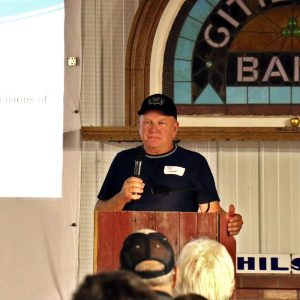
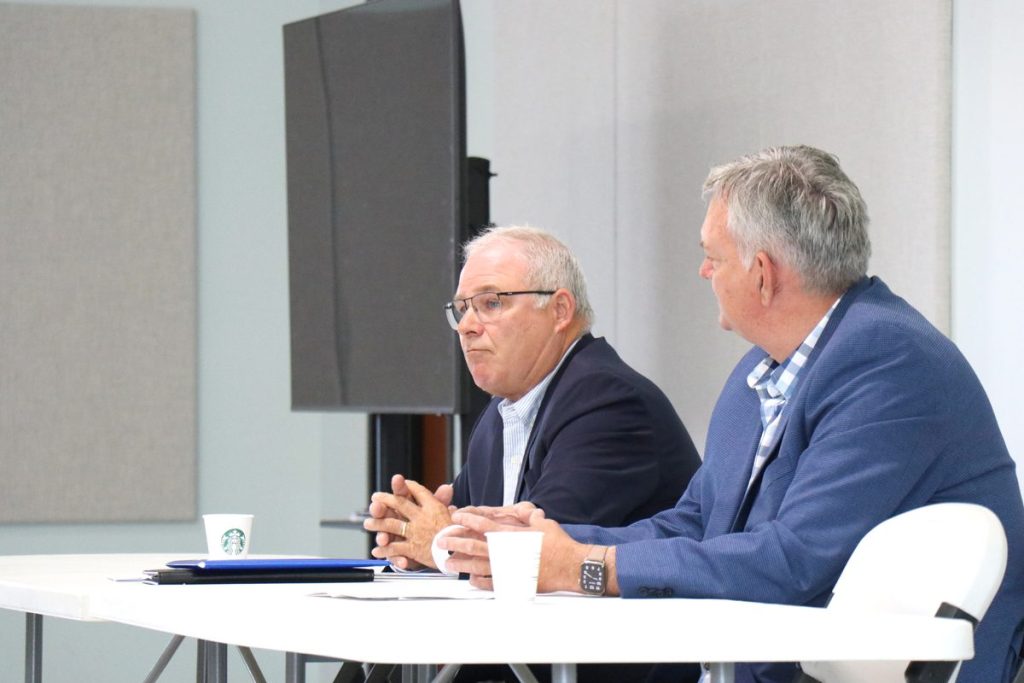
Sen. Rusty Black, left, and Rep. Jeff Farnan spoke to constituents during Tuesday morning’s Legislative Coffee event hosted by the Greater Maryville Chamber of Commerce. The two disagreed over whether to eliminate the state income tax.
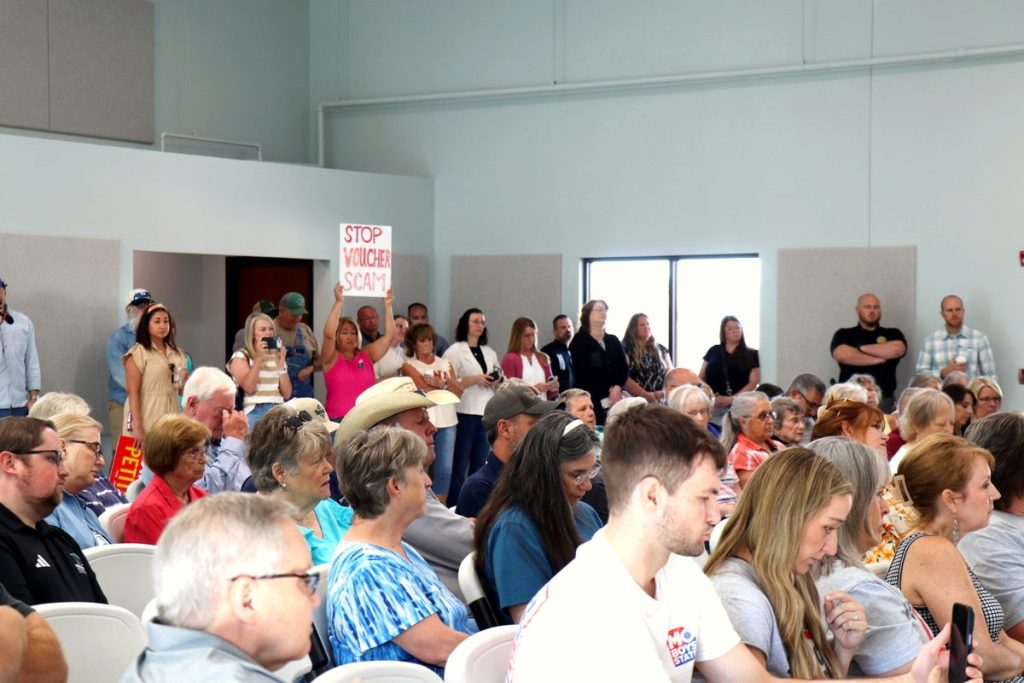
MARYVILLE, Mo. — A crowd of more than 100 confronted state Rep. Jeff Farnan and Sen. Rusty Black at the Greater Maryville Chamber of Commerce’s Legislative Coffee event on Tuesday, demanding answers about school funding, income tax legislation, data centers and more.
School funding
The legislators kicked off the question-and-answer session by talking about school funding, and the MOScholars school voucher program in particular.
The MOScholars program allows state-approved nonprofit organizations to award scholarships to students the organizations select and write off the cost on their taxes. This year, the state also budgeted $50 million of public money for the MOScholars fund, sending public money to private schools, 98 percent of which were religious. The legislature added another $10 million to next year’s budget for MOScholars.
Farnan has long opposed the program because he says it diverts funding that could otherwise go to public schools. He reiterated that opposition on Tuesday, saying flatly that public money should not go to private schools.
Black, who chairs the Senate Appropriations Committee, has been a frequent target of rural public school advocates for his support of MOScholars and, more generally, for policies that they say jeopardize rural school districts.
On Tuesday, Black defended his record on education by repeating his assertion that public schools have seen large increases in funding since he began in the legislature in 2017.
“There has been a monstrous increase in funding for K-12 education in that time — about $2 billion of it,” he said, and claimed credit for $90 million of that increase.
But Black did not give an answer about his support of MOScholars. As chair of the Senate Appropriations Committee, Black was instrumental in crafting the state budget sent to Gov. Mike Kehoe’s desk that included $10 million more for MOScholars, but falls approximately $190 million short of fully funding the K-12 funding formula for schools.
Another questioner asked Black if he was “proud” of Missouri’s relatively low share of state support for schools compared to other states.
In his response, Black cited data from the National Education Association, which noted that on average, Missouri public K-12 schools received 61.7 percent of their funding from local sources in 2024-2025, while only 30.6 percent came from the state — putting Missouri 48th in the nation.
SCHOOL FUNDING SOURCES
Average share of funding by source for Missouri K-12 public schools in 2024-2025.
Local: 61.7%
State: 30.6%
Federal. 7.7%
SOURCE: NATIONAL EDUCATION ASSOCIATION
Black said the state share of funding has remained relatively even since he began his teaching career in 1979, and that Missouri has traditionally funded schools with a high local share of support.
“That’s where we’re at,” Black said, “and my guess is, if you went back and looked at 1979, it would probably be fairly close to those (numbers), and if you look at 2049, it will probably be fairly consistent with those numbers because we’re a local-control state, as other states have been, on funding schools and making school decisions.”
According to the Missouri Annual Report of the Public Schools for 1977-1978 published by the Missouri State Board of Education, the share of state funding for local schools at the time was 43 percent. The 1979-1980 report was not available through the Missouri Digital Heritage online portal of the Secretary of State’s office, but the 1980-1981 school year saw the state share rise to 45.9 percent, according to that year’s annual public schools report.
According to a 2005 report from the nonpartisan Missouri Budget Project, the state share of funding was at 40.5 percent that year, when the state moved to the current funding formula.
The only two states with a lower share of state support for its schools are Florida and New Hampshire — two states that do not have an income tax.
Income tax
Farnan said that despite his vote in favor of putting a constitutional amendment on the ballot to allow the legislature to expand sales taxes as part of an effort to eliminate the state income tax, he is not in favor of it.
“I voted to bring it to a vote of the people,” he said.
Farnan said one of his biggest problems with the proposal is that it does not outline what will be taxed instead. Legislators in his party, including Black on Tuesday, said that because taxes are statutory, the legislature will pass laws separate from the constitutional amendment if it is approved by voters. They have not outlined which services will be taxed or how much other sales taxes will increase to make up the shortfall from eliminating the state’s largest revenue source.
Black said he supports the measure because he believes it will help spur population growth relative to other states which have grown faster.
According to the Missouri Budget Project, states without income taxes that lead the nation in population and GDP growth — like Florida, Tennessee and Texas — shift much of the tax burden to sales taxes, which are paid in higher proportions by lower-income individuals than income taxes. In Texas, much of the lost revenue is also made up for through the oil industry, a resource Missouri does not have.
And the sales taxes, according to the Missouri Budget Project study, are buoyed by booming tourism industries: Florida has about 157 million out-of-state visitors each year while Tennessee brings in about 114 million. Missouri attracts about 28 million, which would put the sales tax burden even more on state residents than in those other states.
To make up the funding shortfall, the state portion of sales taxes, currently at 3 percent, would need to increase by as much as 8.5 percent — nearly tripling — if no new goods or services are taxed, according to the Missouri Independent.
Black said Tuesday that he did not believe those estimates, calling them “nuts.” Instead, he said that by broadening sales taxes to include services, the state tax rate could only increase by “a point to a point-and-a-half, but it matters how broad we go.”
Herzog Foundation
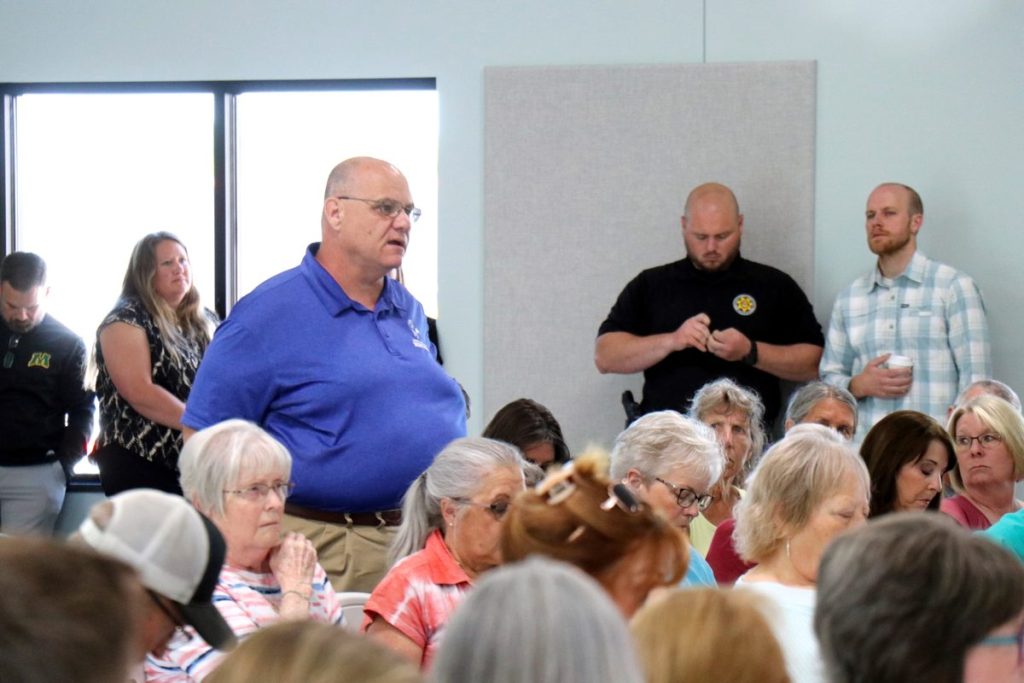
North Nodaway R-VI Superintendent Chris Turpin, who has been critical of Black for his stances on public school funding, asked the two legislators if they feel they still represent their constituents, or if they are now beholden to “outside influences.”
Farnan said he hears often from constituents and frequently talks with people across his district, including superintendents about any topic that is important to them.
“So I don’t think I get influenced by outside resources,” he said. “I get more influenced by people like you, people in the community, that’s who I listen to.”
In contrast, Black said he would answer “in a different way” than Farnan, stressing his close ties to lobbyists. In his response to Turpin, Black highlighted his relationship with Craig Barker, a former northwest Missouri superintendent who is now a lobbyist for the Missouri Council of School Administrators.
“He leaves his briefcase, his bag in my office,” Black said. “We went to school together. I see him every Tuesday. Sometimes we eat lunch and don’t talk about anything but home, and sometimes we eat lunch and talk about nothing but schools.
“So I think that’s my job: to listen to the people that your organizations, your groups send there to represent you.”
Later, Democratic organizer Jess Piper asked Black to defend his acceptance of campaign funds from the Stanley M. Herzog Charitable Foundation, a Christian education advocacy organization that is also associated with one of the largest users of the MOScholars program.
Black disputed that notion.
HERZOG FOUNDATION AND RUSTY BLACK
Below are totals of donations made to Sen. Rusty Black’s campaign committee or to a political action committee created to support his state Senate campaign, Great Northwest PAC, from entities that, according to reporting from the Missouri Independent, are associated with the Herzog Foundation. All donations were made during the 2022 election cycle, when Black was running in a crowded Republican primary for the state Senate.
- $150,000 from Herzog Contracting Corp.
- $90,400 from MO Alliance for Freedom Grace River PAC
- $90,400 from American Democracy Alliance – Ridgely PAC
- $2,400 from Chouteau PAC
- $2,400 from Graves Garrett LLC
TOTAL: $335,600
SOURCE: ACT FOR MISSOURI
“The Herzog Foundation cannot fund political candidates,” he said.
While contributions to Senate candidates’ campaign committees are capped at $2,400, political action committees are not bound by campaign contribution limits.
According to data collected by Act for Missouri, which tracks committee contributions from Missouri Ethics Commission filings, Black’s campaign committee and a PAC created in 2021 to support his Senate campaign, Great Northwest PAC, received $335,600 in donations during the 2022 election cycle from entities that the Missouri Independent connected to the Herzog Foundation as part of that organization’s efforts to influence candidates.
Black has faced criticism from area school administrators for appearing to back policies that they say would be devastating to rural school districts if enacted under a tweaked formula that the governor’s School Funding Modernization Task Force is developing. Black chairs the task force. Also on the task force are multiple school choice advocates, including Chris Vas, senior director at the Herzog Foundation.
Data centers
Both legislators also talked briefly about data centers.
Black said he did not have enough information about the proposed White Cloud Acres data center project to have an opinion either way.
Farnan said he had just started to hear about the data center project in the past several weeks and was trying to learn as much as he could. Although he said it is “hard to overlook” the potential tax revenues, he said he does not support the data center project coming to Nodaway County.
“I cannot support this data center because there’s been no study, that we know of, of water usage, nothing about environmental issues,” Farnan said. “I am gonna go visit one here in a week just to see exactly how loud it is. But until we get some more answers, there’s no way I can support this data center.”
Farnan also defended his handling of HB 3362, which included provisions to further limit the effects of large-load electric users on residential electric utility prices, and additionally would have instituted a large-load tariff on water users that used more than 2 million gallons per day — similar to measures already in place for large-load electric users — along with other accompanying regulations. The bill was a topic during an anti-data-center meeting held last week because of its provisions having to do with water users. It is unclear if the bill would have actually applied to the data center project since Scale Microgrids, the data center developer, says the data center will mostly use wastewater, not potable water, to cool its equipment.
The bill died in the Conservation and Natural Resources Committee, which Farnan chairs.
Farnan said he did not support the bill because he said it should have been two different bills — one concerning electric users and one concerning water users. He also said he did not like the 5-year permitting provision, which would have allowed the revocation of a water user’s permit to withdraw water at the end of the permitting period, and he said that a drought provision in the bill could have prevented a business from getting its water even with a permit during a drought, which he did not think was fair. Additionally, he said the bill did not give enough tools for enforcement to the Missouri Department of Natural Resources.
On top of that, the bill came up only six weeks before the end of the session, he said, which meant it would be extremely unlikely to have enough time to pass.
He said he has continued talking with the bill’s sponsor, Colin Wellenkamp, R-St. Charles, about the bill.
Neither Black nor Farnan attended the Nodaway Says No meeting Tuesday evening at the Maryville Community Center.
GEOFFREY WOEHLK/THE FORUM
North Nodaway R-VI Superintendent Chris Turpin asked the legislators if they felt they still represented their constituents or if they were beholden to outside influences.
GEOFFREY WOEHLK/THE FORUM
More than 100 people attended the Greater Maryville Chamber of Commerce’s Legislative Coffee event on Tuesday morning held at the Nodaway County Services multipurpose building to hear from Rep. Jeff Farnan and Sen. Rusty Black about the legislative session that wrapped up earlier this month.