Museum adds Conception Abbey exhibit
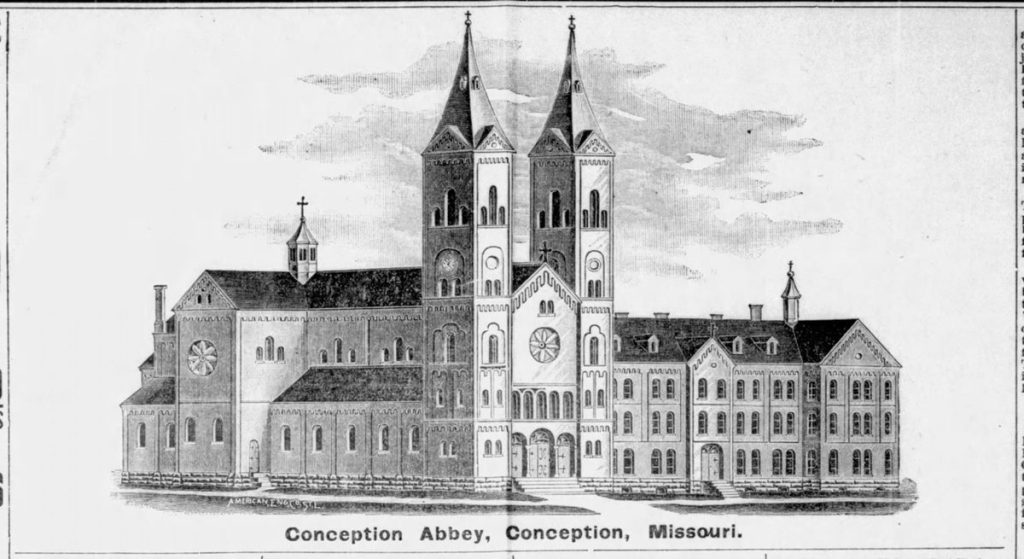
NODAWAY COUNTY DEMOCRAT, 1898
Conception Abbey was founded in 1873 and elevated to an abbey in 1881. When designing the buildings that would become the Abbey, Father Frowin, one of the original Swiss monks who started the abbey, took influence from the traditional Romanesque and Beuronese styles of architecture that have become synonymous with Catholic infrastructure.
Continuing our recognition of the religious history of Nodaway County, the Nodaway County Historical Society Museum recently added an exhibit about Conception Abbey.
Founded in 1873, and elevated to an abbey in 1881, the Abbey has been in operation for 153 years. Its primary function has been to serve as a monastery for Benedictine monks and religious education via the Conception Seminary College. It is estimated that the college has educated 75 percent of the priests in the Kansas City-St. Joseph diocese. The most notable figure to have attended was Supreme Court justice Clarence Thomas in 1967.
Located in the southeast of Nodaway County, the former railway junction community of Conception is a quiet town with a population just over 100. It was settled in the 1860s by Irish and German Catholics from Reading, Pennsylvania, who were struggling to find employment opportunities in that region.
The Reading Land Association acquired the land on what would later be a railway junction for members of their community. Along with them came Father James Power, who had the idea of establishing a Benedictine order in the rural lands of northwestern Missouri to establish a place for monks to pursue a monastic lifestyle.
At first, Father Power invited the monks of St. Meinrad Abbey in Indiana to come and settle the land, but they were unable to do so. Despite this potential roadblock, the monks of St. Meinrad were still a helpful intermediary between Catholic groups in Missouri and Switzerland.
Father Power used these connections and worked with Bishop John Hogan of St. Joseph, Missouri, to petition Benedictine monks from Engelberg Abbey in Switzerland to make the trip to Nodaway County. At first, the Swiss Benedictines were reluctant to establish a new site in America because of fears that branching the order out like this would cause the group to become too distanced from the motherhouse in Switzerland.
However, the growing threat of religious persecution by the Swiss government led the group in Engelberg to send three of their monks: Father Frowin, Father Meinrad, and Father Adelhelm. They were put in charge of establishing a suitable abbey that would align with the monastic principles of the Benedictines.
Despite this goal, Adelhelm and Frowin fell into a dispute over how to design the church and abbey grounds. Father Adelhelm eventually left Conception to establish his own abbey in Oregon called Mount Angel.
When designing the buildings that would become the Abbey, Father Frowin took influence from the traditional Romanesque and Beuronese styles of architecture that have become synonymous with Catholic infrastructure. This is most evident in the stunningly intricate Basilica of Immaculate Conception, which was designed by a Franciscan, Adrian Weaver, and received its status as a minor basilica by Pope Pius XII on May 10, 1941.
Visit the NCHS Museum at 110 N. Walnut St. to learn more about religious history in Nodaway County. The museum is open March to December on Tuesdays to Fridays from 1-4 p.m. and on the second Saturday of each month from 9-11 a.m. We also host monthly programs and are free to the public.
Upcoming events include a program about genealogy with local expert Tina Brown on Saturday, June 13, at 11 a.m. During the county fair on July 11, from 2-4 p.m., we will hold an ice cream social and exhibit opening about “Remembering the Bicentennial” to celebrate America’s 250th.
Learn more about the museum’s work on our website, nodawaycountymuseum.com. You can contact us at [email protected] or at 660-582-8176.