Spoofhound robotics statebound
SKYE POURNAZARI/THE FORUM
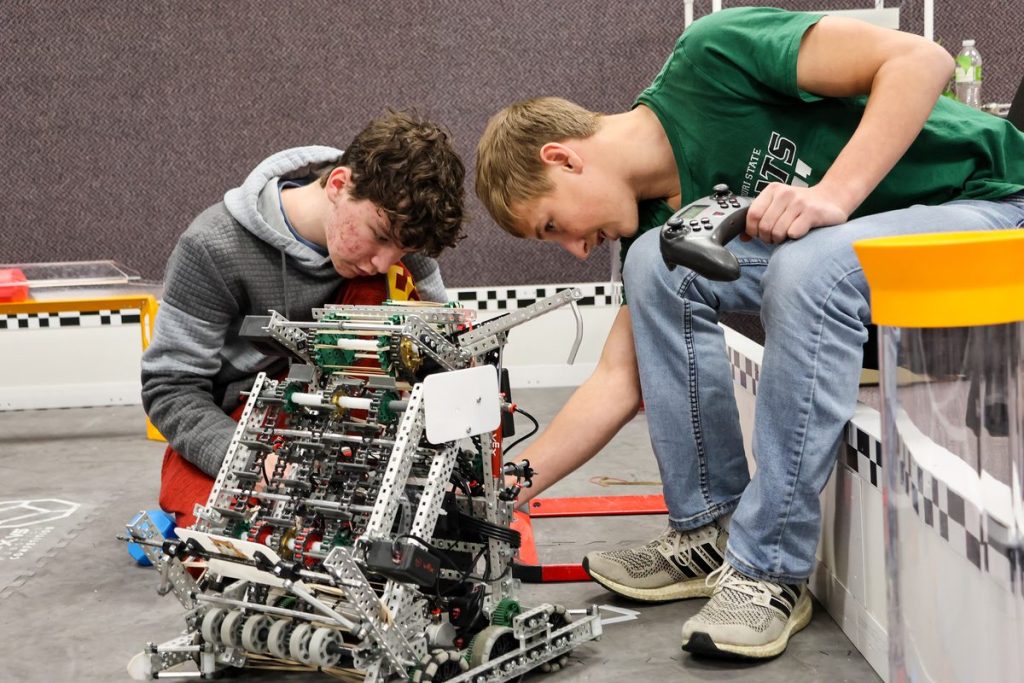
Maryville High School freshmen Matthew Winters and Will Snyders work on their robot Feb. 20 in the relatively new dedicated engineering space in the Northwest Technical School. The two will join junior Karsen Ebrecht at the state competition in Wentzville on March 7 and 8.
MARYVILLE, Mo. — Constantly working to improve it, three young Spoofhounds will put their robot’s skills on display this weekend at the state competition in Wentzville.
Team Paradigm — comprised of junior Karsen Ebrecht and freshmen Matthew Winters and Will Snyders — offers what science teacher and robotics sponsor Phil Stone calls a “well-defined robot,” for this year’s state contest.
“We think it’s one of the higher scoring robots in the state,” Stone said.
On display during a practice last month, the quick robot sports numerous features that help it function well in the field, like a strong drivetrain, which is Snyders’ favorite part. Having helped space the wheels and construct the six-motor, three-wheel base, he said it is powerful and offers stability when other robots are crashing into it.
The field includes several scoring stations at various height levels in which robots, whether autonomous or driven, have two minutes to place balls of their team’s color. Different parts of the scoring station are also worth more points. The points are totaled at the end of the match, which means that teams construct their robots not only with a focus on offensive scoring, but also on removing balls or blocking scoring by other teams.
“A lot of teams only have four motors,” Snyders said. “But we noticed that the majority of the robots that do really good and make it to state have more motors.”
So they worked to give their robot more power in the wheels, putting six of its eight allowed motors into that effort.
“The other robots will just be ramming into you, so you have to have a strong enough of a drivetrain to fight back,” Snyders said. “Sometimes you just have to drive forward so you don’t get pushed out of the way.”
Another strong triangular feature helps the driver position the robot quickly into scoring position from a nearly 90-degree angle and then stay there while defending against attacks, just long enough to place the balls it has collected from the field. With different scoring for their color, and even placement within the plastic scoring location, the driver has to quickly decide where and how to pick up the balls and get them into the apparatus.
Stone said the robot has changed throughout the year and will continue to do so right up until state, but he has seen the team grow in its knowledge enough to trust their decisions will only make it better.
Since 2017, Spoofhounds have taken part in the VEX Robotics season, which begins the same day the world competition ends the previous year in June, allowing a summer’s worth of work.
This year, the team got an early start and was able to attend a very early signature event at the Strategic Air Command and Aerospace Museum in Ashland, Nebraska, one of several early events held across the nation. Gathered in huge hangars, engineering enthusiasts from throughout the country, including members of Maryville’s [Team Name Here], were surrounded by feats of engineering, including a B-2 bomber and other military planes.
Maryville’s second team of robotics enthusiasts, called [Team Name Here], included senior Emma Southers and juniors Dylan Taylor and Siyan Driskell.
“It was so much fun,” Stone said, noting it was a great experience and the team’s robot ranked in the middle of the 60 teams involved. “You start to see how good some teams are early on. … And then both teams really kind of hit a stride.”
He said when fall sports ended, Paradigm members were able to get together more often and work to finesse the robot.
Ebrecht, the team’s main driver — though Snyders has been practicing and perfecting his controls — said after a major rebuild, which is fairly normal, he is looking forward to competing at state.
“I really think we can be one of the most competitive teams there and it’s really nice seeing all this hard work paying off at the end of the season,” Ebrecht said.
Last year, Ebrecht joined former teammates at the VEX World Championships in Texas, and the team hopes to return. Stone said he has kept open the newly acquired engineering space for a couple of hours each day throughout the week and the team usually takes advantage of that time.
“These guys are very dedicated,” he said. “I almost have to kick Will out sometimes.”
Snyders said while he was still learning about the materials, he showed up nearly every day and, yes, was kicked out most of those days.
Winters said it is not every day now, but many days Snyders will come in saying “I have an idea,” and then they get to work tweaking or perfecting one element of the robot.
Other areas the team has worked on include a lower plate that helps get the balls out of the storage containers on the side of the field, and an array of rubber paddles on chains to lift them into the center of the robot. Then this design quickly shoots them out the rear of the robot once it is aligned.
“We can hold a pretty good amount of balls in there and get them out really fast,” Winters said.
A defensive and pneumatic “wing” feature pushes out a small, bent metal rod that, when positioned correctly, will force the other team’s balls out of the upper scoring area.
Snyders explained that it has to stay flat due to size constraints.
“Our robot is one of the biggest robots on the field whenever we’re in a match,” Snyders said. “We are pushing the limits in every single dimension.”
To get the robot’s large size up and over some low rails, the team crafted small white, plastic pieces to help lift it so the rubber wheels can reach the rails and the motors push it over during the quick two-minute matches.
“Every robot’s a little different,” Snyders said. “Speed is kind of the name of the game.”
The first 15 seconds of the game are autonomous and rely solely on coding — this year provided by Ebrecht — to propel the robot to complete specific tasks and score points.
“But usually I’m always trying to find gaps of time where I can work on the robot,” Snyders said. “For example, I’ve spent probably three hours just trying to get this top part to be spaced equally so that whenever we would score, it would push the balls way into the goal.”
Winters said they are both in Stone’s engineering class and are interested in the field after school, but are mostly interested in attending competitions and learning more about it from other teams. Stone said the events are collaborative, with students helping others with details on their robots.
“They’re not shy about showing you what they’ve done,” he said. “Nobody’s really secretive.”
Snyders said they had some difficulties with chain tensioning but, working with another team, were able to raise a part of the robot about a quarter of an inch to help keep the tension strong.
“Now it works fine,” Snyders said.
Looking forward, the team is excited for state and hopeful to attend worlds. The engineers are also excited about learning next year’s game specifics, tearing down this year’s robot and starting over with a new design.
SUBMITTED BY RITA PIVERAL
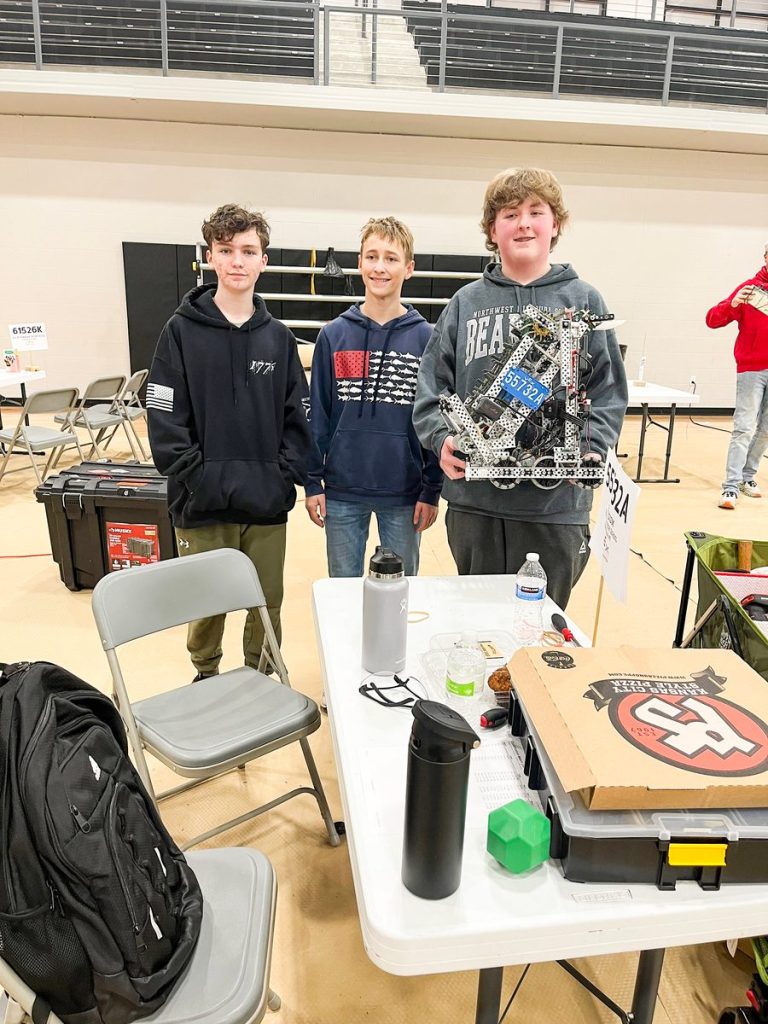
Paradigm robotics team members Matthew Winters, Will Snyders and Karsen Ebrecht are shown with their robot at a Platte City competition on Feb. 7.