Emancipation Day Celebrations
2-5 Historical Tidbits – NCHS Museum 2.jpg
January 1st is celebrated for both New Year’s Eve and the Emancipation Proclamation, the document issued by President Abraham Lincoln that freed all slaves in Confederate areas in 1863. As we consider this idea of freedom, especially as we begin 2026, the year of America’s 250th, there is another set of independence celebrations that took place in Nodaway County: Emancipation Day celebrations.
Emancipation Day celebrations were held to recognize the importance of August 1st in 1834 when Britain freed most slaves across its colonies. African American communities across the United States celebrated this event starting in the 1830s. In places like Nodaway County, where slavery was legal until 1865, these celebrations usually only began after the start of freedom. The Civil War era newspapers in Nodaway County were destroyed during the war, but accounts of Emancipation Day celebrations can be found in local papers starting in 1874. They took place almost annually through 1920.
These events were organized by local African American leaders and often received the support of white leaders, business owners and residents. For instance, local white politicians participated as invited speakers, business owners donated money to fund the event and residents attended the celebrations in the hundreds and even thousands. Some years the Emancipation Day events attracted up to 7,000 people, most of them white. With these numbers, the annual Emancipation Day celebrations frequently were the largest events held each year.
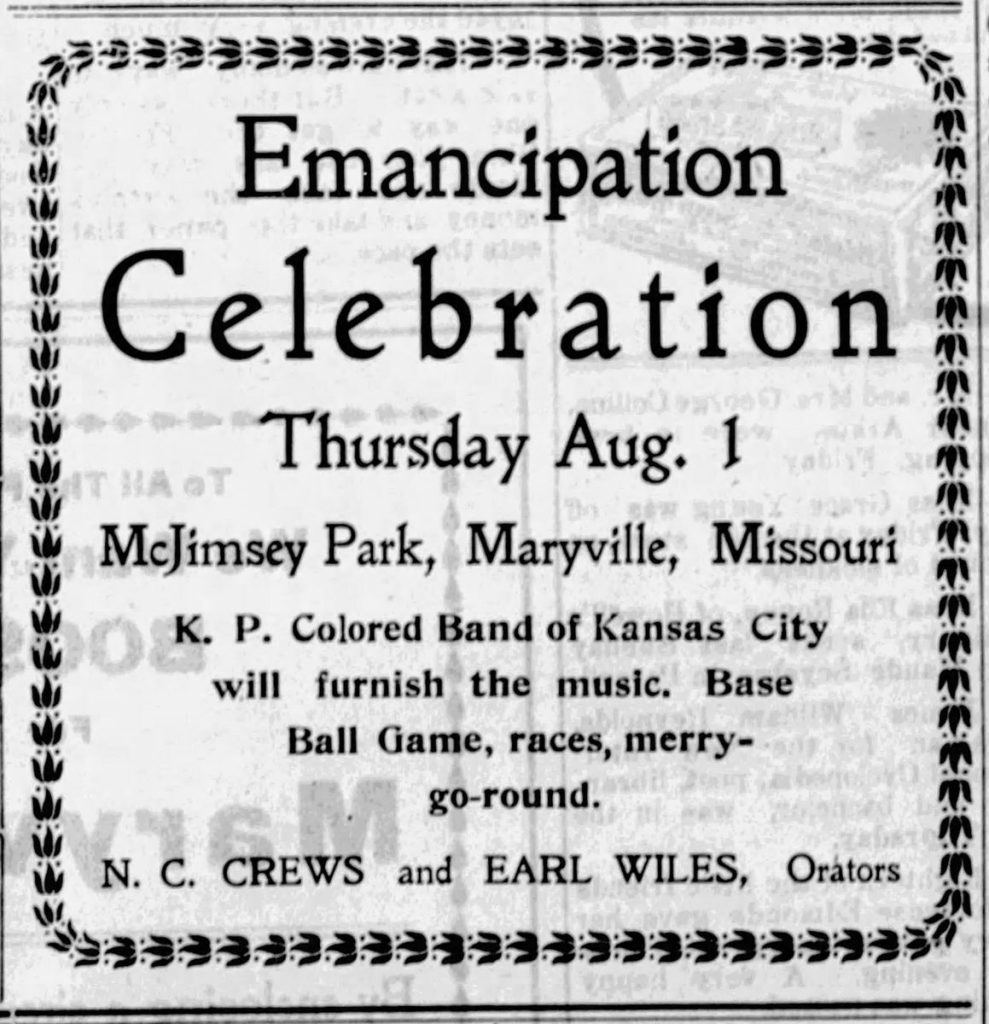
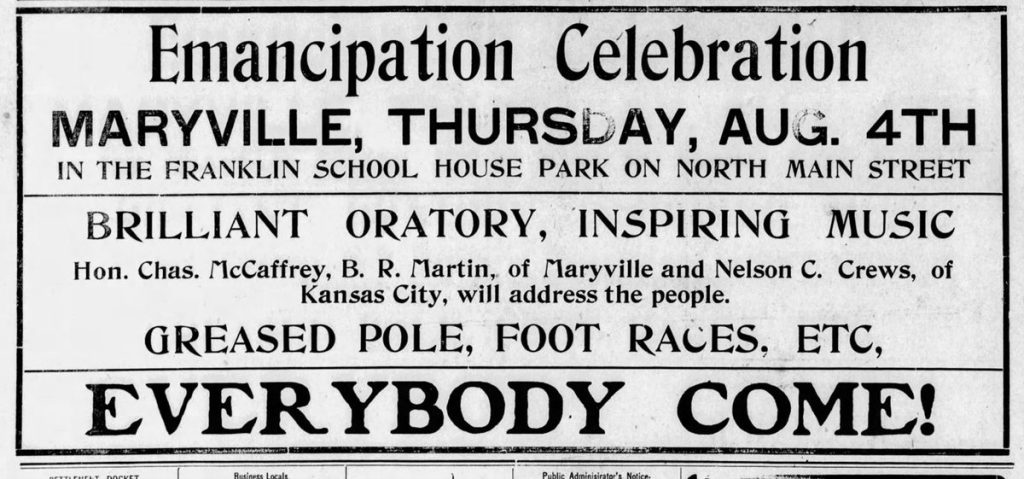
Despite the ability of this event to draw a big and mostly white crowd, there was something still contentious about African Americans appearing in public like this. Black Nodaway Countians did not shy away from the spotlight and instead began the day with a parade from the African Methodist Episcopal Church (located at Vine and Jenkins streets) through the main streets of town to the site of the celebration. In the years before official parks in Maryville, the celebrations took place at “groves,” or park-like places that landowners opened to the public for picnics and social events. Most frequently, they were held at McJimsey Park (located just north of where Delbert’s Garage is today at Depot and Seventh Street) or the Franklin School grounds (now Franklin Park at Main and Seventh Street). The parades through town often featured an all-Black band, which over the years came from Gallatin, St. Joseph, Omaha and Kansas City. A local Black baseball team (called the “Black Wonders”) played games against local white teams. Black speakers also supplemented the local white speakers. Nelson Crews was the most frequent African American speaker. He came to the Nodaway County Emancipation Day events every year but one between 1896 and 1919, and he often broached political sensitive subjects. For instance, in 1900 he harshly criticized the Democratic Party for their support of the Boers in South Africa. Crews called out the hypocrisy of the party that supported slavery to now be in support of the Boers in their fight for “liberty” against the British. In 1902 he criticized the laws in southern states that disenfranchised Black men, and in 1919 he talked about the race riots sweeping the country. Collectively, the bold public statements of the Emancipation Day celebrations were presented positively in local newspapers, but some cracks in this apparent racial harmony appeared at times. Some of the papers outside of Maryville spoke more critically of African Americans, and Black organizers noted the problems they sometimes faced in their fundraising efforts.
Visit the NCHS Museum at 110 N. Walnut St. to learn more about the history of Nodaway County. The museum is currently closed for the winter season and will reopen in early March for its regular hours (Tuesday-Friday, 1-4 p.m.). You can still visit us in February on the second Saturday from 9-11 a.m. for a special Valentine’s Day coffee hour! Stay tuned for our slate of programs for the 2026 year. Learn more about the museum’s work on our website nodawaycountymuseum.com. You can contact us at [email protected] or 660-582-8176.
2-5 Historical Tidbits – NCHS Museum 1.jpg