The Alma Nash Archives
SUBMITTED BY THE NCHS MUSEUM
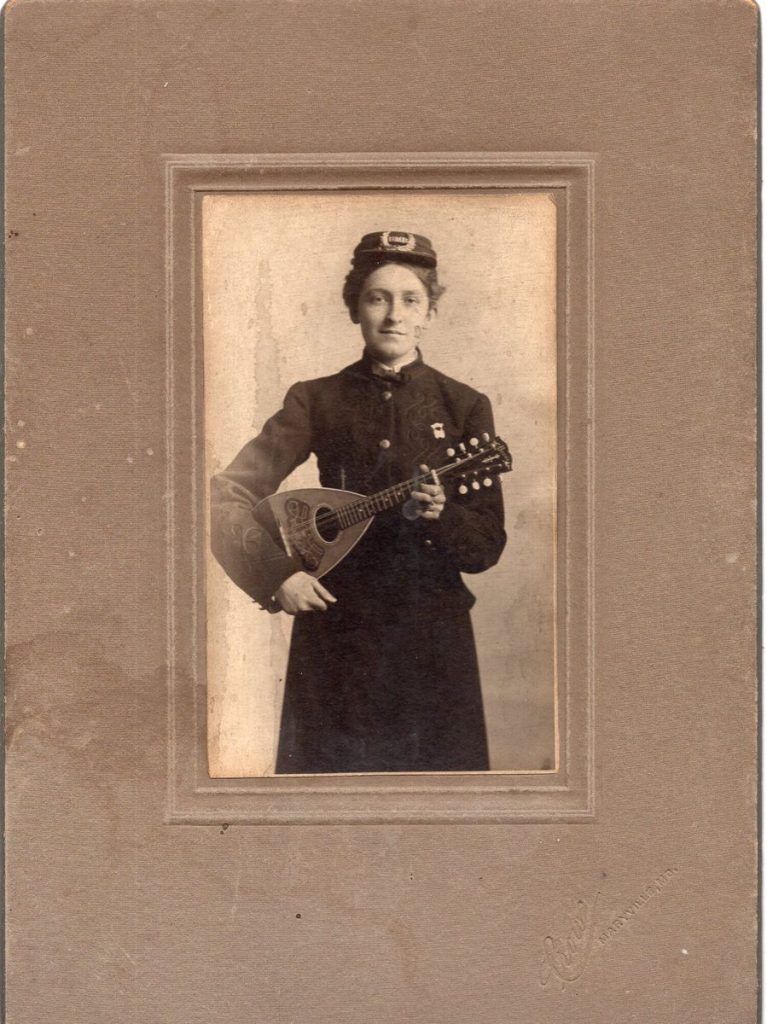
Photograph of Alma Nash as part of the Helen May Butler Ladies Military Band, c.1904. Image from the Alma Nash Archives, NCHS Museum.
MARYVILLE, Mo. — Many of us in Nodaway County are familiar with the name Alma Nash, but for those of you who are not, let me tell you a little about this incredible woman. She was born in 1883 to George A. Nash and Mary Houston Nash. George had studied medicine in St. Joseph and moved to Maryville in 1879 to work as a doctor, and he is deserving of his own newspaper feature in the future because of the important role he played in the medical field in the region. For now, let’s turn our attention back to Alma.
She was the eldest of two daughters that the couple raised. Alma attended Maryville High School and studied string instruments at the Maryville Seminary, from which she graduated in 1902. At this point, Alma pursued a musical career, one focused not just on teaching but also on traveling and performing. This was an unusual step for a young, single woman in the early twentieth century!
Within a few months of graduating with her music degree, she opened a music studio in town where she taught mandolin lessons. She also established several performing groups, including a juvenile mandolin orchestra. It was apparently the only one of its kind in the country, and she was invited to join the American Guilt of Mandolin, Guitar, and Banjo players. Soon, though, Alma was drawn into performing herself, and she joined the Helen May Butler all-women’s band. She first performed with them in Omaha, and they were set to travel across the Midwest and East. Following that experience, Alma was invited to play with an orchestra for their summerlong engagement in Atlantic City, New Jersey. The group performed three times daily, but Alma still managed to pursue even more musical studies, taking harp and drum lessons.
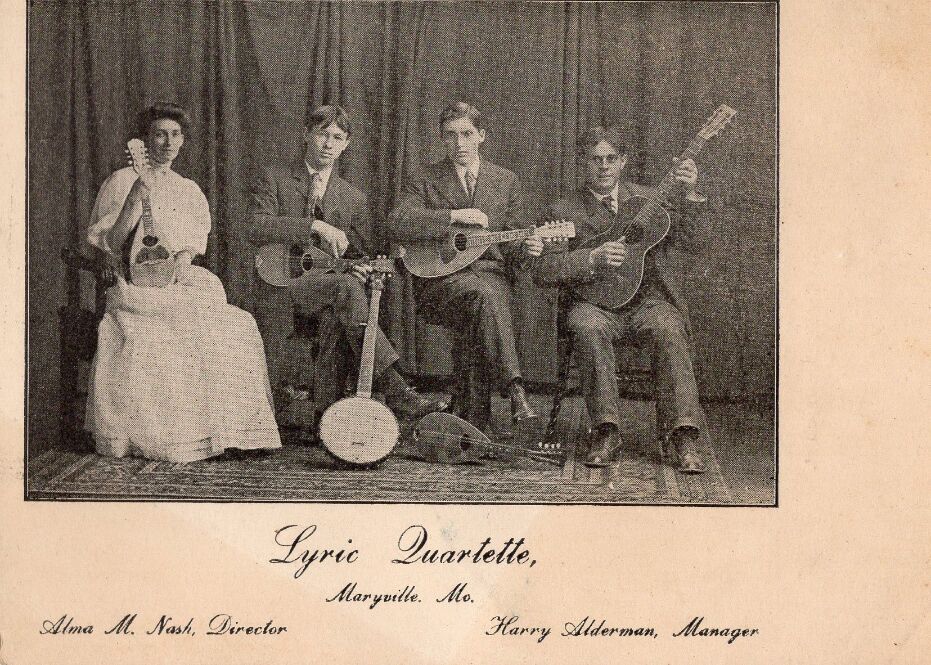
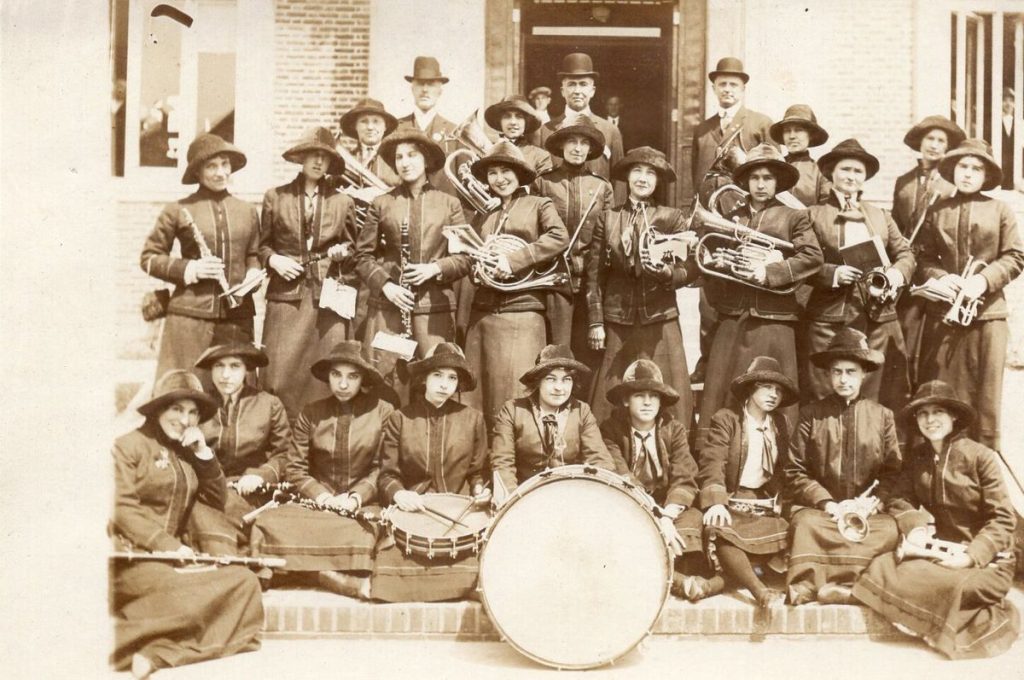
Between 1905 and 1915, Alma primarily was based in Maryville, where she gave lessons out of her Maryville School of Banjo, Mandolin, and Guitar. She also formed and directed any number of musical groups in the community, and performed herself in the Maryville String Quartette, which advertised in local papers as being available for hire for receptions, church functions and more. In the midst of this activity, Alma sometimes traveled further afield. In 1909, her musical quartet spent a month performing in Wisconsin, and in 1913 she took her all-women’s band to a national suffrage parade in Washington, D.C. For their involvement in this parade for women’s voting rights, Alma Nash and her band received national attention. Stories of the band and photographs of Alma appeared in newspapers across the country.
Following this experience, Alma returned to Maryville and soon faced a massive upheaval that changed her life. Her father died unexpectedly in 1915, and she and her mother moved to Kansas City. She opened several schools, including the Alma M. Nash School of Fretted Instruments, Almarion School of Fretted Instruments, and finally, the Alma Nash Studios. She also continued to organize bands and performance groups across the Kansas City region, performed locally herself and even wrote her own practice guide. Alma Nash died at her home, between student lessons, on Dec. 22, 1965, at the age of 83. Just three months later, her personal items were put up for auction.
The NCHS Museum has acquired items related to Alma Nash over the years, but nothing more was known about the bulk of her papers — until December 2024. That month, her archives appeared at a Kansas City-area auction, and thanks to the generosity of donors, the museum was able to acquire this incredible collection. It includes hundreds of letters between Alma and her family, original photographs we could only have dreamed of, music that she composed, and even her high school report cards. We invite you to visit the museum this fall to see just a small sampling of these materials and to visit our music room to learn more about her band’s trip to D.C. and the history of women’s suffrage in Nodaway County.
Most importantly, we would like to thank all of the donors who made this acquisition possible: Melissa Middleswart, Janet Hawley, Maggie Barnes, Linda Girard, Linda Benedetti, Melody Blair, Jessica Vest, Catherine Gast, Mike Steiner, Jennifer Partridge, Julie Tobin, JoAnn Outs, Elyssa Ford, Billie Mackey, Carole Couts, Peter Milinkov, Katy Strickland, Amy Houts, Nina Dewhirst, JR Kurz, Dawn Gilley, Matt Johnson, Sarah Naramore, Heather Soat, Tom Carneal, Alice Hersh, Sue Schenkel and Janette Padgitt.
The museum is open March to December on Tuesdays to Fridays from 1 to 4 p.m. and on the second Saturday of each month from 9 to 11 a.m.
Upcoming events include a BBQ dinner fundraiser on Friday, Aug. 22, from 5 to 7 p.m. Tickets are $15 per meal, and you can eat in at the museum or pick up food to go. We also have a free quilt program on Saturday, Sept. 13, at 11 a.m. Learn more about historic quilts in our collection and bring your own family heirlooms to discuss with the group!
Learn more about the museum’s work on our website, nodawaycountymuseum.com. You can contact us at [email protected] or at 660-582-8176.
SUBMITTED BY THE NCHS MUSEUM
Alma Nash and her Maryville Lyric Quartette, c.1906. Image from the Alma Nash Archives, NCHS Museum.
SUBMITTED BY THE NCHS MUSEUM
The Maryville Ladies Military Band, c.1912-1913. This is the group that traveled to Washington, D.C., but they are photographed here locally. Alma Nash can be seen standing in the center with her baton raised. Image from the Alma Nash Archives, NCHS Museum.