Too fast for Maryville
SUBMITTED BY HISTORICAL SOCIETY
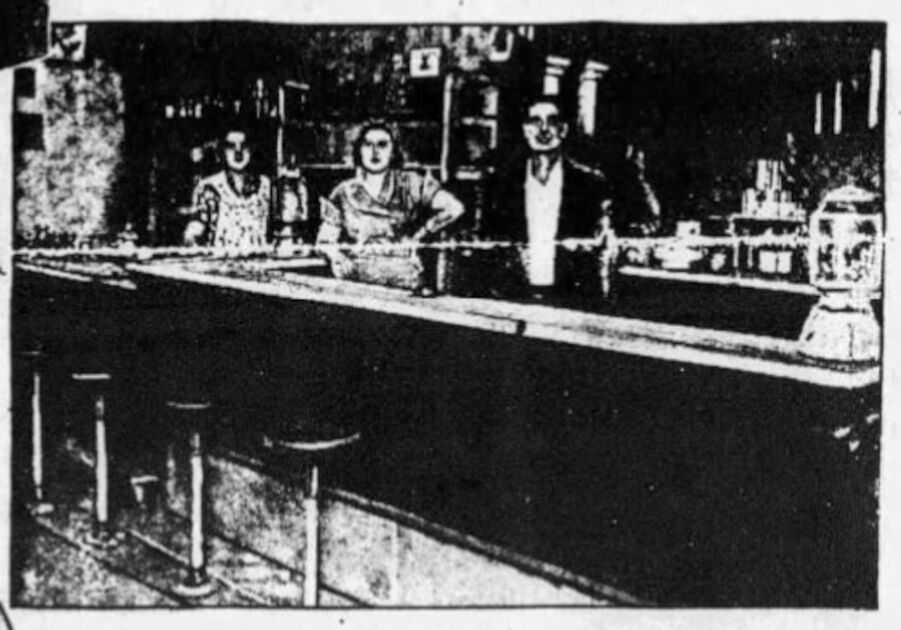
Interior of the Rank Tavern in Hopkins. Image from the Hopkins Journal, May 18, 1894.
It started, as these things often did, with a little too much bug juice and a lot too much confidence.
On the afternoon of Saturday, June 3, 1893, one William Rhodes, from the Barnard area, thundered through the streets of Maryville on horseback at a pace better suited to a frontier chase than a county seat. The clatter of hooves on dusty dirt roads drew the attention of shopkeepers and citizens alike, but when he started shooting his pistol as he rode, that was something else. Whether he was showing off, running from something, or simply under the influence of poor judgment and potent spirits, he made quite a scene. The constable did his duty and hauled the man in for disturbing the peace. After his arraignment the next morning, he pleaded guilty to discharging a firearm on a public thoroughfare, riding through the city at more than an ordinary gait, drunken and disorderly conduct, and most significantly, to dangerously disturbing the peace. All told, he was fined around $150 — or over $5,000 today!
But the story doesn’t end there. It begins again, remarkably, just hours later, when the same man, now free from the confines of justice and, one imagines, still under the influence of the same homemade liquor, was arrested a second time. This time by Prosecuting Attorney Vinsonhaler before ’Squire Schenck on state charges. The charge? Riding through town too fast. Again. Not only that, but he was charged another $159!
Maryville may not have been Dodge City, but some days it tried its best to imitate it.
A town with standards
This wasn’t how Maryville liked to see itself. As the seat of Nodaway County, complete with a fine courthouse, a proper downtown square and no shortage of civic pride, Maryville worked hard to distinguish itself from the lawless image of the “Wild West.” This was a place of judges and mayors, of schoolteachers and bank clerks. A place where order was the goal and respectability the currency. While there was not yet a university in town, it still had high standards.
But even respectability had its limits, and those limits were often tested by men under the spell of local “bug juice,” a term that graced the pages of papers more than a few times in those years. Bug juice was never defined precisely, but everyone seemed to know what it meant: something strong, something cheap and something liable to leave a man regretting his choices, assuming he could remember them.
Bug juice justice
There was no shortage of colorful episodes tied to the stuff. Arrests for fighting, shouting, throwing things or riding like one had just robbed a stagecoach, bug juice was often the unnamed coconspirator. The town’s leadership, including its long-suffering mayors and overworked constables, treated it less like a curiosity and more like an affliction. Yet each time someone ended up in the city jail or before the judge for an outburst, you could feel the subtext in the newspaper’s tone: This is not who we are.
Of course, the very need to say so meant that, on some level, it was.
Earlier that year, the tragic influence of “bug juice” was evident, when the Diagonal Railroad in Jackson Township, three miles south of Parnell, took the life of Fred Atwood in February 1893. Atwood had apparently “taken too freely of bug juice, and on his way home became sick and vomited, and seeing the (train) cars attempted to get out of the way and instead got in the way not knowing what he was doing.” He proceeded to get run over by the train and killed.
Speed, then and now
In those days, speed was measured in hooves and nerve. Riding too fast through town wasn’t just reckless. It was disruptive, dangerous and decidedly uncivil. Today, the horse has been replaced by the car, but the temptation remains. You can still hear the whine of an occasional too-fast engine on Main Street on a Saturday night.
We issue tickets now, not public scoldings. We talk about public safety, not decency. But the impulse to tame the town for its own good has never gone away.
From bug juice to bourbon
And what of the drink? Bug juice has faded from our vocabulary, but not from our experience. In its place are branded bottles, tasting notes and local distilleries that promise sophistication where once there was only heat and regret. We regulate, we label and we romanticize, but liquor remains a familiar companion in our ongoing dance with order and disorder.
The man who galloped through Maryville in the 1890s likely saw himself as free, untethered, alive. The judge saw a man in need of limits. And so Maryville responded, as it always has: not with frontier chaos, but with a little paper, a little gavel and the insistence that this town is better than that.
The streets are paved now. The rides are faster. But the story’s the same.
To learn more about the dramatic early days of Nodaway County, visit the NCHS museum. The museum is located at 110 N. Walnut St. in Maryville and is open March to December on Tuesdays to Fridays from 1 to 4 p.m. and on the second Saturday of each month from 9 to 11 a.m.
Upcoming events include a program about genealogical research with expert Tina Brown. The museum also will hold several events during the Nodaway County Fair. The museum will be open Saturday, July 12, from 9 to 11 a.m. for coffee and tours, and the museum will be open again that afternoon from 2 to 4 p.m. for its annual ice cream social, with homemade ice cream available for $5. Visitors can also explore the historic Caleb Burns House that afternoon as it will be open for guided tours.
Learn more about the museum’s work at nodawaycountymuseum.com. You can contact us at [email protected] or 660-582-8176.