Rotarian pulling rickshaw from St. Louis to Calgary
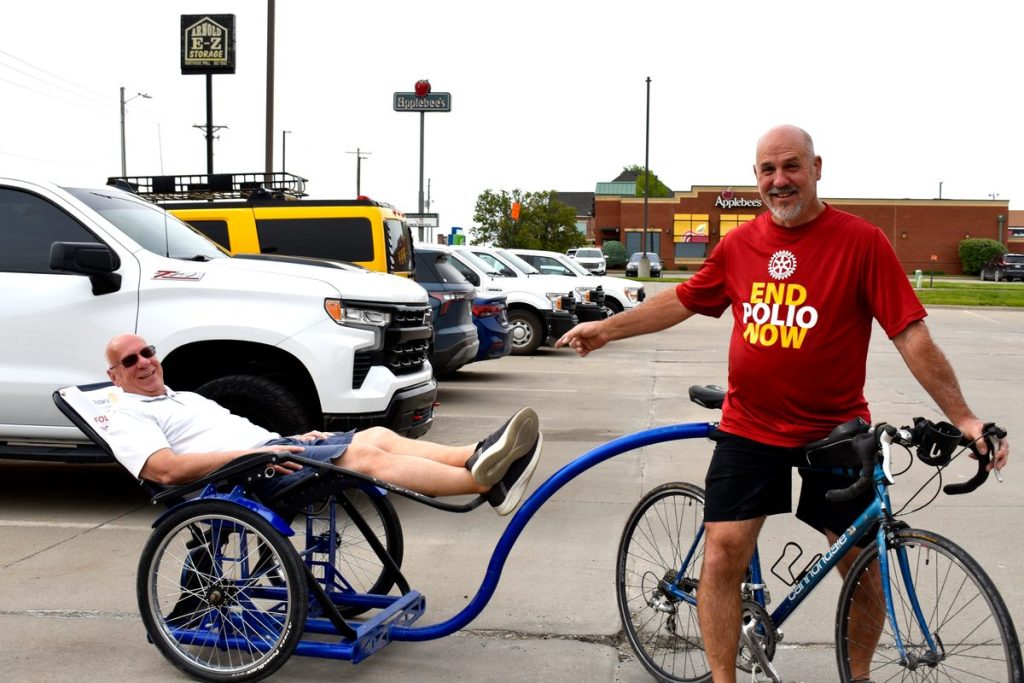
GEOFFREY WOEHLK/THE FORUM
Ralph Zuke, right, shows off his rickshaw with a game Mike Baumgartner, president of the Rotary Club of Maryville, during a stop at the Maryville Holiday Inn Express on Tuesday. Zuke is pedaling his custom-made rickshaw from his home in St. Louis to the Rotary International Convention that will be held in Calgary, Canada, from June 21-25.
MARYVILLE, Mo. — Ralph Zuke was in a bar, where so many good ideas seem even better, trying to figure out a new way to raise money for Rotary International.
He was going to ride a bike. He’d heard of that before, and he needed to get some exercise anyway. But then somebody asked him, “OK, what’s your hook?”
“Because people ride bikes everywhere,” he said. “No big deal if it’s just a bike.”
It only took him two pints of Pyramid apricot ale to come up with the answer.
“But if you throw a lounge chair on it, then it becomes newsworthy. This was the hook,” he said. “And it’s been incredibly effective — way more than I ever thought.”
That’s how he ended up pedaling a rickshaw from St. Louis to Toronto. And then from St. Louis to Houston. And this year, from St. Louis to Calgary — longer than his previous two trips combined.
Zuke is raising awareness for Rotary’s efforts to end polio across the globe and help bring in money for the cause.
With a custom-made chair in tow behind him, the approximately 1,750-mile trip (2,816 kilometers) will take about 52 days, he said. Well, maybe. “I don’t know. I just go until I get there.” As long as he’s there in time for the Rotary International Convention from June 21-25, Zuke said he’ll call it a win.
When he first made his trip to the Toronto convention in 2018, the lounge chair he rigged up weighed about 115 pounds. After working with a professional, he’s dragging a much more lightweight, aluminum rig this year at 44 pounds.
When it’s raining too hard or if a gravel road is in too rough of shape, he and Tiggs, his longtime friend and support-and-gear vehicle driver, load up the rickshaw and drive to the destination instead..
He left St. Joseph on Tuesday morning at around 9 a.m. and arrived at the Holiday Inn Express in Maryville while the afternoon pot of decaf in the lounge was still hot around 5 p.m. That’s including a midday rest.
“The challenge is really trying to stay calorie’d up,” Zuke said.
Sure enough, wherever he goes, strangers want to take a (surprisingly smooth) ride and find out what all the fuss is about.
“When we pull into a gas station, I can guarantee you I’m gonna get somebody in this chair,” he told The Forum before proving it and luring a reporter into the chair. “And the fun thing about this is that nobody gets in this chair without smiling.”
The point of it, though, is to get people interested in the reason he’s riding.
“You can’t go anywhere without people looking at it and saying, ‘All right, we need to know the story,’” he said.
The story
In 1979, Rotary International began its first effort against polio with a vaccine program for children in the Philippines. The initiative has always been aimed at children, when the illness is almost always contracted. That’s part of what has made it such an important humanitarian effort to the organization.
In 1987, in celebration of its 100th year, Rotary pledged to raise $100 million to eradicate polio, and the year after that, the Global Polio Eradication Initiative was created, now spearheaded by the World Health Organization along with Rotary, the U.S. Centers for Disease Control, the United Nations Children’s Fund (UNICEF) and The Gates Foundation.
At the time, there was no continent on Earth where polio was not endemic. Since then, the number of polio cases across the globe has dropped 99.9 percent, according to Rotary.
Today, the GPEI says there are only two countries where polio is still endemic: Afghanistan and Pakistan. Vaccinating children in those regions faces significant challenges because of how remote many of the communities are and because of political tensions.
Progress was significantly set back, for example, when in 2011 the CIA used DNA taken from syringes that were part of a Hepatitis B vaccination campaign to track down Osama bin Laden in Abbottabad, Pakistan. After that, local support for international vaccination initiatives plummeted in Pakistan and health workers were frequently targeted, officials have said.
More recently, the United States’ decision to leave the WHO and shut down the United States Agency for International Development — USAID — has left the polio initiative with $133 million less in funding this year and thrown subsequent funding and support from the CDC into question, WHO officials have said.
Isolated cases have also cropped up in other places across the world, including Europe and the U.S., as vaccination rates in some regions have dipped under the 95 percent that the WHO recommends for each global region to keep polio at bay.
Zuke said that with all that in mind, it’s really not so hard to pull a rickshaw.
“We made a promise to the world — Rotary made a promise to all the kids, at the time and in the future — that we would make this world a polio-free world,” he said. “We’re going to finish this up.”
Zuke said he’s hoping to raise at least $50,000 through his international rickshaw ride.
To donate, visit bit.ly/RotaryRickshaw. Every donation made is matched 2-to-1 by The Gates Foundation.
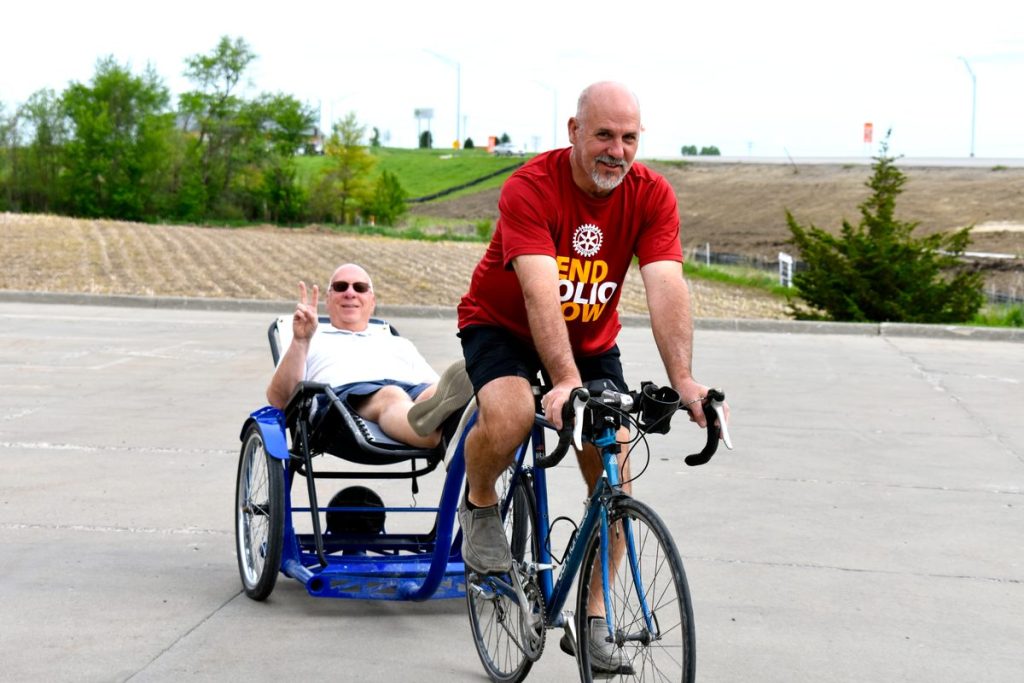
GEOFFREY WOEHLK/THE FORUM
Ralph Zuke, right, shows off his rickshaw with a game Mike Baumgartner, president of the Rotary Club of Maryville, during a stop at the Maryville Holiday Inn Express on Tuesday. Zuke is pedaling his custom-made rickshaw from his home in St. Louis to the Rotary International Convention that will be held in Calgary, Canada, from June 21-25.