
R-II board talks teacher pay schedule
SKYE POURNAZARI/THE FORUM
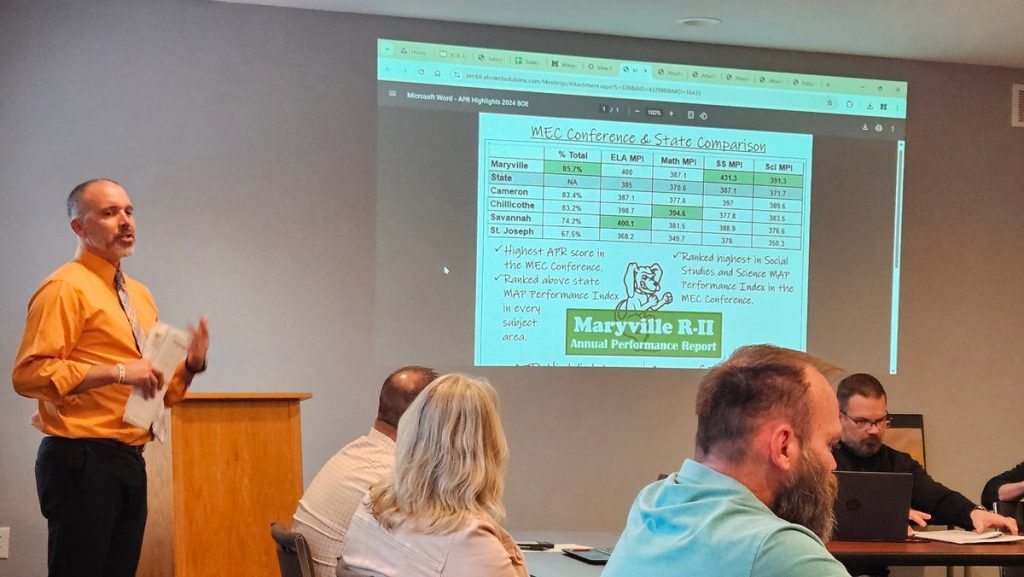
Maryville Student Services Coordinator Brian Lynn presented the district’s Annual Performance Report in comparison to other Midland Empire Conference schools.
MARYVILLE, Mo. — The Maryville Board of Education on April 16 discussed and approved (4-1) a 2025-2026 teacher salary schedule that adds $1,000 to the base pay, bringing pay for a first-year teacher to $40,750.
The board agreed this has been long overdue.
“I’m just so happy we’re up to $40,000,” board member Traci Westfall said. “It sounds stupid, but we finally got there.”
During discussion, Interim Superintendent Philip Pohren showed the board where Maryville lies in comparison with other Midland Empire Conference schools and others of the same size throughout the state.
He said that among the MEC, average starting pay during this current year (because those are the numbers available) is $42,213, while Maryville’s current staring pay was $39,750. The district’s newly approved teacher salary schedule still puts Maryville below the MEC Conference average.
“I mean, that bothers me — I’ll just be honest with you — the MEC Conference average, that we’re below it,” board member Josh McKim said.
The new salary schedule raises the salary for teachers in Step 1 or 2 about 3.65 percent, or by about $1,450. Pohren said there are about 10 teachers in these steps. Teachers in Steps 14 and 15 (four to six in the district) with a master’s degree will see about a 3.85 percent increase or about $1,875. Teachers in Step 28 (Four or five teachers in the district) with their master’s and 38 hours of education beyond it, will receive about a 5.08 percent increase or around $3,160. Pohren explained that this is due to recognizing their longevity with the district with 15 years of service or more.
“Something that (Superintendent) Logan (Lightfoot) started last year was putting about $75 more into that group so that we honor their time with the district.”
Compared to 18 schools of similar size throughout the state, Pohren’s research shows Maryville’s current pay is lower at all levels by around $2,000.
“We just gotta keep fighting through to keep taking that number up,” Westfall said.
Pohren said that teacher pay has a major impact on the district’s overall budget, and that the administration has done a great job positioning the district to continue increasing pay for staff.
“I don’t know a better investment we can make than paying teachers what they deserve,” McKim said. “I mean the very best we can. I mean that’s what we’re here for.”
And that was a major focus at the April 16 meeting for board member Isaiah Korthanke who questioned the district’s salary caps and whether it was doing enough for those teachers with a bachelor’s degree and no further education, but who have been with the district for an extended period of time.
Maryville uses salary caps at certain years of service to encourage teachers to continue their own education thus improving education offered at the school district. These caps are placed throughout the salary schedule influencing how much teachers can earn while factoring in additional compensation like years of experience and higher education degrees.
The caps also serve as a way of limiting teacher pay in some respects.
“The longer we keep the caps in, the bigger that variance becomes and the harder it is to fix it,” he said.
Korthanke said that last year a teacher in the higher number steps got a 5 percent pay increase, while a person in the lower number steps with a bachelor’s degree only got a 1.8 percent increase, “which isn’t even keeping up with inflation.”
He compared Maryville’s caps at 10 and 15 to Savannah’s cap at year 20.
“So I could see where we’re losing teachers,” Korthanke said. “So the possibility of losing teachers who say, ‘OK, year 10, I might go down to Savannah because they’re gonna gimme an increase for another 10 years.’”
Pohren further broke down the staff distribution into levels of education, showing that 41 teachers, or 29.3 percent, have a bachelor’s degree. Nine (6.4 percent) teachers have a bachelor’s degree plus 16 hours of more education.
Fifty teachers, 35.7 percent, have a master’s degree. Eighteen teachers (12.9 percent) have a master’s degree plus 16 additional education hours. Twenty-two teachers (15.7 percent) have a master’s degree plus 32 more hours of education.
“So the cap is my biggest concern for retention,” Korthanke said. “Just these 41 teachers looking forward that are in that (lowest degree level) now, looking at that and saying, ‘Well, in 10 years, I’m tapped out unless I go back to school.’”
Westfall said these teachers got into education with the knowledge that to increase their pay over time, they would have to go back to school and continue their education. She said the schedule is always available for teachers.
“You still want to incentivize them to continue, but you don’t want to be forced,” said board president JR Kurz.
Korthanke said with the 10-year cap, the district is basically telling teachers that they’ve peaked unless they go back for more education.
“So you’re saying a kindergarten teacher has to go back and get their master’s to get further education to get paid more,” he said. “Instead, I would like to say … that teachers with 15 years in with a bachelor’s are good teachers.”
He said going back to school at $500 per credit hour is cost prohibitive to teachers who are making the lowest in the district, just to be able to increase their future pay.
“I think what Isaiah’s saying has a lot of merit,” McKim said. “I think it’s something we probably need to discuss pretty in depth. I agree with you, Isaiah. If we are gonna look at changing it, pushing it down, down the road another year only makes it harder to do it the following year. But I also don’t think it’s something we can decide tonight.”
He suggested the board hold a work session where members can fully evaluate the costs associated with making changes to the schedule. Board member Kelley Baldwin suggested this topic be discussed at the board’s retreat in June.
SRO program
The board briefly discussed its School Resource Officer program and the possibility of adding another SRO position to the district.
Board member Isaiah Korthanke said he had been in contact with a couple Maryville City Council members to discuss how the school and the Maryville Police Department could work out contract details for a second SRO to serve in the school district. He believes the city may also be interested in renegotiating the city/school pay percentage split. Korthanke said the city plans to discuss it at its next meeting, scheduled for Monday, April 28.
He said Maryville Police Chief Mike Stolte told him that department staffing is somewhat of an issue right now, but that he believed there would be interest within the department to serve at the school district.
Other news
- The board reorganized following a nonelection in the April 8 municipal election. McKim and Mitch Coffelt took the oath of office for their new terms. Board member JR Kurz was elected president and Missouri School Boards’ Association delegate. Coffelt was elected vice president and MSBA alternate. Westfall continues as the 2025-2026 Fraud Risk Committee representative.
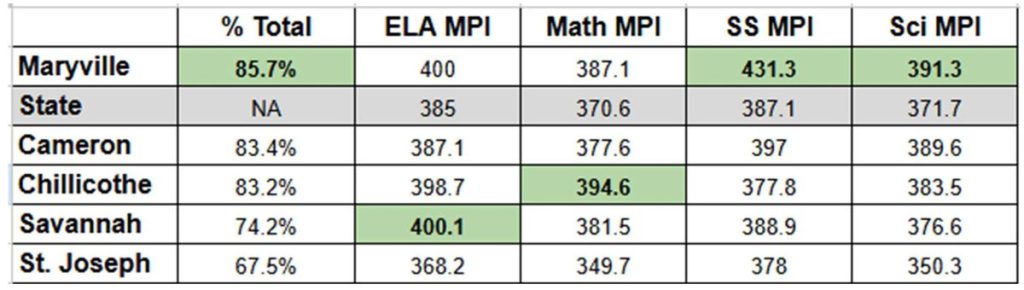
- Maryville Student Services Coordinator Brian Lynn told the board that the district’s Annual Performance Report compares well with the other Midland Empire Conference schools. Maryville led the MEC Conference in total points with 85.7 percent, Cameron scored 83.4 percent, Chillicothe 83.2 percent, Savannah 74.2 percent, and St. Joseph 67.5 percent. While Maryville didn’t lead every category, it did lead in social studies and science.
- The board approved the 2025 graduate list.
- The board accepted several bids including orientation and mobility services, occupational therapy services, physical therapy services, portraits, concrete replacement and asbestos abatement. Pohren recommended awarding the asbestos abatement bid of $25,000 for mechanical removal to Insco Environmental, of Shawnee, Kansas. He explained that mechanical removal is likely to work better than chemical removal. The board approved the bid.
- In regard to portrait companies, Pohren said that he heard from several parents unhappy with their portrait packages offered by the district’s current photographer. The board approved a bid from Lifetouch which offers its lowest package price of $19.
- The board approved the low bid of $63,840 from Andrew Spire Construction LLC to remove/replace concrete throughout the district. At the Maryville High School, an area west of the Multipurpose Building is being removed, and the discus pad will be removed and replaced. At the Maryville Middle School, 2,690 square feet of 6-inch thick driveway and west sidewalk will be removed and replaced.
Personnel
Resignations
- Brylie Abrams, EFES paraprofessional, effective May 9
- Lindsay Eckert, MECC paraprofessional effective at the end of school year
- Gabi Argo, EFES paraprofessional at the end of the school year
- Abby Clawson, youth development worker, effective April 25
- Mya Southwell, youth development worker, effective April 24
- Stacy Eychaner, MMS eighth grade math teacher, effective at the end of school year
- John Ammons, assistant basketball coach, effective at end of the school year
- Korena Sundell, paraprofessional/substitute, effective at the end of the school year
Reassignments for the 2025-2026 school year
- Chelsea Wells, MECC special education teacher to MECC teacher
- Wendy Miller, MECC special education paraprofessional to MECC paraprofessional
- Kaylyn Sander, MECC paraprofessional to EFES attendance secretary
- Jessica Oelze, EFE paraprofessional to MECC paraprofessional
- Sarah Pedersen, EFES counselor to NTS counselor
Recommendations for employment for the 2025-2026 school year, unless otherwise noted
- Kaitlin Dunkin, EFES first-grade teacher
- Emma Harper, youth development worker for remainder of the school year
- Zach Lynch, youth development worker for remainder of the school year
- Jackie Spire, MECC paraprofessional
- Morgan Lee-McGinnis, MECC paraprofessional
- Nicole Williams, MECC special education teacher
- Grace Pemberton, youth development worker for remainder of the school year
Extra duty assignments
- Trevor Townsend, seasonal maintenance position starting May 13
Compensation for salaried positions
- Thom Alvarez, MHS principal
- Bryan Grow, MHS assistant principal
- Matt Webb, athletic director
- Kate Lydon, MMS principal
- Erin Hageman, MMS assistant principal
- Chelli Green, EFES principal
- Laura Tobin, MECC director
- Jeremy Ingraham, NTS director
- Amanda Haile, administrator of AEL
- Brian Lynn, student services director
- Craig Borey, special education director
- Maddie Dowis, EFES assistant principal
- Philip Pohren, interim superintendent
SOURCE: MARYVILLE R-II SCHOOL DISTRICT
The above chart shows Annual Performance Report results from schools in the Midland Empire Conference based on each category of student assesment results.

SKYE POURNAZARI/THE FORUM
After April’s nonelection, Mitch Coffelt and Josh McKim are sworn in by Maryville R-II Board of Education Secretary Jenn Judd at the April 16 board meeting at the district office.




