
Tatum addresses Northwest students about DEI cuts
GEOFFREY WOEHLK/THE FORUM
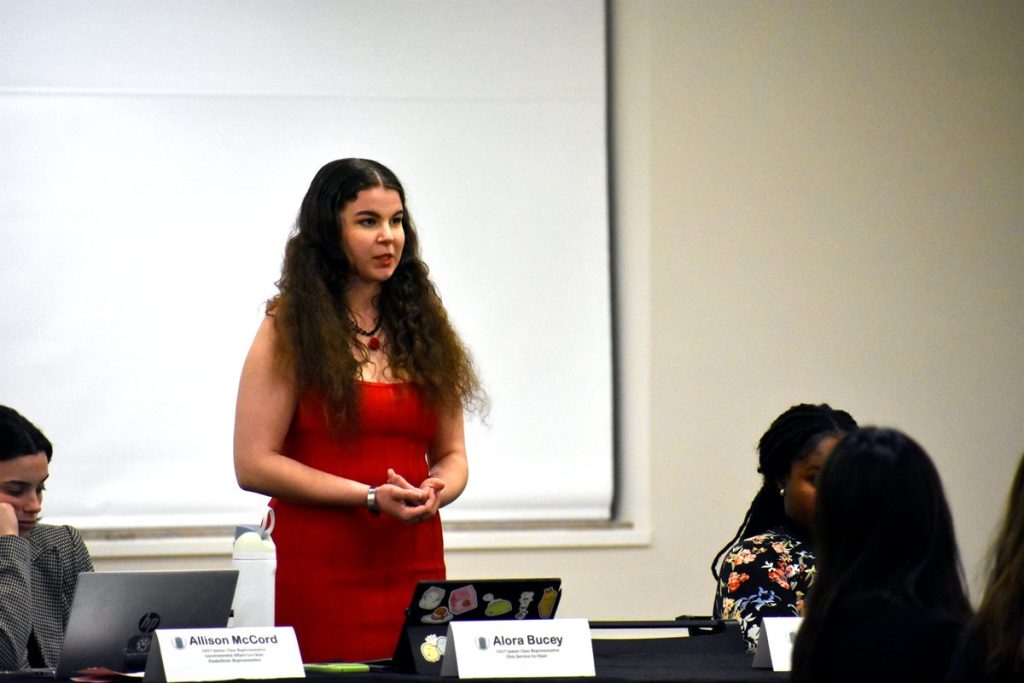
Northwest Student Senate member Alora Bucey asks a question during a Q&A with President Lance Tatum on Tuesday. Students expressed frustration with Tatum’s handling of the dissolution of the Office of Diversity and Inclusion.
MARYVILLE, Mo. — Northwest Missouri State University President Lance Tatum said Tuesday that the university’s abrupt decision to dissolve its Office of Diversity and Inclusion last week was due to pressure from state legislators that threatened the school’s “autonomy.”
During a town-hall-style meeting held during the regular Student Senate meeting on Tuesday evening, Tatum framed the sudden timing of ODI’s dissolution on Feb. 3 and the limited communication about the move as a decision that was out of his hands.
The university president largely tried to put an optimistic spin on the future of the initiatives that had been spearheaded by ODI, saying that it is an opportunity to broaden student engagement programs to address more groups of students and enhance student retention efforts.
Shay Malone, formerly the assistant vice president for diversity and inclusion and now the assistant vice president of institutional excellence and global engagement, will head a working group of faculty, staff and students to help sketch out the future of Northwest’s student success and engagement programs.
“I know it looks rushed, and, to be honest with you, it was probably about 45 to 60 days ahead of when I planned to announce,” Tatum said during the meeting. “But unfortunately I didn’t get that chance.”
Chaotic rollout
Last year, proposed legislation in the state General Assembly spurred the University of Missouri to axe its diversity, equity and inclusion programs and shuffle those initiatives into a larger reorganization. It was a warning shot to every other state university that change would eventually come to them, too.
NEXT STEPS
- Some programs will be picked up and broadened by the Office of Institutional Excellence and Global Engagement
- Office of Diversity and Inclusion employees have been reassigned
- The physical former ODI space will remain open
- Shay Malone, assistant vice president of institutional excellence and global engagement, will lead a working group made up of faculty, staff and students to steer future initiatives aimed at assisting students more broadly and increasing student retention
- Institutional scholarships are not affected
- Some scholarships through the Northwest Foundation will need to be adjusted to comply with federal laws around DEI
Over the past six months, leaders at Northwest had been having preliminary discussions about what they might need to change to comply with state and federal mandates about DEI programs that hadn’t yet been issued. They were looking to do something similar to the University of Missouri and broaden its initiatives to target more groups of students along with an organizational reshuffle, Tatum said Tuesday.
But he admitted that the university was caught flat-footed when the dominoes fell all at once.
On Jan. 29, Missouri State announced it was closing its Office of Inclusive Engagement immediately.
The next week, state leaders turned their sights on Northwest, according to Tatum. That in itself wasn’t a surprise.
“I mean, the governor has already come out in his State of the State and said, ‘We’re not doing DEI in this state. We’re not doing it. We’re going to eliminate it.’
“I think that was a pretty clear signal where all of this probably was eventually going to find itself.”
But the timing meant that Northwest didn’t have a plan in place yet for how to transition to a new model for programs that were being led by the Office of Diversity and Inclusion.
On Monday, Feb. 3, Tatum sent an email to faculty and staff about the university’s larger departmental reorganization plan, which included a paragraph about dissolving the Office of Diversity and Inclusion.
The office’s social media accounts were taken down and the office’s page on the university’s website was changed to “Global Engagement.”
Just prior to sending the email, Tatum said he met with ODI employees to assure them that their jobs were safe and briefed the presidents of Faculty Senate, Staff Council and Student Senate on the change. But the news went public almost immediately after the email was sent — faster than Tatum said he thought it would — making for a chaotic rollout.
It wasn’t until Monday — a week later — that Tatum publicly addressed the situation with another campus-wide email that provided more information on the changes.
Tuesday, Tatum took the blame for the fumbled communication and said he regretted not giving more time to the three presidents to disseminate the information to their constituency leaders.
Student backlash
However, the only statement released to the public at that point was the one paragraph that did not go into detail about what the effects would be. The information vacuum resulted in a swift backlash from student leaders, many of whom were critical of Tatum for not seeking student input earlier and for not effectively communicating the change.
“So I think our frustration is there was no communication,” said Lili Bryant, a student ambassador who takes prospective students on campus tours, during Tuesday’s Q&A. “We came in on Tuesday morning (Feb.4) and that space was gone. The social media was gone.
“As an ambassador, we were told not to refer to that space, that it wasn’t ODI anymore. So there was an immediate change without students being notified.”
Tatum said that he had hoped sending the information to faculty and staff first would “help students, particularly those most deeply impacted, have people that they could talk to.”
But in practice, no one had answers.
“I was sitting in the ODI when (the email from Tatum on Feb. 3) was released by the (Northwest) Missourian,” said Maria Nino-Elliott. “I had four students come to me, crying, and they had no faculty to talk to. I didn’t have any answers. I had nowhere to point them.”
In defending the brief Feb. 3 email, Tatum said, “I wished I could’ve waited a week, but I wasn’t given that chance.”
Legislative pressure
Instead, Tatum said he had to be in Jefferson City on Feb. 4 to meet with House and Senate members at 7:30 a.m. That meant he wasn’t around the day after his email announcing the dissolution of ODI.
“The timing of it was not something that I created, it was something that I had to deal with,” Tatum said. “You know, if I had my druthers, I’d probably do it a little bit different way, in some ways. But in the moment, there just didn’t seem like there was a whole lot of flexibility.”
Tatum declined to get specific about what mandates came from state leaders, but stressed to students during Tuesday’s Q&A that he felt he didn’t have a choice. That’s also why, he said, student leadership didn’t have input before the Feb. 3 memo.
“There’s too much wrapped around it that threatens certain parts of our ability to make decisions on our own,” he said, so no input from any group was going to change what had to happen before he met with legislators the next day.
Later, Tatum told The Forum that if the university did not dissolve ODI on Feb. 3, “There probably would have been a lot of conversation around, ‘What are our plans for DEI?’”
Legislators made explicitly clear to him, he said, that some remedies would not be enough to appease them, like simply renaming the office.
“They are tightening down all the things that have been used in the last probably three or four years to try and navigate through this,” Tatum told The Forum.
Instead, the university will retain its “autonomy,” a theme Tatum returned to often during Tuesday’s meeting, and will be able to reorganize largely as it sees fit.
“You know, honestly what’s at stake is where (legislators) come in and they say, ‘We’re gonna create a law that will prevent you from honoring heritage months,’” Tatum told The Forum. “And then I’m like, ‘Well, I have students who are very deeply connected and invested in that.’ Well, we’re not gonna do that.”
It’s the same choice every other university has made so far when targeted by state legislators, especially when “the hammer,” Tatum said, is probably a “loss of state funding.”
According to state budget data, about a third of Northwest’s annual budget comes from state appropriations. While Tatum didn’t directly equate the dissolution of ODI to keeping state funding intact, Missouri State President Richard B. Williams seemed to do just that in a statement on Jan. 29 announcing the dissolution of that university’s Office of Inclusive Engagement.
“As a university, we value diverse thought and actions and support all our students, faculty and staff,” Williams said. “However, 38% of our budget comes from the state. For us to continue providing a quality education to our students, we must align with the requirements laid out by state leadership.”
Looking ahead
Tatum said multiple times on Tuesday that it isn’t clear yet what the reorganization is going to look like for initiatives previously handled by ODI.
A working group led by former ODI head Shay Malone, now the assistant vice president of institutional excellence and global engagement, will include faculty, staff and students who will work through the rest of the semester to come up with a new structure for implementation by July 1, the beginning of the state’s new fiscal year.
The group will focus on finding new opportunities to help forge stronger ties between different groups of students and the university, Tatum said.
“And I really see it as an opportunity, because we were serving students, but we were not serving a large number of students as it relates to cultural interactions,” Tatum told The Forum. “We have a lot of students on campus who don’t go to certain events or don’t go to certain activities because, A) they don’t know about it, or B) they’re not sure if that is for them. So the idea is to broaden this out.”
Malone said that one thing the university will look to do is encourage student organizations and clubs to take on some of the programming formerly handled by ODI.
“Something I’ve done at other institutions is call it ‘Identity 365’ — you can’t use the word ‘identity,’ but maybe ‘Global 365’ — (which) is celebrating identity all throughout the year and not just during the heritage months,” Malone said during Tuesday’s meeting. “Because oftentimes the only time you see programs about the African diaspora is during Black History Month, right? But we wanna see those programs throughout the year and not just those programs in the heritage months.”
Other than a general shift toward student-led programming, Tatum said he was reluctant to offer up any other possibilities in case “later on, we can’t maneuver it.”
Tatum assured students that Title IX services won’t be affected and the diversity, equity and inclusion academic minor offered by the university will still be available for students. Scholarships offered by the institution will not be affected, he said, but some scholarships offered through the Northwest Foundation will be because of some criteria donors have placed on scholarship awards. They’re still working with the foundation on bringing those scholarships into compliance with federal law.
Tatum stressed that although the structure of the organization will change, the idea is to continue to offer the same services that are meaningful to students, but find ways to broaden those programs even further.
“I will tell you this, universities are, by their nature, diverse places,” Tatum told The Forum after Tuesday’s meeting. “Not everybody that goes to Northwest is coming from Maryville. They’re coming from Kansas City, they’re coming from southwest Iowa, they’re coming from Omaha, they’re coming from other countries. We’re recruiting student-athletes from California and Arizona — this is a melting pot. It is by its nature a melting pot.
“So what I always express is that you can’t take diversity out of a university. It exists whether you call it that or not, because we’re all different — we all come from different places — and I truly think that the value we provide students here is the opportunity to learn and to be exposed to other ways of thinking.
“That’s not a bad thing.”
GEOFFREY WOEHLK/THE FORUM
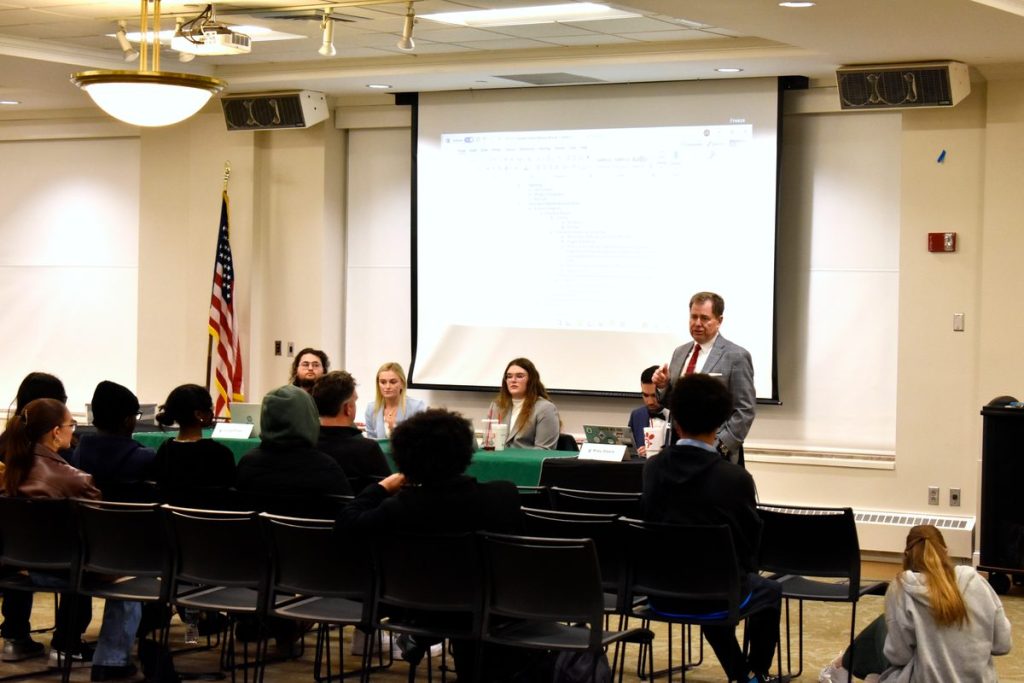
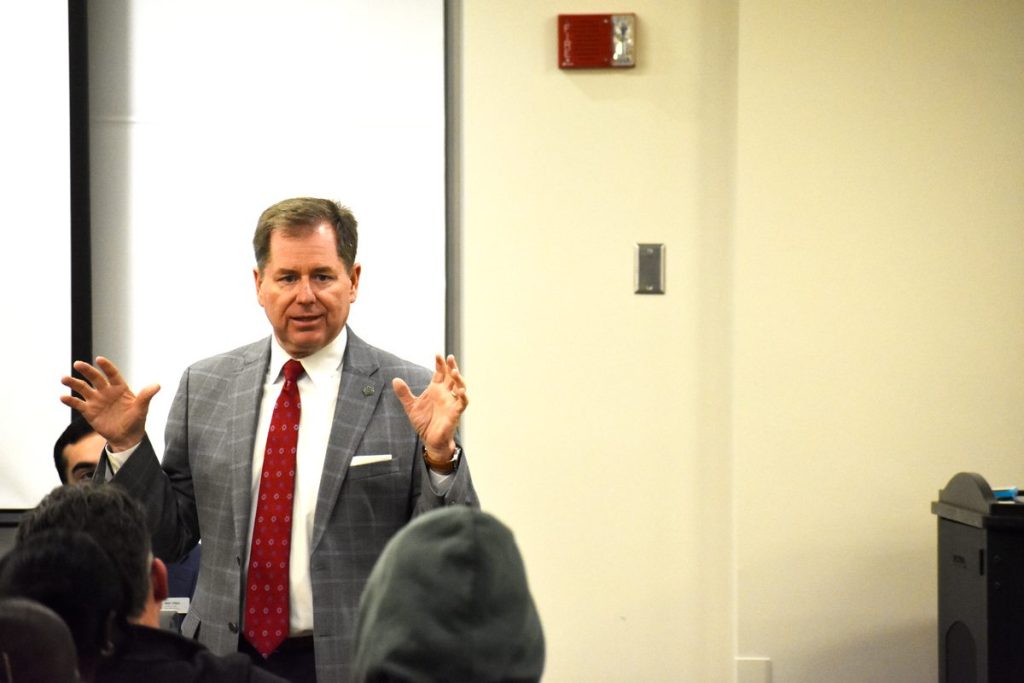
Northwest President Lance Tatum spoke during a Student Senate meeting on Tuesday, taking questions from students during a lengthy Q&A to discuss the dissolution of the Office of Diversity and Inclusion.
NORTHWEST MISSOURI STATE UNIVERSITY
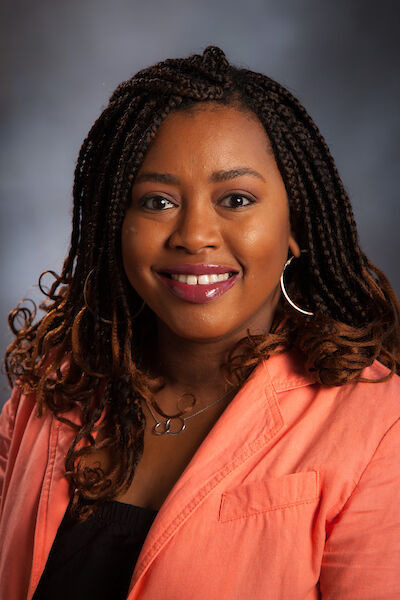
Shay Malone Assistant Vice President of Institutional Excellence and Global Engagement
GEOFFREY WOEHLK/THE FORUM
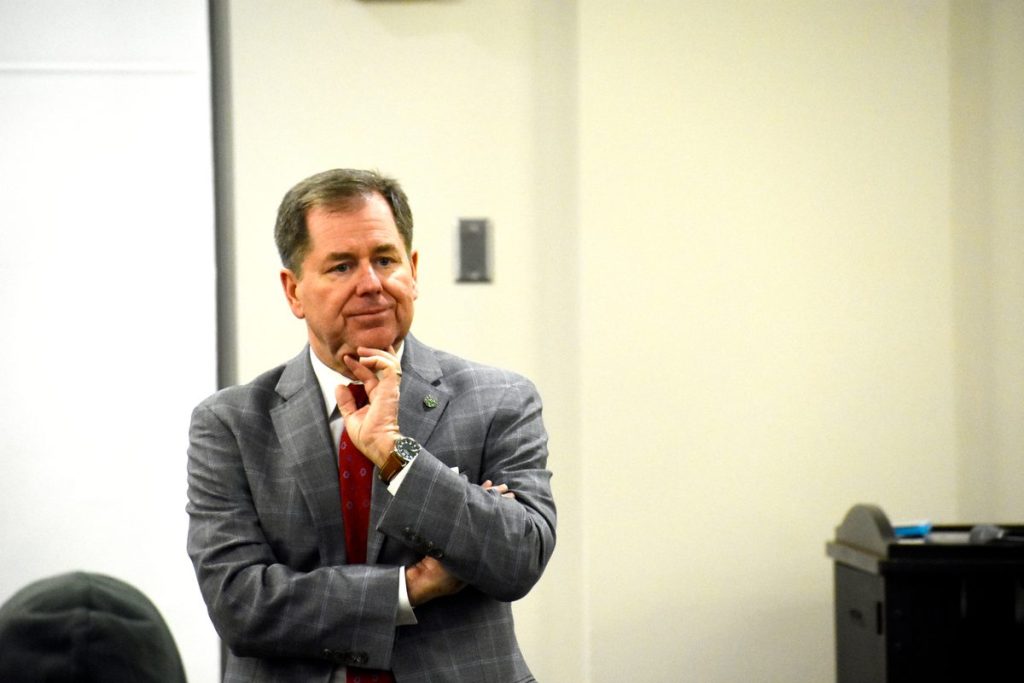
Northwest Missouri State University President Lance Tatum during a Student Senate meeting on Tuesday evening answered questions from students about the university’s dissolution of the Office of Diversity and Inclusion.
GEOFFREY WOEHLK/THE FORUM
Northwest President Lance Tatum repeatedly said during a Q&A with students on Tuesday that dissolving the Office of Diversity and Inclusion was necessary to protect the university’s “autonomy.”




