Education is key in battling scammers
Scam Series Finale artwork
MARYVILLE, Mo. — Scammers continue to persist in attempting to take hard-earned money from unsuspecting people and after a year of focusing on the issue locally, it appears knowledge and education is the answer to combat it.
SERIES INFORMATION
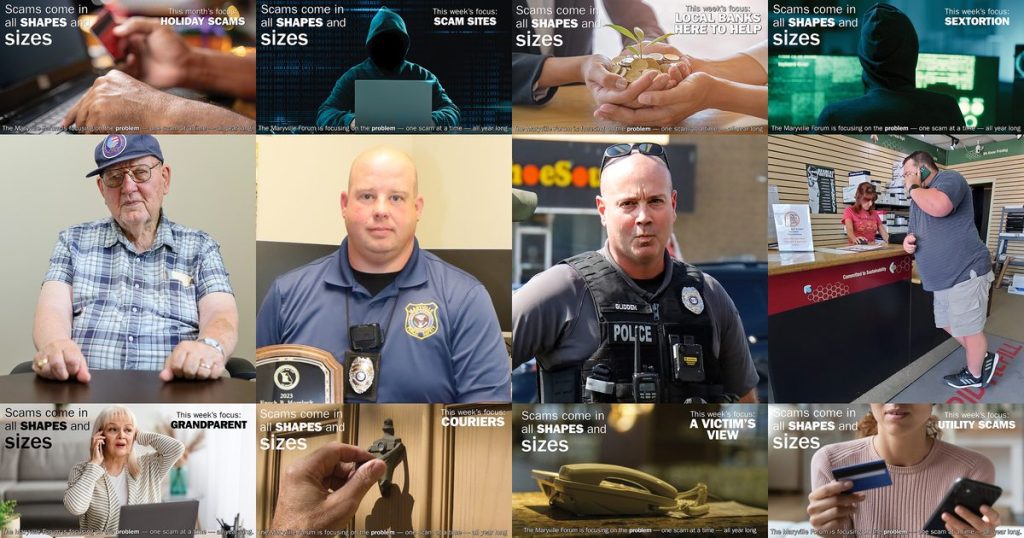
This is Part 12 of The Forum’s yearlong series about scams. With the ever-evolving nature of scams, new AI tech and faster communication, people of Nodaway County and northwest Missouri are falling victim, losing more than a million dollars to scams over the past five years.
The Forum is diving into the specifics of some of the most prevalent scam types being used in Nodaway County today, red flags to look out for and what local law enforcement, businesses and financial institutions are doing to stop the scams before they happen.
Find the previous stories at maryvilleforum.com/news/scams.
In 2024, The Forum put forth special effort in a 12-part series to focus on scams, their outcomes and the people who have been harmed by them. With help from the Maryville Police Department, the Nodaway County Sheriff’s Office, local banks and a local shipping retailer, The Forum was able to track down the facts, figures and feelings surrounding the scam industry, the many ways in which it occurs and local people who have had to go through the traumatic experience of being scammed and losing money.
Sgt. Adam James, detective with the Maryville Police Department, told The Forum in an email that while the department continued to encounter scam incidents, law enforcement did observe a notable shift from the previous year.
“Throughout the year, as scam articles were released monthly, I identified 16 formal reports submitted to our department, in addition to 53 calls from victims who opted not to file reports,” he wrote. “The total financial impact of these scams reached $51,466.11.”
When comparing to 2023, James said the department managed 20 scam cases and received 90 complaints from victims who opted not to file formal reports. The amount taken from victims totaled $377,788.55.
The recognizable difference led the detective to express the need for greater community awareness regarding various types of scams and how they function.
“Throughout the year, I was invited to speak for five different groups, and (Detective Sgt.) Ryan (Glidden) and I also conducted two additional sessions,” James said. “The attendees felt that these engagements were valuable, demonstrating a strong interest in scams by asking many questions and giving feedback that highlighted the significance of the information shared. A number of participants had been keeping up with the monthly scam articles.”
James reminded people that law enforcement is available 24 hours a day, seven days a week.
“We encourage individuals not to feel embarrassed to discuss their concerns or seek assistance,” he said. “I am always open to meeting with anyone at any time to talk about scams, especially if it helps prevent them from becoming victims.”
He noted that reports over the years show there are countless and ever-changing scams, however, some of the most prevalent in this community appear to revolve around false romance schemes, Facebook Marketplace fraud, fraudulent computer pop-ups and cryptocurrency ATM machines.
Significant funds being taken from the community
Each month The Forum focused on either a different aspect of a particular scam, a different scam or a victim who told their story. The Forum kicked off its yearlong series with a conversation with scam detection experts James and Glidden about how they are helping victims of scams and watching the number of them rise year-to-year.
“That money is coming out of our community and actually it’s so much more because people don’t report it,” James said at the time.
Over the past five years, James and Glidden said MPD has handled reports in which victims have lost a total of $1,221,940.54 to scammers. This doesn’t account for reports not made, or reports made to the sheriff’s office or the Northwest Missouri State University Police Department.
In February, The Forum focused on sextortion scams targeting local minors. James and Glidden said this type of scam — which typically targets young males and involves the threat of releasing compromising photos he has sent to the scammer — has been reported locally.
The Kansas City Division of the FBI said the scam works because selected victims are young males who don’t often go to their parents or friends to report the occurrence. Scammers can access so much information on social media then pressure the youth into sending money so their friends and family members don’t receive the typically potentially embarrassing photos.
Glidden told The Forum in February that sometimes it’s only after the victim has run out of money that they go to someone for help.
“They’re embarrassed,” he said at the time.
March and April: “pig-butchering” scam and Publishers Clearing House
In March, The Forum dove deeper into a local ongoing court case involving a woman who flew to Kansas City and drove up to Maryville to allegedly further defraud a Maryville man as part of a long-term “pig-butchering scam,” as the FBI calls it, that had already cost him about $190,000.
That’s what made the scam so rare, James told The Forum in March. At that time, it was the only local case that he and Glidden are aware of where someone has come to physically pick up cash used in a scam.
The case is still ongoing, with the suspect’s next court date set for Jan. 6, 2025.
In April, a local woman mustered the courage to talk about her ordeal with a scammer that saw her not only lose a considerable amount of money, but also made her uncomfortable in her own home and embarrassed to talk about it.
The Forum withheld her name so she would feel comfortable telling her story, referencing her as Talula.
Talula fell for a Publishers Clearing House scam due to the phone scammer’s incredible skill to make her feel like speed was necessary and that it was important to keep quiet about her “winnings.”
After purchasing large gift cards to pay “taxes,” and sending a cashier’s check for $44,000 from her savings to allegedly pay the IRS, the scammer had Talula get a title loan for her car and attempt to get funds from her retirement account.
“I wasn’t able to eat, it made me sick,” she told The Forum. “And, of course, I couldn’t sleep, so I was tired and I was sick and stressed. … I couldn’t tell anybody nothing. … But they (the scammers) were basically bankrupting me.”
Before the scam began, Talula had a bank account with $57,000 in it. By the end of this ordeal, it was empty, and she was in debt. After reporting the crime, officers worked with banks and the cashier’s checks were able to be stopped and much of Talula’s funds were able to be retrieved.
Just over a year later, Talula said she finally feels financially secure again. Her advice to people who may receive this kind of call?
“Just don’t answer the phone (if you don’t know the number),” she said.
May and June: Banks on the lookout, victim talks about his ordeal
The Forum spoke with a couple bankers in May about their perspective on scams and the ongoing battle to keep funds secure.
Local Southern Bank manager Mandy Felton talked with The Forum noting that the bank finds around four to five different possible fraudulent charges per week.
“… I’ve had so many tears in this office,” Felton said, explaining that more often than not it’s the shame of realizing what they’ve fallen for that hurts the most for people she’s had to tell they’ve been scammed.
At U.S. Bank, Assistant Vice President Megan Johnson is focused on helping customers.
“We’re there to protect you,” she told the members of the Maryville Rotary Club in February. “… It literally can happen to anybody,” she said. “And if it happens to you or if it happens to a loved one, don’t be ashamed. Don’t be embarrassed. Ask for help, because it can really spiral, super, super quick.”
In June, Maryville resident Roland Tullberg bucked the trend of being embarrassed and spoke on the record with The Forum about the scam that cost him $4,000 — and very nearly $27,000 more.
Tullberg was initially wary, but he soon began to consider what good he could do with the $19.9 million he had been told he won in a sweepstakes by a smooth-talking man who used his nickname, “Rollie,” and began to ingratiate himself into his life, promising to make him a multimillionaire.
“The guy that was talking to me, he was so convincing,” Tullberg said. “These people, they practice, they research.”
Now Tullberg has been open about his ordeal, speaking at Men’s Forum about it and to anyone interested.
“I was bamboozled,” he said. “I was convinced beyond all reasonable doubt that I had won millions of dollars. … They know how to do it and they do it with precision and skill. … I got taken in and I don’t want other people to be taken in and lose their funds.”
July and August: Shipping cash, grandparent scam
In July, The Forum just happened to be in the right place at the right time talking to Rapid Elite owner Matt Gaarder about his staff’s work to stop scammers when Rapid Elite employee Terrilynn Wilson felt the small hairs on her neck perk up which led to stopping a man from being scammed out of money.
A man referred to as “Friedrich,” to protect his identity at his request, stopped in to send an envelope. After he left, she held up the envelope and felt the bottom.
The two said overnight shipping is a red flag since many scammers are waiting for the tracking number to take control of the package’s destination.
The staff at Rapid Elite have never yet been wrong when contacting police about a potential scam victim trying to ship large quantities of cash, they said.
James said that Rapid Elite has “played a crucial role in preventing a confirmed loss of $7,500 this year,” in addition to the unmeasured value of other cash packages caught by staff.
Gaarder called police and an officer arrived to take possession of the item. Following some research at the Maryville Police Department and a conversation with Friedrich, officers returned the funds.
Friedrich, who lives outside of Maryville in Nodaway County, spoke with The Forum about spending some time on dating websites, where he was used to running into scammers. But, this situation was different, Friedrich said.
“But, this one lady I’ve been talking to, she never has — like I told (the officers) — she never did ask me for money,” he said. “I volunteered to help her out.” Friedrich said it was talking to the officers that convinced him to see the relationship was a scam. Over a few weeks, Friedrich had sent the woman $1,200. Rapid Elite and MPD saved him $1,800 that day in July.
“You just gotta be cautious,” he said. “Until you really get to know them, you gotta take whatever they say with a grain of sand, because they’ll lie to you.”
As classes picked back up at Northwest Missouri State University in August, so did the potential for scammers seeking to separate grandparents from their money.
Emergency scams, also known as “grandparent scams,” work because a scammer preys on the willingness of an unsuspecting, worried individual to help friends and family members in a dire situation.
These scams start with scammers mining social media for information and then calling or texting someone impersonating their family member in distress. They may say they’ve been arrested or there was an accident, medical emergency or other difficulty, and they’re in need of money. Sometimes the scammer even sends a photo that appears to look like a mugshot.
“It does happen here,” said Detective Glidden.
He told The Forum about one particular case a few years ago in which a local grandmother showed up at the police station searching adamantly for a specific law enforcement officer. One that did not exist.
“The scammer had given her a fictitious name,” Glidden said. “I visited with her. She had all these notes. … I was able to track down her granddaughter on campus.”
He asked her to come down to the station. Immediately, the stressed grandmother asked if she was all right.
“Even though (the grandmother) could now see her, she was still convinced she needed help,” Glidden said.
Nothing had happened to her granddaughter, who was also very confused about the entire situation. Not all the local cases — which have all had a similar story — ended so well.
September, October and November: Utility scams, fake websites and holiday scams
In September, The Forum focused on utility scams.
“Pay NOW to avoid disconnection!” “Click this link to verify your utility account TODAY!!” These are just a few of the numerous ways in which scammers attempt to gain access to your financial information. They also pose as utility workers at your door, and on the phone threatening service interruptions to obtain immediate payment or more private information like your Social Security number.
“It’s nonstop,” Capt. Austin Hann with the Nodaway County Sheriff’s Office told The Forum about scams.
He said that utility scams aren’t something the sheriff’s office sees often, because they’re not typically reported to the office.
United Electric Cooperative and United Fiber also hears from its members about scams. Amy Ziegler, chief public relations officer with United, told The Forum that the company hears from members at least once a month questioning a contact they have had with someone calling them.
“The most recent scam was a member who was told he received a free iPad from us via email,” Ziegler said. “It was asking for his information in order to claim the iPad.”
She said the most common scam involves a scammer calling a member saying their bill is past due and asking for a credit card or checking account number over the phone.
In October, The Forum talked with detectives James and Glidden about fake websites. Whether buying through Facebook Marketplace, Craigslist, eBay or any other number of websites listing items for sale, scammers are on the lookout for every way possible to separate a buyer from their funds and offering incredible deals on absolutely nothing.
“If it looks too good to be true, it probably is,” Detective Glidden said. “… This is something, I think, that people need to watch for.”
Based on investigations in multiple jurisdictions, he said there’s been an uptick in fraudulent website advertising of the sale of heavy machinery and farm equipment as of July 2024.
“The websites and the criminals operating them go to great lengths to appear legitimate, and their tactics are becoming increasingly sophisticated and difficult to detect,” Glidden said.
He said scammers use fake websites, sometimes even sites cloned from real businesses, to lure in prospective buyers. Scammers exploit legitimate sites with little to no internet presence to use authentic information, thus appearing more legitimate.
“And sometimes things turn out to be legit, but any more you just can’t take things at face value,” Glidden said.
In November, the FBI and Better Business Bureau, among numerous others, work to inform the public about potential new scams. And as the holidays arrive, the truth is abundantly available regarding holiday scams.
The FBI warns online shoppers to be wary of too-good-to-be-true ads promising expensive goods at low prices.
The BBB found that reports are up more than 125 percent from last year, in part driven by items popular on social media, such as beauty products and viral sensations.
Gaarder at Rapid Elite said that his business, like all shipping services, will see an increase in shipping during the holiday season.
“The holidays, when you’re talking about scams, we’re always on higher alert, because of two things,” he said. “People are in more of a giving mood and people are so busy that sometimes they’re just trying to get through stuff and quick. They don’t always think through it.”
Lessons learned
Detectives James and Glidden continue to express the need for community awareness of scams and both have reiterated the adage, “If it sounds too good to be true, it probably is.”
“It’s essential for readers of this year-long series conclusion to compare the numbers from last year to this year within our small community,” James said. “I’m confident that looking back at previous years will show a similar trend with 2023 over 2024. The increased public awareness generated by this scam series and the accompanying talks has contributed to positive changes. I urge those who have gained insights about scams from the published articles and discussions to share their knowledge with others, as education is clearly making a difference.”
If someone suspects a family member or friend has been scammed, the earlier they reach out to law enforcement the better.
Call the Maryville Police Department non-emergency line at 660-562-3209 to report a possible scam.