VFW awards essay, speech contest winners
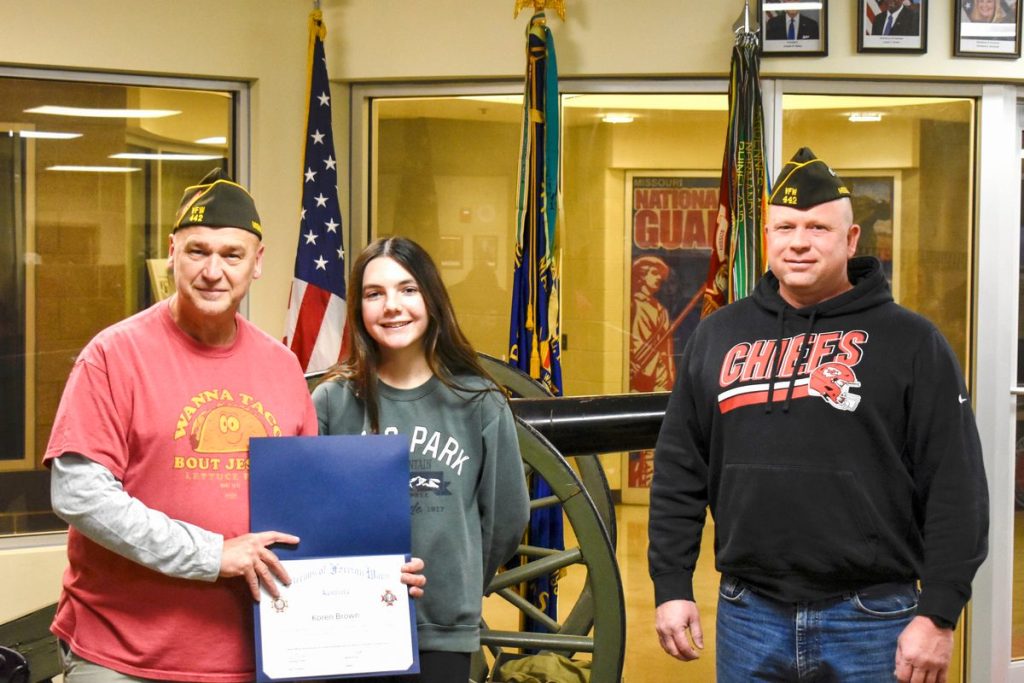
GEOFFREY WOEHLK/THE FORUM
Koren Brown, center, an eighth grade student from St. Gregory Barbarigo Catholic School, won first place in the local VFW Patriot’s Pen Essay contest. She received a certificate on Wednesday from Program Director Jeremy Cobb, left, and VFW Post 442 Commander Josh Wilmes, right.
MARYVILLE, Mo. — Local winners of the Veterans of Foreign Wars’ Patriot’s Pen Essay and Voice of Democracy audio essay contests received their awards from members of the Seth Ray David VFW Post 442 on Wednesday.
Patriot’s Pen
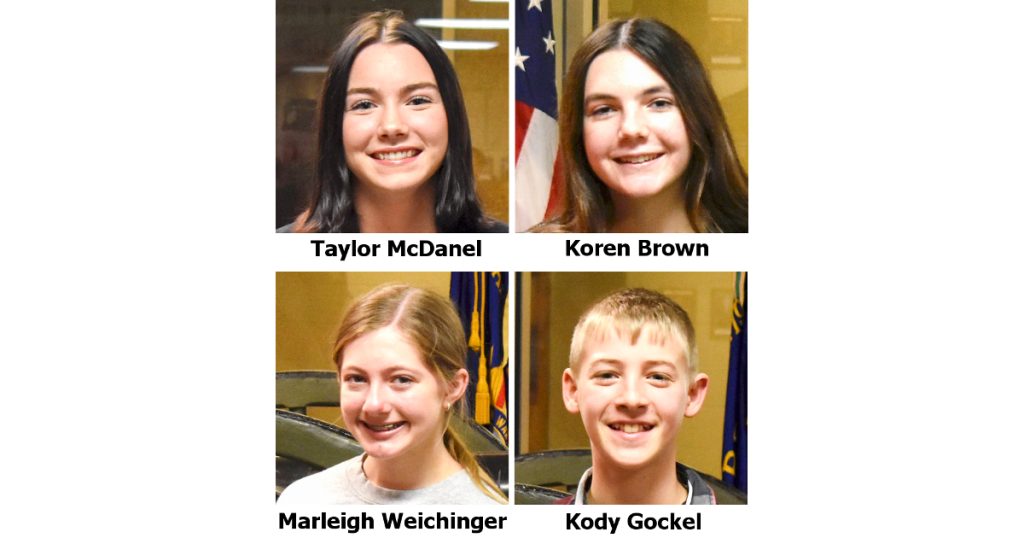
According to a news release from the VFW, Koren Brown, an eighth grade student from St. Gregory Barbarigo Catholic School, won first place locally in the Patriot’s Pen essay contest. Brown received a certificate and $100. The runner-up was Marleigh Weichinger, a sixth grade student from St. Gregory Barbarigo, who received a certificate and $50. Third place went to Kody Gockel, a seventh grade student from St. Gregory Barbarigo, who received a certificate and $25.
Each essay was based on this year’s theme, “My Voice in America’s Democracy?”
The Patriot’s Pen youth essay competition began in 1995 as a way to encourage young minds to examine America’s history, along with their own experiences in modern American society, while improving their writing skills, the news release stated. The worldwide competition gives students in grades 6-8 the opportunity to write an essay between 300 and 400 words on a particular theme that changes each year expressing their views on democracy while competing for awards and prizes.
More than 27 students participated locally in the Patriot’s Pen competition this year. Brown, as the first-place winner, advanced to the district competition and will compete to move on to state. At the national level, students compete for individual awards ranging from $500 to $5,000.
Voice of Democracy
Taylor McDanel, a Maryville High School junior, will serve as the local representative in the 2024 Voice of Democracy audio essay competition. McDanel received a certificate and $200, and will advance to the districtwide competition.
The Voice of Democracy worldwide audio essay competition requires entrants to write and record a 3-to-5-minute essay on a patriotic theme that changes annually. This year’s theme was “Is America Today Our Forefathers’ Vision?”
The National Association of Broadcasters started the Voice of Democracy scholarship program in 1947, according to the news release. The VFW became a national sponsor in the late 1950s and assumed sole responsibility for the program in 1961. The competition was created to provide students in grades 9-12 the opportunity to express themselves in regard to democratic ideas and principles. Around 40,000 students participate in the competition each year and the VFW awards more than $2.1 million in scholarships each year, the release stated.
The first-place essays are below.
My voice in America’s democracy
By KOREN BROWN
Patriot’s Pen
Many other kids my age feel as if we don’t have much of a voice in our democracy because we can’t do things like vote or run for positions in the government, but there’s so much more we can do now other than that. I already do basic things like having a flag hung outside my house, saying the pledge, and having political signs in my yard. Those are just normal things that most people already do. Occasionally, I even go out to the polls with my parents when they vote. Even though I can’t vote myself, I can still try to stay educated and aware about situations relating to my country. If there’s a new policy, law, or concern, I try to learn what I can about it, so I can stay informed.
Lots of people wouldn’t specifically think about staying informed when it comes to having a voice in America’s democracy, but it’s very important. When I’m finally old enough to vote and be a part of these decisions, knowledge of the topic is necessary to make a rational decision. Even if I weren’t voting, staying informed about politics is helpful because I’m able to form my own opinions and confidently share information relating to our country. Sharing information is also another way I have a voice in our democracy. I can use it to make sure people are receiving factual information and to influence others to rethink their opinions. Something as simple as having a conversation with someone about my personal opinions might change their beliefs or who they may be voting for.
Besides staying informed and doing common things like hanging flags, I also have a voice in my democracy by being involved in my own community. For smaller choices like decisions made by my school, I’m allowed to voice my own opinion on it and contribute directly to what happens. It’s very helpful because it gives me practice on how I can pitch in once an adult.
Even though most of what I’m able to do for America’s democracy at 13 might seem small, over time it all really adds up. What I do now has an effect on our country in some way. Regardless of who I am, I can still have a voice in America’s democracy.
Is America today our forefathers’ vision?
By TAYLOR MCDANEL
Voice of Democracy
When posed the question, “Is America Today Our Forefathers’ Vision?” an immediate yes or no answer is unrealistic. The first of many steps we need to take in discovering an answer to this question is defining our forefathers’ vision. Our forefathers hoped for a better society, not a perfect one. Whether or not someone believes America’s current society is better than that of 1776’s is wholly up to them. This leads me to my personal answer that I hope to help you understand: America today is a loosely interpreted version of our forefather’s vision due to the amount of gray area within our successes.
America carries out the 14th Amendment of the constitution through the allotment of same-sex marriages, which are becoming more popular within American society, a prime example of current-day America meeting our forefathers’ vision of society transforming throughout the years. Our forefathers knew that our society would change and hoped for improvements such as this, rather than homosexual people being shamed for their sexuality. Though, on the same subject, other citizens have abused their First Amendment right by shaming couples in these same-sex relationships. Despite our Supreme Court interpreting this amendment, adding that slander is unconstitutional, people expressing hate words towards these couples are not being punished, leading to tension within society. This is a prime example of how current-day America does not meet our forefathers’ vision, turning our society against one another, which lays out the gray area within one of many societal topics.
One ongoing political battle between citizens and the federal government is whether or not to end affirmative action. Affirmative action is the requirement for a certain percentage of workers to be historically discriminated against minorities. This topic poses the critical issue of how to respect every citizen’s rights. When a percentage of people being historically discriminated against minorities is required, you deny other people’s rights. When you don’t guarantee historically discriminated against minorities jobs, you deny them the equality they deserve, as they have been rejected of this right in the past. Though, citizens and the government are working together to find a solution to this issue. The government is wholeheartedly taking American citizens’ opinions into account, which is why the decision has not yet been made. This power balance has been a constant struggle within the United States, leading to stress within the country’s society, which is the opposite of our forefathers’ intention for societal advancement. Though, citizens and the federal government are working together to make this decision, which is exactly what our forefathers intended for societal advancement.
A popular social media platform in the United States is Instagram, created by Kevin Systrom and Mike Krieger. Their intention in creating this app was to provide people with new, creative ways of communication. Instagram has substantially done so, that is until its political content limit was established. This platform restricts everyone but approved accounts to publish posts regarding their opinions on political matters, which could arguably be a violation of the First Amendment. Not everyone has equal rights to speech and expression through the restriction of political posts. Though, the restriction of political posts could reduce online arguments over the matters. This would reduce tension within society. Our founding fathers would not want our First Amendment to be limited through new technological advancements, such as social media platforms, but they also wouldn’t want to view tense arguments over political matters.
The question of whether or not America today meets our forefathers’ vision cannot be answered concretely due to the many political issues existing within American society, such as the three above. There are both agreeable and dislikable aspects surrounding each topic. Related to this statement, I have three questions for you to ponder over, in order for you to form your own opinion on the matter. First: Is the allotment of marrying someone you love being a packaged deal with slander and shame what our forefathers truly wanted for our country? Second: Is the stressful power balance between historically discriminated against minorities and other people what our forefathers wished for our country? Finally, third: Would our forefathers have wanted us to have our speech limited through modern-day advancements of technology, such as Instagram? As you ponder these questions please consider that our founding fathers hoped for a better society, not a perfect one. Current-day America is doing its greatest to maintain the greatness of our country, and our founding fathers would admire our achievements, no matter the gray area within them.
GEOFFREY WOEHLK/THE FORUM
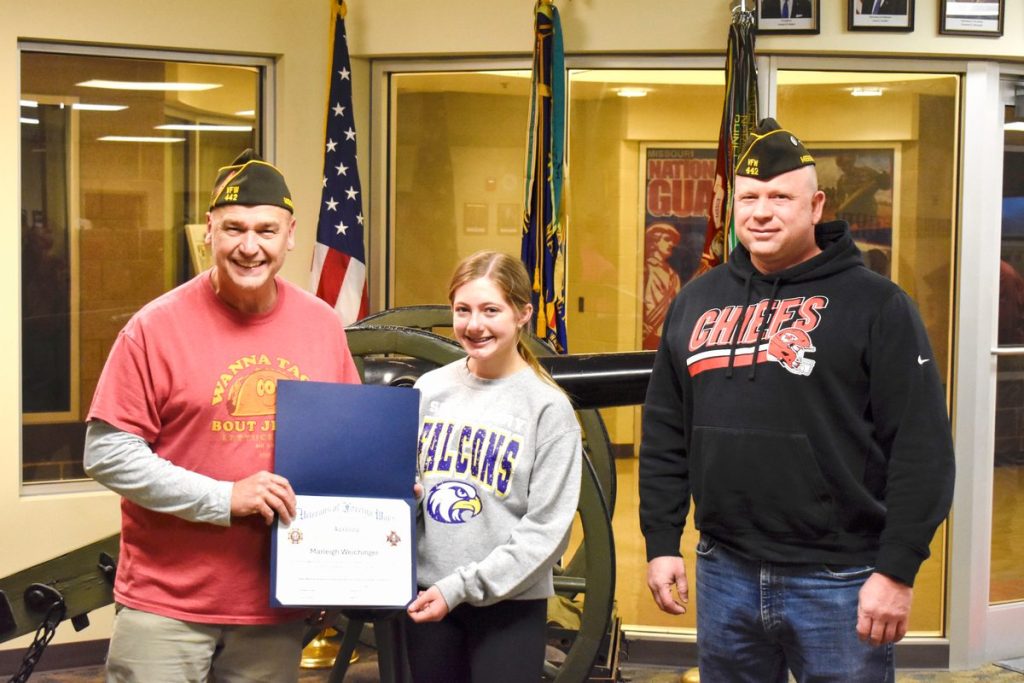
Marleigh Weichinger, center, a sixth grade student from St. Gregory Barbarigo Catholic School, won second place in the local VFW Patriot’s Pen Essay contest. She received a certificate on Wednesday from Program Director Jeremy Cobb, left, and VFW Post 442 Commander Josh Wilmes, right.
GEOFFREY WOEHLK/THE FORUM
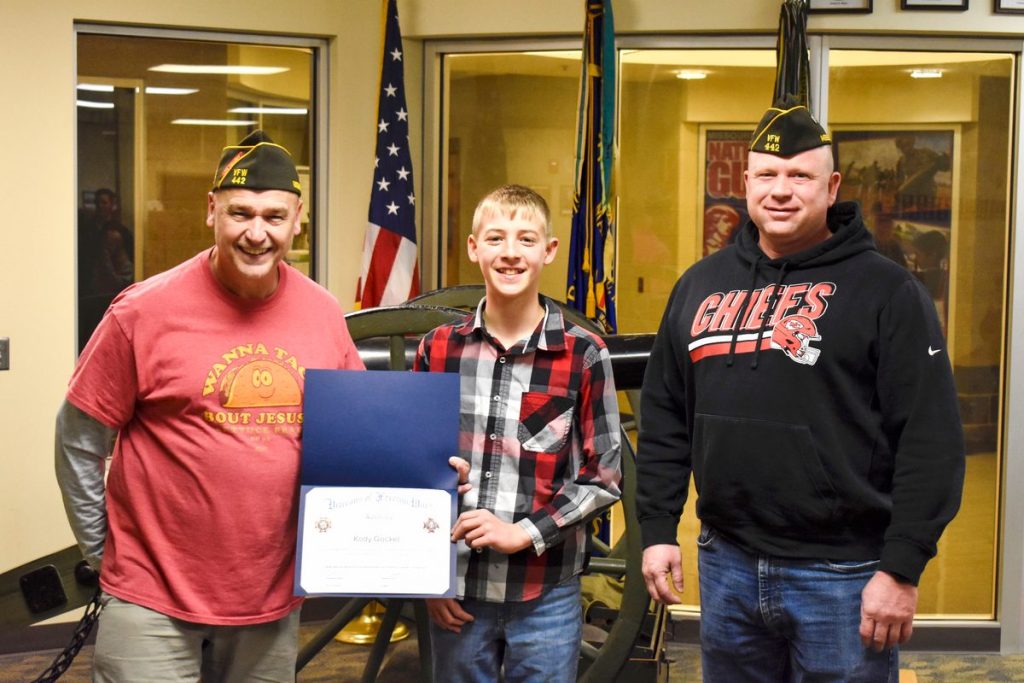
Kody Gockel, center, a seventh grade student from St. Gregory Barbarigo Catholic School, won third place in the local VFW Patriot’s Pen Essay contest. He received a certificate on Wednesday from Program Director Jeremy Cobb, left, and VFW Post 442 Commander Josh Wilmes, right.
GEOFFREY WOEHLK/THE FORUM
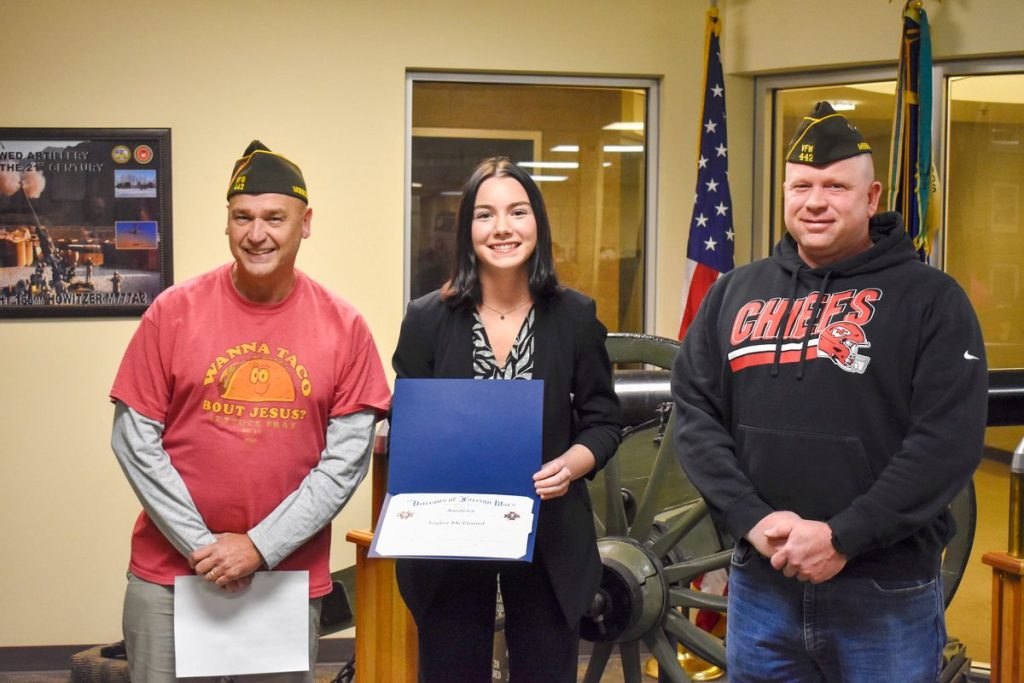
Taylor McDanel, center, a junior at Maryville High School, won first place in the local VFW Voice of Democracy audio essay contest. She received a certificate on Wednesday from Program Director Jeremy Cobb, left, and VFW Post 442 Commander Josh Wilmes, right.
VFW contest winners