Northwest students create downtown walking tour
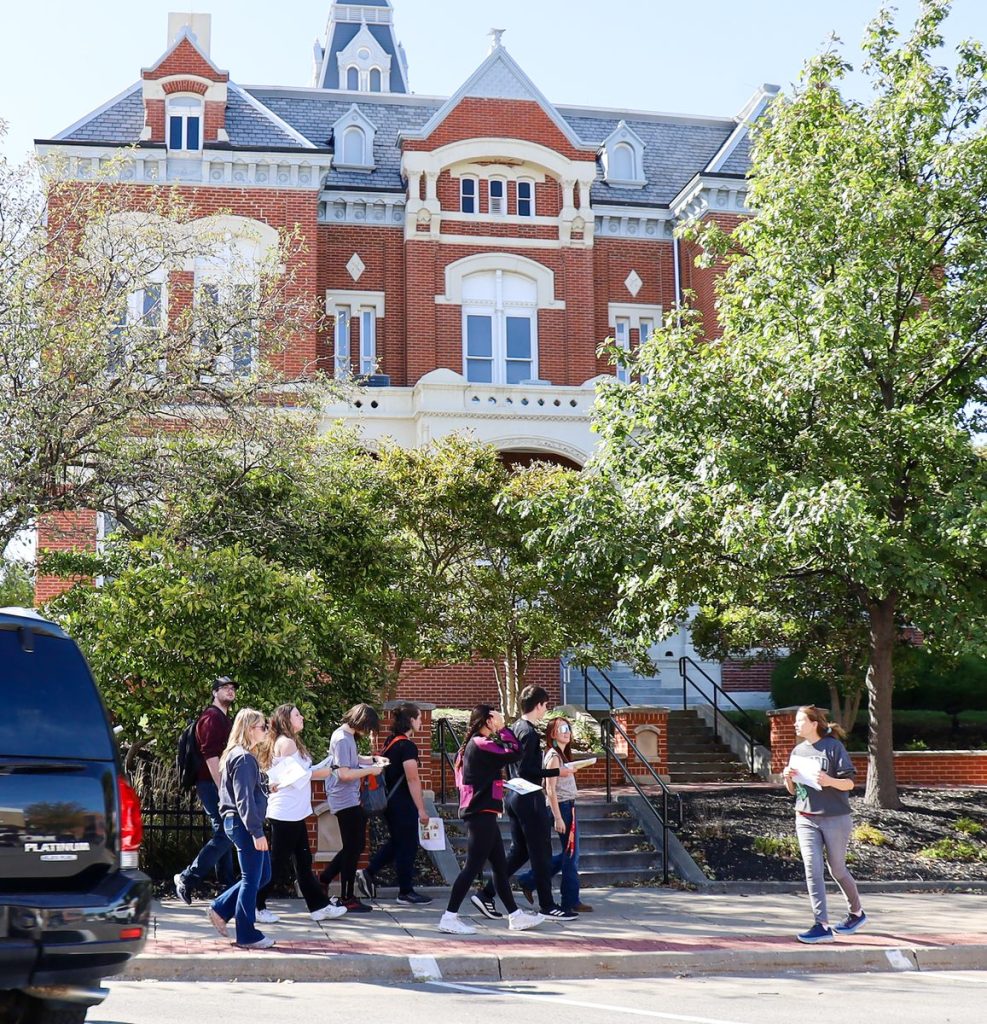
SKYE POURNAZARI/THE FORUM
Elyssa Ford, professor of history and coordinator of the Public History & Museum Studies Program at Northwest Missouri State University, leads a group of students in the U.S. History Since 1877 course around the downtown Maryville square in early October. As part of a class project, the students created an online walking tour of downtown.
MARYVILLE, Mo. — Twenty-five Northwest Missouri State University students toured downtown Maryville, researched its buildings and created an online walking tour filled with historic information available for the public.
“Learning about more local history helps make history feel more tangible and relevant, and the students have responded enthusiastically to the focus of the class this semester,” Elyssa Ford, professor of history and coordinator of the Public History & Museum Studies Program at Northwest Missouri State University, said in an email to The Forum.
Focusing on local history in the honors section of the U.S. History Since 1877 course allows the students to learn more about the community and the wider region where they are living while in college, she said.
Each student was assigned one building and spent a couple weeks utilizing historic Sanborn maps; fire insurance maps available for Maryville from 1886, 1891, 1900 and 1909; the Nodaway County Historical Society Museum; and digitized newspapers available through the university library and online at newspapers.com to create the online tour.
Ford said that using Clio, an online educational website that is free, which helps guide the public to thousands of historical and cultural sites throughout the U.S., according to its website, made the process fairly simple for the 25 students to work separately, but combine their gained knowledge in one place.
“We are so lucky today in the twenty-first century to have digital tools like this available to us because it helps make classrooms more engaging and it allows us to create projects that can be made publicly available,” Ford said.
Freshman Mara Franklin, who is majoring in marine biology and minoring in Spanish, told The Forum in an email that she researched Kris and Kates, the restaurant and ice cream parlor, as her part of the walking tour.
“I enjoyed learning about the history of this area and the businesses that once occupied this same spot in downtown Maryville,” she wrote. “… This project was unique, as going to a relatively small high school I have never done anything similar to this. I was able to gain new skills and research strategies in a fun way through this project!”
She said that while the class is not directly affiliated with her declared major or minor, she is “extremely grateful” for the opportunities it offered her to grow and learn.
“This class is excellent about teaching (we) students not only history in a broad sense, but also specific examples in Nodaway County. This allows me to be educated on the history of this town as an out-of-state student.”
In her second year at Northwest and seeking a degree in human services, Illyana Vesel told The Forum that she was responsible for researching the Office of the Public Defender in the blond brick building next to the modern day Burny’s Sports Bar on the corner of North Market and East Third streets.
While she doesn’t really have any interest in history and doesn’t enjoy research, she did think it was interesting to see how often the building she researched changed over the years.
“Many modern businesses like to advertise how long they’ve been open for, but my building changed its roles several times,” she said. “It updated with transfers of ownership, but also with what the town needed during the time period.”
She said this assignment was different than others because it offers a real-world purpose instead of being archived in a grade book and forgotten. She said the research was also different because the documents used were maps and old newspapers, instead of peer-reviewed articles and juried papers.
“I would highly recommend going on the walking tour, or at least reading through it,” Vesel said. “There is plenty of interesting stuff for anyone who has an interest in the history of Maryville. I would also like to say thank you to Dr. Ford for putting all our submissions together!”
Ford said that as long as the Clio website stays funded, the walking tour will remain available for the public and for possible updating as necessary.
“The students have put together a fantastic walking tour, but it is only the start as there certainly is more detail that can be added in the future,” Ford said. “… We encourage folks — both locals and visitors — to get out and explore the history of the area!”