Two local veterans talk Veterans Day
SUBMITTED BY BOB WESTFALL
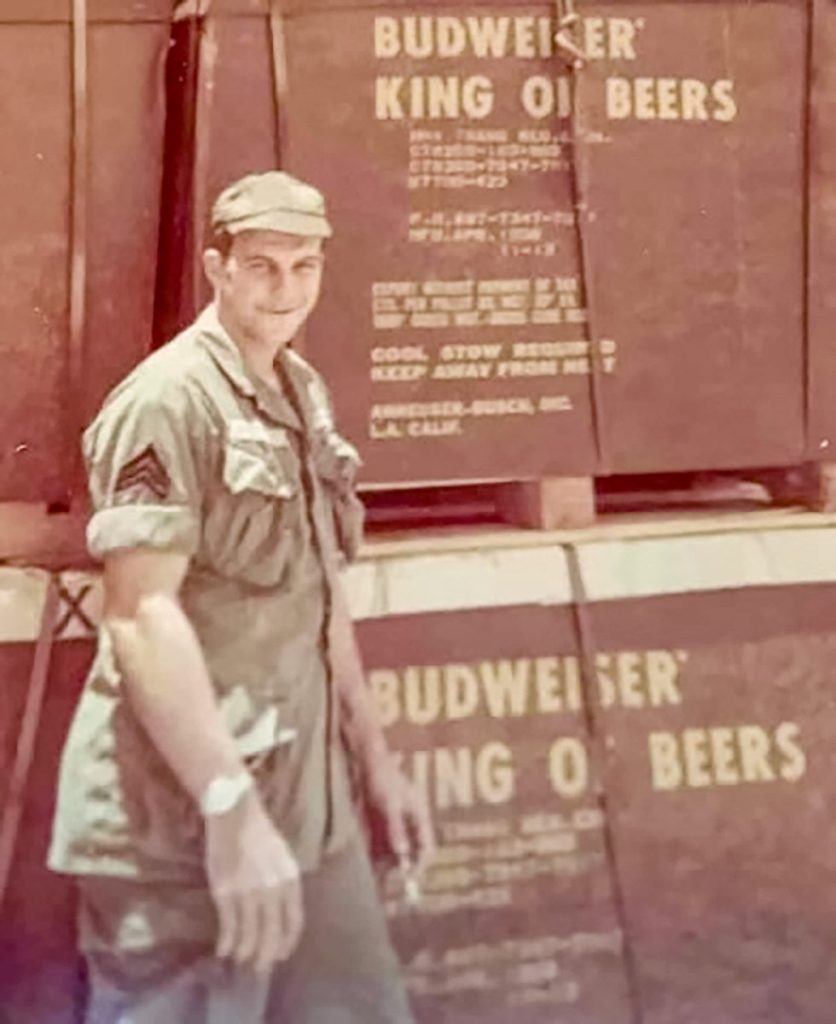
Bob Westfall is shown during the Vietnam War alongside crates of Budweiser shipped to his supply depot for distribution to Army troops.
One unseasonably warm, late October afternoon, seated on the porch of a house located on a block in east Maryville he has called home nearly his entire life, Robert “Bob” Westfall sat down with me for a wide-ranging, casual conversation about military service, beer, family, life in Maryville, life in general and just some reminiscing about the past over a couple of cold beverages while taking in the view from Bob’s porch.
You probably know Bob, or know of Bob, but if you don’t, here are some highlights from what he would be hesitant to call his life spent in service of others.
First and foremost, Bob is a husband, father and all-around family man. He’s also a U.S. Army Vietnam War veteran. And prior to serving as Nodaway County north district commissioner for 12 years, he worked in the oil industry, specializing in pipeline construction for 36 years.
He’s a member of the American Legion, Maryville Host Lions Club, Maryville Elks, the Maryville Forum Editorial Board, a former member of the Maryville Parks and Recreation board — and these are just the tip of the iceberg.
Earlier this fall, Bob was recognized with the Greater Maryville Chamber of Commerce Spearhead Award and went on an honor flight to Washington, D.C., along with three other veterans. He was in the midst of life-saving cancer treatment in his second battle against the disease.
He told me the highlights of the trip were the war memorials and the 9/11 Pentagon Memorial.
“Well, all the (war) monuments, especially the Vietnam (memorial) with the 58,000 names on it, we probably spent more time there,” he said. “Everybody was looking for different names and different things.”
Westfall said another highlight of the trip was the visit to Arlington National Cemetery, where they witnessed the changing of the guard.
“That was very neat,” he said. “When we were driving around and then when we were flying out, we could see all those graves. I mean 600 and some acres of monuments. It’s not like 600 acres right here. It’s up hills, it’s unbelievable. I don’t know how if you were somebody that was looking for somebody — I’m sure there’s a way to find it — but, boy, some of those would be hard to get to.”
Westfall then talked about some of his family’s service, including his uncle who served in the Naval Reserves during World War II and Korea.
“He couldn’t march when he went in, but he was very smart,” Westfall said. “He’d gone to college here and was out in California teaching at a junior college and (the Navy) sent him to Florida to give classes on cloud formation and different things. He had (Major League Baseball Hall of Famer and World War II veteran) Ted Williams and there was another baseball player that he had (in his class), and he said, ‘Yep, they were good at blowing their clouds.’”
Around that point in our conversation it was time for adult beverage Round Two.
When he returned with another cold, frosty one, the attention briefly turned to my service in the military, of which I served nearly seven years in the United States Marine Corps (1991-1997).
When people ask me about my time in the military, I tell them the truth: I didn’t do anything special, but I worked with and for a lot of people who did a lot of special things. There was nothing about my service that was extraordinary; I didn’t have to overcome anything.
Bob said that during the course of his latest cancer treatments, he has been receiving numerous visits from people he hasn’t seen in quite a long time and that had sent him thinking about his own service.
“I felt pretty lucky where I was in Vietnam and before that,” he said.
Bob said one of those visitors was someone who also served in Vietnam.
“They were asking if anybody knew how to type, and I said yes. Well, that was the best thing. They sent me to typing class, and then I got to be a clerk, more or less, over in Vietnam. And he said, yeah, I did that, and by golly, it worked all right. It’s funny how things work out sometimes.”
Bob and I swapped several stories about our service in the military.
One comedic instance Bob brought up was he was on kitchen duty for the Thanksgiving meal when General Abrams came to visit.
“I had to eat salami,” he said. “I didn’t get no turkey. But the salami was almost as good as Nodaway Packing. Almost.”
A longtime reader of the Maryville Forum and its previous iterations, Westfall received the newspaper while in Vietnam and one of his fellow soldiers who was from New York enjoyed reading Westfall’s hometown newspaper. Due to slow mail service at the time, Westfall would routinely receive at least a half-dozen issues at a time. His buddy even learned something about Bob’s wife, Carolyn, before he did.
“We had bunks next to each other and I’d throw down the paper and he’d read it. He got to where he’d read the Maryville paper. And one day he says, ‘You didn’t tell me your wife had a wreck.’
“I said, what? ‘Yeah. Second and Market Street. She went through the stop sign.’ And I said give me that stuff. He was reading the paper before I was. She hadn’t told me that.”
In one of the only times I posed a direct question the entire afternoon, I asked Westfall what Veterans Day means to him.
“Oh, freedom,” he said while looking over at Happy Hollow Park from his front porch, which is located in the basically one-block area he has spent most of his life living on. “It probably means a little bit more this year because I’ve been sick.”
With the current political climate and division, I asked him as we enjoyed the warm afternoon if he wonders sometimes, how did we get to where we’re at now as a nation and world.
“You know, I don’t let that worry me too much,” he said. “I think for the most part, people, even though it’s different now — but I wish we were together like after 2001, where everybody came together.
“I’m just thankful for what the hell we have. We still have a pretty free nation. You can still give your opinions in our area more than in a lot. I wouldn’t want to be in someplace like that. That’s what I feel pretty fortunate about.”
Recognizing military service as a positive isn’t something Vietnam veterans often experienced. When Westfall left the Army after Vietnam, many of those who served in that era did not actively share that they had been in the military due to the political and social climate.
Westfall recalled that one of his fellow veterans from the area who attended Northwest Missouri State University and was a Purple Heart awardee was ridiculed for his service.
“He said, he walked into the Student Union and a couple of students said something about him being a Vietnam veteran. And all of a sudden, some of them started calling him a ‘baby killer’ and, I mean, that was so far from the truth,” Westfall said. “He says, ‘There’s some dumbasses, that don’t know what they’re saying. They just heard things over the radio or the TV.
“I mean, it was just different. You just didn’t wear anything that you’d got. Hell, I think I wore my boots when I was working, but that was about it. You didn’t advertise you were a veteran in those days.”
I told Bob that is one reason that nearly every time I see a Vietnam veteran I tell them “welcome home,” because it was something that they never or rarely heard.
As the afternoon wore on and more stories were exchanged, I realized that nearly two hours had passed and I had taken up enough of Bob’s time.
So until the next time I can get together with a fellow veteran for a brew and a view — Welcome Home.
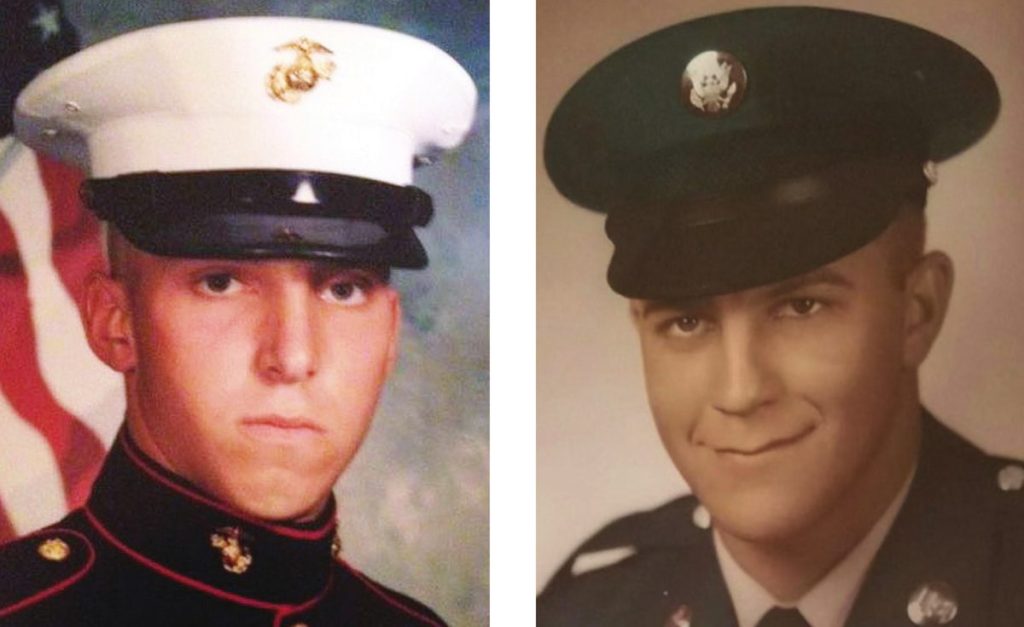
Garner and Westfall