Horner attacks Farnan’s record in primary challenge
FORUM FILE PHOTO
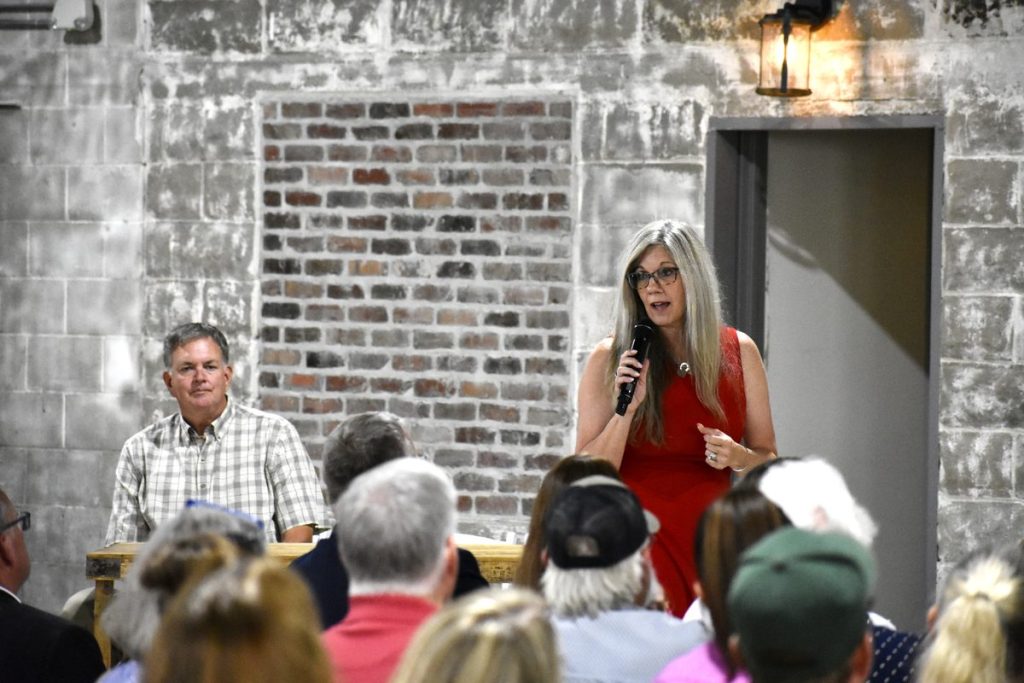
Michelle Horner speaks during the Greater Maryville Chamber of Commerce’s candidate forum on July 11.
EDITOR’S NOTE: The Forum conducted in-person interviews with each local candidate in a contested race on the Aug. 6 primary ballot. Each race will be posted on weekday mornings from Thursday through Tuesday.
MARYVILLE, Mo. — In the race for state representative in District 1, Michelle Horner, an insurance agent from King City, is challenging incumbent Rep. Jeff Farnan, of Stanberry. Farnan won against a crowded primary field two years ago that included Horner. Horner came in last in that five-way race, getting just 5.7 percent of the vote in August 2022.
District 1 includes Atchison, Gentry, Holt and Nodaway counties.
MICHELLE HORNER
Horner has centered her primary challenge around aggressively attacking Farnan’s record and trying to frame him as beholden to special interests and unresponsive to constituents.
“We need actual representation down here in this area,” she told The Forum. “We need someone who will actually listen to the voice of the people. Someone who’s honest, who won’t lie. Someone who will actually represent we, the people.
“I think we have a problem in Jeff City where special interest groups take precedence over the people. And it should never be that way.”
In her interview with The Forum, Horner, secretary of the Gentry County GOP and the caucus chair during the presidential caucus held earlier this year, said that Farnan did not listen to her or others from the Gentry County GOP who wanted Farnan to support HB 1169 last year, a bill that would have required labels on pharmaceutical and agricultural products that had been genetically altered, among other provisions. The bill was a favorite of conspiracy theorists on social media who believed mRNA vaccines were regularly being injected into food products like beef. Farnan sat on the House Emerging Issues Committee, which killed the bill.
The Missouri Cattlemen’s Association, the Missouri Soybean Association, the Missouri Corn Growers Association, Missouri Pork Producers, the Missouri Farm Bureau and the Missouri Chamber of Commerce were all against the bill, which they said would have put onerous regulations on farmers and businesses. Missouri Cattlemen’s Association Vice President Mike Deering called it “the most poorly drafted piece of legislation I have seen in my career.”
Horner said that Farnan, during a visit to the Gentry County GOP last year, rejected their claims about the vaccines that have been widely debunked and eventually left without engaging further. She said this was an example of Farnan “lying.”
“That’s a problem,” she said.
Farnan actually went further this year by filing a bill that would have prohibited requirements for labeling bioengineered food that are more stringent than federal requirements, which HB 1169 would have been. The bill didn’t get out of committee.
Horner also cited “big school districts” and local school boards as special interest groups that pushed Farnan not to support an education omnibus bill that Gov. Mike Parson signed into law this year after it narrowly passed the House.
She noted it’s a bill “he didn’t even vote on.” Farnan was at a funeral during the vote, he told The Forum at the time. The vote had been moved from its initial date because Republican leadership did not yet have the votes to pass the legislation. Once they did, Farnan was gone. However, his vote would not have made the difference.
Horner said that she would have voted for the bill.
“It gave our teachers raises — a major raise. And they are the most underpaid group of people we have here in the state of Missouri is our teachers,” she said.
Farnan did not support the bill because of strong opposition from every school district in the four-county region he represents. Rural schools across the state and locally opposed the bill primarily because it massively expanded the Missouri Empowerment Scholarship Accounts program, which many school officials viewed as a way to divert funds from public education to private schools — hitting small, rural schools hardest. The bill also did not include funding mechanisms for the parts of the bill that many local officials were in favor of, like teacher raises, but did guarantee funding for the Empowerment Scholarship Accounts program.
However, Horner said that local school boards and superintendents did not speak for “the people.”
“No, you can’t listen to the special interests, you need to listen to the people,” she said.
Farnan’s decision not to support the education omnibus package also earned him the ire of national groups that have sent out anti-Farnan mailers.
Horner also said she is in favor of open enrollment, another hot-button education issue that rural school officials say could hurt small schools by forcing them to compete against each other with more marketable programs instead of focusing on improving the core educational opportunities.
“I think that’s just a bunch of BS,” Horner said. “… I don’t think that that’s going to happen at all. I think that’s what a lot of the superintendents are telling to fearmonger people. I think if anything, it’s going to bring more people to more of the rural schools because our schools are much better than some of the other schools.
“… If you have a good school, you’re not gonna lose anybody. And we have good schools here. We’re not gonna lose a single kid.”
Another bill that Horner has criticized Farnan about is HB 2599, which was passed by the House during the most recent session but didn’t make it to a vote in the gridlocked Senate. The bill would have allowed Missouri retailers to use biometric systems like facial recognition and palm or retina scanning to verify a customer’s age when purchasing alcohol. The systems allowed under the bill would require a company operating the service to store the biometric data along with a previously scanned ID to verify age. The technology is gaining popularity at sporting events, and Farnan said he was approached about the bill because some companies want to use it during the World Cup in 2026 when Kansas City will host six matches.
However, Horner said it would open the door to more surveillance and eventually a social credit system like in China. She also said that it is dangerous to have that kind of biometric data stored. Data, she said, can always be hacked and stolen. And if someone steals a handprint or retina scan, that could pose greater problems than stealing credit card information or a Social Security number.
“Biometrics is just another way for people to know what we’re buying, what we’re doing and controlling it and monitoring that,” she said.
Priorities
Horner said the greatest challenges facing northwest Missouri are poverty and housing.
“We have a lot of needs,” she said. “Poverty’s a big one. We don’t have a lot of homes here. We don’t have a lot of businesses here. We need someone to focus on us — not just Nodaway County, someone to focus on Atchison, Holt, Gentry. We need someone that’ll focus on what every county in the district needs.”
Horner said she decided to run again because she wants to improve people’s lives. She said that she thinks about it when she stops at a stoplight in a highly populated area and sees the faces of all the people walking past.
“Have you just stopped for a second and just looked at them and wondered, are they happy? Are they sad? What can I do to make their lives better?” Horner said. “It doesn’t matter what race, creed, religion, whatever — it’s to make people’s lives better. And that’s what I wanna do.
“I’ve gone through the last four years and I’ve lost my son, and then last year I lost my granddaughter, and I lost my sister and I lost my son’s dog. And I still want to make other people happy and make sure that their freedoms are there because this country was founded on different races, different religions, different belief systems, but we have the freedom to do that under our Constitution.”
JEFF FARNAN
In his interview with The Forum, Farnan responded to some of Horner’s criticisms and talked about how he’s grown more comfortable and capable after two years in the House.
Unsurprisingly, Farnan took issue with Horner’s characterization of him at the Greater Maryville Chamber of Commerce’s candidate forum earlier this month as someone who doesn’t listen to constituents and is hard to reach.
“I totally disagree with that, because on an average week, I get a thousand emails,” Farnan said. “If it’s a form letter, I won’t respond. Because, I mean, they’re not really taking the time to personalize their email. But if you send me a personal email or call my office, I will always call you back.”
Farnan said he had his legislative assistant check their records and could not find anything to indicate that Horner had ever tried to contact his office. In her interview with The Forum last week, Horner indicated that a friend had contacted Farnan about a bill and that he did not respond, but she was not more specific about the circumstances.
Horner’s steady stream of attacks, along with the attention of a national super PAC that is targeting him for his opposition to the education omnibus bill last session, hasn’t made him think twice about his record, Farnan said.
“Absolutely not. Nothing. I stand behind every vote I took,” he said. “You know, just like this education bill … there were parts of this bill that I couldn’t vote for. None of my superintendents wanted me to vote for it. I did the right thing. I represented the district.
“And obviously (Horner) wouldn’t represent the district because she said she would’ve voted for this bill. That’s not what the superintendents wanted, you know? That’s not what’s best for this district.”
Additionally, Farnan said he did not regret cosponsoring HB 32 last year with Kansas City Democrat Richard Brown. The bill would have made it illegal for someone who has been convicted of domestic assault, is in the country illegally, was dishonorably discharged from the armed forces, has renounced their U.S. citizenship or has an order of protection issued against them to possess a firearm.
“If you, say, were arrested for domestic violence, you didn’t get access to your guns,” Farnan said about the bill, which made it no further than being referred to a committee. “Well, that’s a commonsense law that they’re trying to do, because, what if this person was released on bail and goes home, takes his gun, and goes ahead and kills his wife? I mean, I don’t want that to happen to anybody.”
Horner has called the bill a “red flag law” that would restrict gun ownership, which she said she is categorically against, though she told The Forum that she was not against the provision preventing illegal immigrants from owning guns.
Priorities
If reelected, Farnan said he will be ready to hit the ground running in Year 3. His first year, he said, was a lot of learning how things worked, although he did get a few bills through the House. This year, though, he said that he’s had more connections in both halves of the legislature, which would also help him in a second term.
Most importantly, he said that since the Senate has been gridlocked for his entire term in the General Assembly, passing very few bills each session, he’s started to successfully get items into the state budget, starting with two major initiatives this session that he said are easily his proudest accomplishments during his term.
In this year’s state budget is $228,000 for the North Star Advocacy Center in Maryville and $600,000 for a levy expansion in Atchison County.
“Last year, I went around and I talked to all the commissioners, all the mayors, anybody that had a capital improvement project, and I said, ‘What do you need?’” Farnan said. “And so actually I had a list of $1.4 million of stuff. And so the only thing I got through the House was the North Star bill.”
He credited state Sen. Rusty Black, R-Chillicothe, with being able to keep the North Star funding in the budget and adding in the Atchison County funding on the Senate side.
In a second term, Farnan said he would want to prioritize getting that kind of help into the state budget again, including potentially for a new pump system at Big Lake in Holt County and assistance for a new fire station in Graham.
In terms of legislation, Farnan said he definitely wants to bring back a bill that would have made it easier to get licensed as a funeral director or embalmer by allowing apprenticeship programs.
“They still have to take all the same tests and everything, but instead of having to go to school — you know, you may have a working mom that wants to, ‘hey I want to be a funeral director or even an embalmer’ — she can do it locally and then take her test and then come back, hopefully, in the community. So it will keep those people here in the community.”
The bill made it through the House this year but died in the Senate.
Overall, Farnan said that the person who represents District 1 must be a strong supporter of two things in particular: agriculture and education.
“I mean, that’s what we are. We’re an ag community and we are an education community,” Farnan said. “… And I think if you’re not into education or into ag, you have no shot.
“You shouldn’t be our representative because that’s what it takes to represent this district.”
FORUM FILE PHOTO
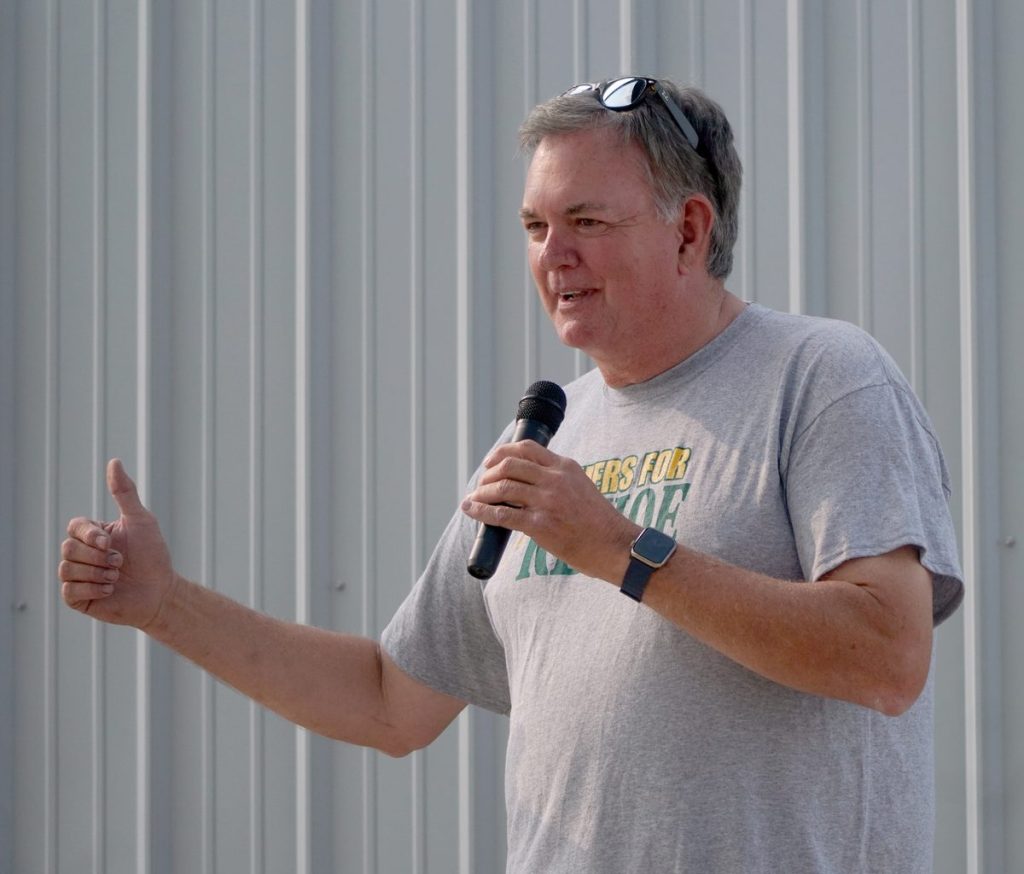
State Rep. Jeff Farnan speaks last week at a Farmers for Kehoe Rally in Sheridan.
GEOFFREY WOEHLK/THE FORUM
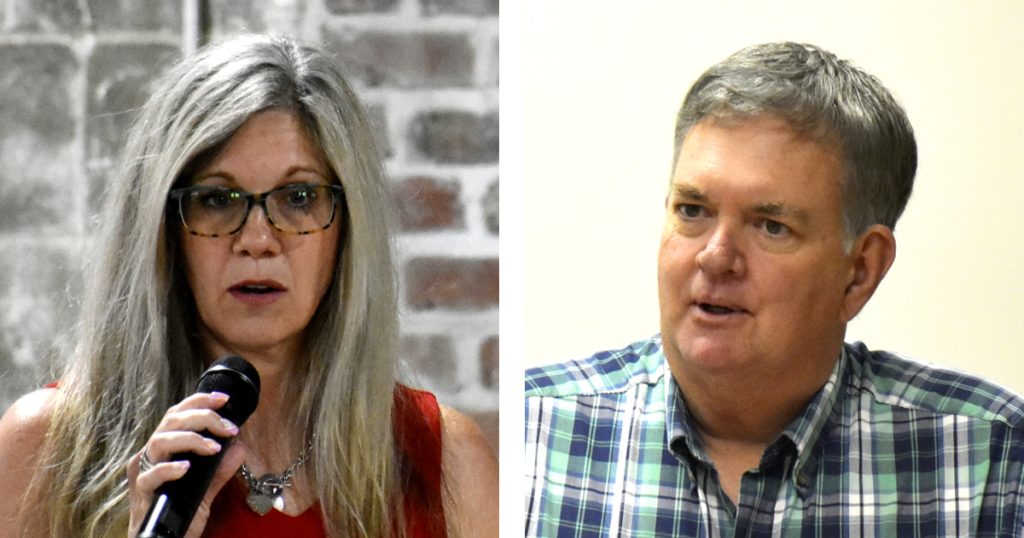
Michelle Horner, left, is running against fellow Republican Jeff Farnan for state representative in the Aug. 6 primary.