
Local legislators recap session
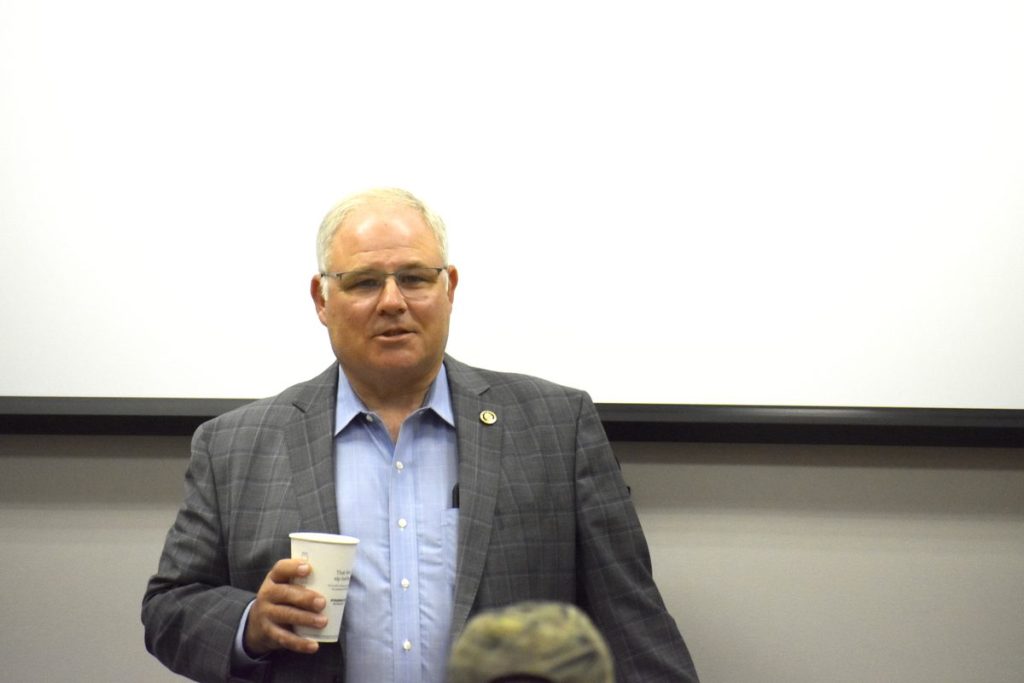
GEOFFREY WOEHLK/THE FORUM
During the Legislative Coffee event held on Tuesday morning at the Nodaway County Administration Center, Sen. Rusty Black, R-Chillicothe, talked legislation and sipped coffee while answering questions from constituents.
MARYVILLE, Mo. — Local legislators Rep. Jeff Farnan and Sen. Rusty Black debriefed on the legislative session that ended on May 17 during the Greater Maryville Chamber of Commerce’s Legislative Coffee event on Tuesday morning, fielding questions from constituents that dealt mostly with education and the initiative petition process to amend the state constitution.
Education
Black and Farnan, who differed on the education omnibus package that was signed by Gov. Mike Parson earlier this month, each explained their position on the legislation.
“I must’ve been wrong,” Black joked. “Every state rep in my area voted no. Rusty Black voted yes.”
The new law contains a large number of sweeping provisions designed to expand access to charter schools, virtual schools and private schools while also increasing teacher pay, adjusting the state’s funding formula to use actual student attendance instead of enrollment when counting students, incentivizing five-day school districts over four-day ones and doubling the size of the small schools grant fund, among many others.
Those added benefits to public school funding, however, were not enough for Farnan to support the bill, though he said it certainly had some “pretty good things” in it.
Echoing concerns from school districts across the county and the state, Farnan said that he was concerned that there was no funding mechanism for the added benefits, potentially putting their status in limbo down the line.
“I looked at it as, so we raise it this year and it goes fine for three or four years, but then the state starts to run out of money to fund that — then what happens?” Farnan said.
The heart of the legislation, though, is a significant expansion of the Missouri Empowerment Scholarships Accounts, which qualifying families can draw from to pay for educational expenses. It’s funded by private donors, who in return get tax credits on their donations.
Prior to the new law, the program was only available in a few areas. The new law expands it to a statewide program, increases the cap on tax credits for the private donations from $50 million to $75 million per year and raises the income cap for eligible families from 200 percent of the amount used to determine reduced lunch to 300 percent — rising from $111,000 a year for a family of four to $166,500 for a family of four.
The tax credit expansion was the major reason Farnan was “a solid no” on the legislation, he said. And unlike the potentially unfunded mechanisms for public school funding, the bill does guarantee the $75 million in tax credits that can come out of the general revenues each year, regardless of how much may be left over for public education.
“I firmly believe that any public money should stay in public schools,” he said Tuesday. “I don’t like the idea of funneling our public money into our private schools.”
However, Black took issue with that description of how the program works. Public school funding comes out of the general revenue fund, along with many other programs. So describing the scholarship program as tantamount to school vouchers — which would transfer money directly from one school to another — isn’t accurate, he said.
Instead, he said that it would only be one of dozens of tax credit programs, all of which take money from things funded by the state’s general revenues.
“When Karie and I give to Noyes Home (for Children in St. Joseph), and we get a benevolent tax credit, we’re taking away from Maryville school, aren’t we? … when I give that money to Noyes Home, and I apply for that tax credit, I’m taking money away from roads, counties, everything. And that’s what these tax credits do as well.”
Black, who taught for more than 30 years including at Nodaway-Holt R-VII, said that even if the new benefits for public schools aren’t fully funded, it will be better than what they’re getting now. All in all, the omnibus education package calls to nearly double the existing outlay for public education funding in the state, he said, to nearly $1 billion when all provisions ramp up over the next four years.
“Rusty Black the old ag teacher (says), if I had $100 last year and I’m supposed to have 150, and now I don’t get the full 150 and I only get 130 of it, I got 30 more dollars. OK?” Black said Tuesday. “So, I told you I’m interested in appropriations, and if I get reelected, the next four or five years is going to be a major focus on trying to fund what we put in there.”
Farnan, a former longtime member of the Jefferson C-123 school board, told The Forum in April that he received “several hundred emails” from within his district from school boards, administrators, teachers and retired teachers about the legislation, and that none of them were in support.
Black also said that he ensured the bill did not include any language allowing school districts to start the school year earlier. In 2019, Gov. Parson signed into law a bill that restricts schools from starting earlier than 14 days prior to the first Monday in September. Some school administrators, including locally, have grumbled about having to fit so many school days into a tight first semester that must begin in the second half of August and end around Christmas while being punctuated by lengthy holiday breaks. That usually results in the first semester being about a week shorter than the second semester.
“Those of you that wanted schools to start earlier, you can be upset with me because I made damn sure that didn’t happen,” Black said. “That was part of that bill, to be able to start schools earlier — I took that part out.”
Constitutional amendments
Much of the rest of the question-and-answer portion of Tuesday’s event focused on initiative petition changes that died in the Senate. Both Farnan and Black supported the legislation, which would have asked voters to change the threshold for voters statewide to approve constitutional amendments from a simple majority to a “concurrent majority.”
A concurrent majority would require a simple majority of votes statewide and also simple majorities in five of the eight Congressional districts in Missouri. An analysis by the Missouri Independent found that about 23 percent of voters in the state could be against an amendment and keep it from passing if using a concurrent majority.
Although it was one of the top priorities of the session for state Republicans, chaos in the Senate driven by the far-right Freedom Caucus and a record-setting Democratic filibuster resulted in the bill dying on the last day of the session when House Republicans refused to pass a version of the bill that didn’t include so-called “ballot candy” — provisions like barring non-citizens from voting and banning foreign interference with initiative campaigns. But critics said the language was designed simply to confuse voters into voting for something that is already illegal in an effort to get more votes for the changes to the amendment process. Democrats in the Senate said they would stop their filibuster of the measure if the “ballot candy” was dropped, but House Republicans refused to do so, leaving the bill to die as the session ended.
Farnan said he supported the change to the amendment process because it would give more of a voice to rural parts of the state.
“So that would give more of a vote to northwest Missouri, northeast Missouri by them having to pass that, too, by having five of the eight (Congressional districts),” Farnan said Tuesday. “That way you don’t have St. Louis, Springfield, Columbia, Kansas City dominating with their agendas what gets through the ballot.”
Black said he supported the measure because he believes the Missouri Constitution should be more difficult to change. Instead, he said, voters should use the initiative petition process for statutory changes for many of the issues that have landed on the ballot since the latest version of the constitution was ratified in 1945.
“I’m a firm believer, period — long before I became a state rep, when I was an ag teacher — our constitution should not be amended or changed easily,” Black said. “It’s the constitution. Of course, I believe the constitution’s got way too much stuff in it, whether it was put in by a conservative group, a group that doesn’t consider itself anything, or by a liberal group — that crap doesn’t belong in the constitution. The constitution should be for our rights and how our government is supposed to work. Not whether you play bingo or not.”
Freedom Caucus
Statutory changes from the legislature, though, were hard to come by this session, with only 31 nonbudget bills passed by the General Assembly — the lowest number in history, according to the Missouri Independent.
Much of the gridlock came from the Freedom Caucus, a now-five-member far-right faction that has clashed repeatedly with Republican leadership the past two years and often ground legislation to a halt in the Senate.
Black said the Senate “continued to degenerate” this session because of Republican infighting, and when a constituent asked him about the minority party in the Senate, Black interjected to ask, “Are you talking about the Freedom Caucus? Or Democrats?”
The aside was one of multiple times that Black and Farnan expressed some frustration with the Freedom Caucus and its members, who frequently attracted the ire of other Republicans this session for blocking their own party’s legislation and for behaving in ways that some found unbecoming of elected officials.
In a discussion with Nodaway County Commissioner Scott Walk during the question-and-answer session on Tuesday, Walk said he had watched some of the Senate proceedings this session, and after learning that Freedom Caucus member Sen. Bill Eigel, R-Weldon Spring, proposed an amendment telling the Senate’s sergeant-at-arms to watch out for a thundering herd of rhinoceroses — a reference to “Republicans in name only,” or “RINOs,” a term sometimes used to describe GOP officials whom other Republicans don’t find to be conservative enough — Walk said he was put off by the whole spectacle and thought that some of the senators should “grow up.”
“I wish I could do it like I taught ag,” Black joked in response. “Let me go back in the back where there’s no cameras. It’s your word against mine.”

GEOFFREY WOEHLK/THE FORUM
Rep. Jeff Farnan, R-Stanberry, speaks during the Greater Maryville Chamber of Commerce’s Legislative Coffee event on Tuesday morning to debrief on the legislative session that ended on May 17.




