Celebrating a historic Derby
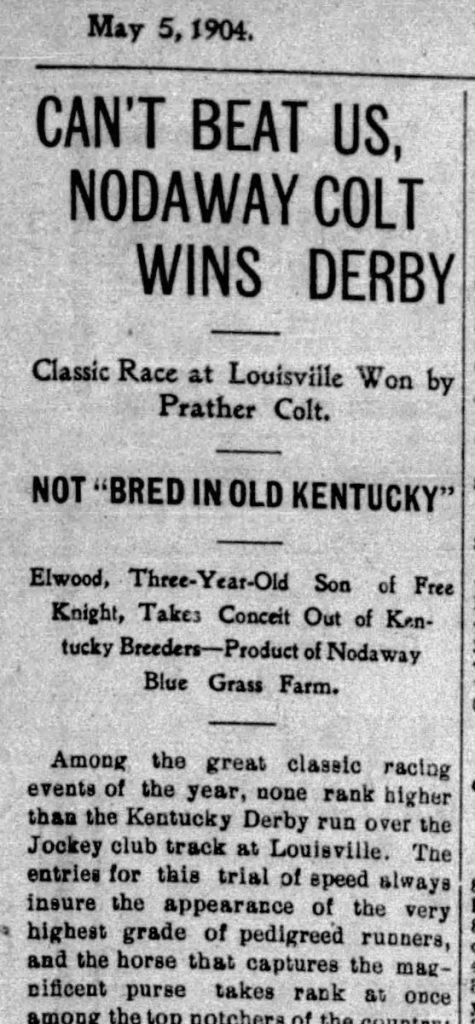
MARYVILLE DAILY TRIBUNE CLIPPING
This photo of a newspaper headline announces the 1904 Derby win of a Nodaway colt Elwood.
Emma Holt was born in 1850 and married James Prather, a prominent Nodaway County citizen. James was president of the Nodaway Valley Bank and opened Maryville’s first drugstore with a business partner. Sometime in the 1870s, James started Faustiana Stock Farm. Faustiana focused on breeding Thoroughbred horses and developed quite the reputation. Soon, Faustiana Stock Farm was the premier Thoroughbred breeding farm west of the Mississippi.
When James died, he left Emma their house and all its furnishings and the building that housed the drugstore. Each daughter was to receive $25,000, and their son Benjamin was to inherit Faustiana Farm, though the will stipulated that all of the horses were to be sold in Kentucky. Although not stated, it appears that James did not intend for Faustiana to continue after his death. However, Emma had other plans.
Because Benjamin was only 16 at the time, Emma contested the will’s requirement that the horses be sold in Kentucky. She wanted them sold in New York City because the horses could sell for more money there. She also used some of her proceeds from the estate to buy back several of the horses and used them to continue running Faustiana Farms until her death in 1910.
One of the horses that came from the farm under her tenure gained national acclaim. In 1901, the mare Petticoat gave birth to a lanky bay foal. Petticoat had success in races with Lamasney Brothers, and Emma purchased her for her pedigree and racing success. The sire of this young foal was Free Knight who also had an impressive record — he had won the Blue Ribbon stakes and placed third in the 1886 Kentucky Derby.
Emma sold the young horse later that year for $825 to L.T. Lee, a local Maryville farmer who also raced horses from Kansas City to Memphis. He soon sold the horse to Charles “Boots” Durnell (though another report says Durnell purchased it for $700 at auction). He then gave the young horse to Philadelphia-born Beatrice Laska Drew (known as Laska) upon their marriage that year. Among the horses given to her as a wedding gift, she named this black beauty Elwood — calling him that to honor her new husband (as that was his middle name).
Under Laska’s ownership, Charles trained Elwood and other horses, and Laska entered Elwood into the 1904 Kentucky Derby, the 30th running of the race, where a crowd of more than 18,000 gathered to watch the main event. Described as a “beautiful woman” with a “commanding and queenly” bearing, Laska attended the races all the way from California (where Elwood had been shipped from just 3 weeks prior to the race). The papers reported that she gave a “piercing scream” when her horse won.
Her joy is no surprise, considering Elwood’s odds were 10:1, the worst of any horse in the race, and he had won just a single race as a 2-year-old the year before. Maryville and even Missouri residents more widely delighted in Elwood’s win as he had bested the Kentucky-bred, owned and trained horses. One Missouri paper said, “It is said the Kentuckians bet recklessly on their horses and lost a good deal of money to the backers of the Missouri thoroughbred.” Another paper said that “Louisville had ‘gone broke’” when Elwood won against the odds.
The jockey who rode Elwood to greatness was Frank Prior. He was just 20 years old and already had won close to 100 races after racing for 4 years. He was born in Petaluma, California, and it was reported that he had a “mania for riding horses” almost from birth. He rode bareback, rodeo wild horses, and even rode anything that could move on the farm — from calves to donkeys.
There, it is in many ways that Elwood’s win at the 1904 Kentucky Derby was notable. He was a “western” horse who swiped the prize from the Kentucky bluegrass boys. He was the first winner to be owned by a woman — Laska Durnell. He won despite great odds against him and with a young jockey. And, he was the first winner to be bred by a woman — our very own Emma Prather, who years earlier had fought her husband’s will to take control of Faustiana Farms and its horse breeding efforts.
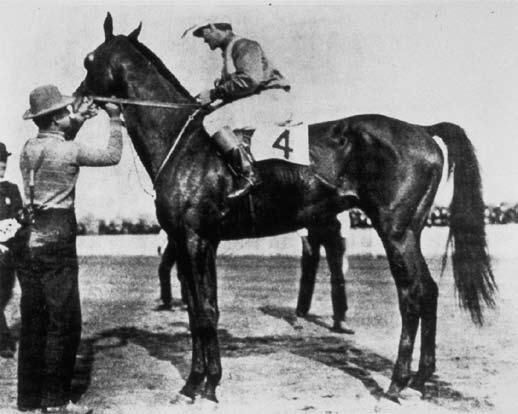
PUBLIC DOMAIN PHOTO
Kentucky Derby winner Elwood is shown in 1904. Elwood was the first winner to be bred by a woman, Emma Prather, of Nodaway County.