Forum Flashbacks: Feb. 1-7
MARYVILLE DAILY FORUM, FEB. 7, 1999
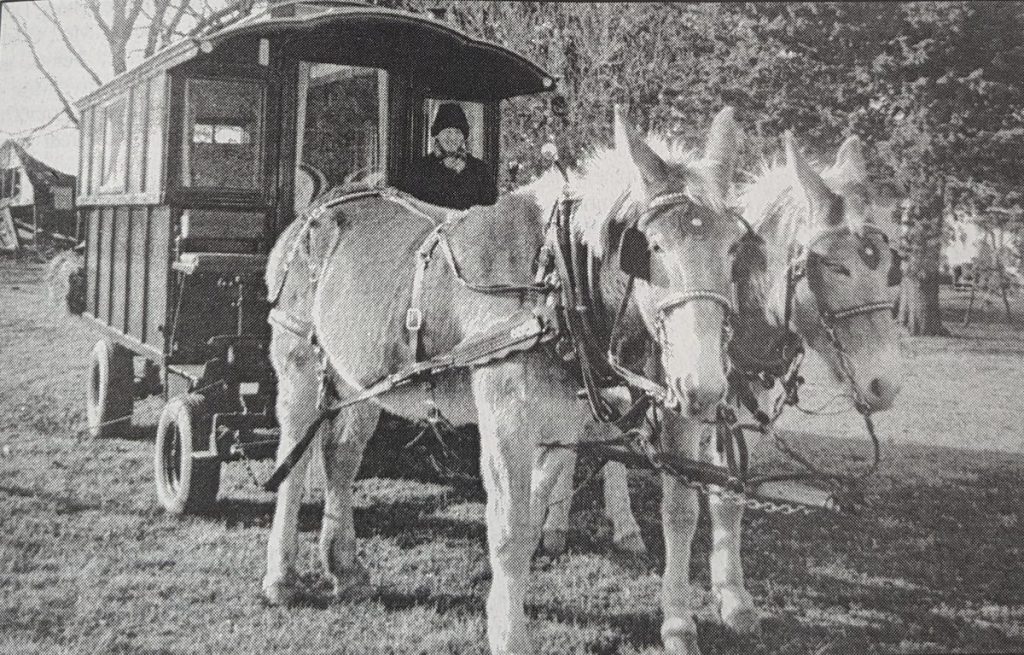
25 YEARS AGO: Laurent Vermeulen, originally from Belgium is passing through the Maryville area, headed for Canada with a team of Belgian draft mules named Millie, right, and Maude, left, and a wagon he built himself. He travels about 12 miles a day, at a speed of three miles per hour.
25 years ago
Maryville Daily Forum, Feb. 7, 1999
Laurent Vermeulen, originally from Belgium, arrived in the United States just over two years ago on Jan. 2. He is passing through the Maryville area, headed for Canada with a team of Belgian draft mules and a wagon he built himself.
Vermeulen travels at a speed of three miles per hour and travels about 12 miles a day. He stayed at the Leroy and Judy Henggeler farm one night and the next night at the Gareld and Vicky Riley farm. He stays one night to rest his mules and then heads on his way the next morning. That’s why he only travels 12 miles per day, because he said the mules get worn out on all the short hills in Missouri. He lives in his wagon and only needs a barn for his mules for the nights.
He shipped the wagon from Belgium to Virginia, after spending a good deal of time making it. The wagon is a copy of a gypsy wagon, according to Vermeulen.
“Only, it’s lighter,” Vermeulen said. “The gypsy wagons weighed over 7,000 pounds — the old ones from 1850 to 1950.”
Vermeulen said the roads were very bad back then, so the wagons had to be heavy. The wagon he built may look exactly like a gypsy wagon, but it only weighs about 4,000 pounds, according to Vermeulen.
He began his trip the first week of May 1997. He bought a team of Belgian draft horses, hooked up his wagon and drove about 750 miles to Tallahassee, Fla. He said he sold the horses, because all they wanted to do was eat.
He then put his wagon on a trailer and hauled it to Tennessee, in search of another team. This time, he was in search of a team of mules and after a great deal of time spent looking for just the right ones, he found them. They were the Belgian draft mules he has now, which he named Millie and Maude. …
He now had the chore of training them, which he said took about three months and 300 miles of travel, before even hooking them to the wagon.
“One of the mules would not even cross a line on the road at first,” Vermeulen said. “If there was any kind of line, she wasn’t going.”
He said it took all of those miles of training the mules to get them used to traffic, including trains, cars and trucks. Now, he said they can pass right by and it doesn’t bother Millie and Maude.
He also travels with another companion, his dog, Romany. He said Romany is what gypsies call themselves, they don’t call themselves gypsies.
Vermeulen left Tennessee with Romany sitting beside him and drove his team through Kentucky, Indiana, Illinois and into Missouri, for a total of about 900 miles so far with this team.
He said Canada is about six months away in his estimation, so he has a lot more traveling to do.
“I have two big options, once I get to Canada,” Vermeulen said. “East or West.”
He said he didn’t want to go any farther north once he gets there, because it is cold enough.
The reason he left Belgium and headed for Canada, “I’ll answer the way I always do — Why does a musician play music?” Vermeulen said. “You are just born that way — it is in your blood.”
50 years ago
Maryville Daily Forum, Feb. 7, 1974
A new Maryville industry, A-C Lightning Security, Inc., has been announced by corporation president Harold G. VanSickle.
VanSickle, who previously had worked as an engineer at Robbins Lightning Protection Co., Maryville, for 24 years, organized and incorporated the company on Jan. 16.
“The company will manufacture and distribute lightning protection and static grounding materials, VanSickle said. …
The A-C Lightning Security plant will be set up in the east end of the White Manufacturing Building, located at 1320 N. Main St., Maryville. VanSickle has established an office for the company in the Bauman Building, 121 S. Main St. …
Besides VanSickle, the only employees of the company at the current time are his wife, Marylee and Miss Kathy Myers, Maryville, both part-time.
“As time goes on,” VanSickle said, “we expect to add a draftsman and factory workers.” …
Production in the White Building is expected to begin in March.
“We are going to manufacture as many products as possible in the Maryville plant,” he said. Products will include lightning rods, copper and aluminum fittings and cable.
Besides VanSickle, other officers in the corporation are: Leigh Wilson, vice president; Frank Strong, secretary; and Stewart Allen, treasurer.
During his tenure at Robbins, VanSickle won national acclaim for his employer for his work in reducing static electricity at Cape Kennedy missile launching pads.
He also designed protection devices for other defense installation and test sites.
VanSickle, who has resided in Maryville for 24 years, is a former city councilman, first elected in 1964 and named mayor in April, 1967, a position he held until 1972.
In 1968, VanSickle was named the recipient of the Outstanding Citizen Award for his work in civic affairs. …
He was one of the leaders in helping the city acquire a municipal swimming pool and in securing the location for Union Carbide on the east edge of Maryville. He was also one of the men who guided the city in its $1 million bond proposal for sewer and water improvements.
100 years ago
Maryville Tribune, Feb. 4, 1924
TEACH LANGUAGE BY PHONOGRAPH
_______________
The Spanish department of the State Teachers College under the direction of C. E. Wells, has a set of Language Phonograph Records and they are being used in the language department with great success according to Mr. Wells. The records are being used in many schools but are a new addition to the State Teachers College equipment.
The Language Phonograph Records are given in the Spanish tongue by Maximo Iturralde of the New York University as a regular lesson series. The series that is now possessed by the College includes everything from simple conjugations to business correspondence. New records will be secured as advance lessons are made and used in the class room work.
The records are now filed in the library of the State Teachers College and can be taken from the reading rooms to the homes by the students as a preparation for the Spanish class assignment. The records are checked out in the same manner as the library books to the members of the Spanish classes. Thirty six lessons are now included in the Language Phonograph Library.
Mr. Wells is very familiar with the language phonograph method of teaching a language, as he used the same method of teaching English in the schools of Peru with remarkable success. The student who is unable to learn Spanish readily is greatly aided by the language phonograph records as they can be played several times and the student is able to hear the proper pronunciation of the words. An index is included with the language phonograph outfit by which the proper pronunciation and meaning of the disputed words may be found by playing the record on which that word is made.
The Spanish department in the State Teachers College serves twenty-two students this quarter, but has had a roll of sixty students in the fall semester.
EDITOR’S NOTE: The 50-year and 100-year flashbacks are courtesy of the Missouri Digital Newspaper Project from the State Historical Society of Missouri, accessible at shsmo.newspapers.com.
MARYVILLE DAILY FORUM, FEB. 2, 1999
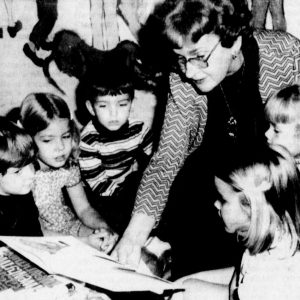
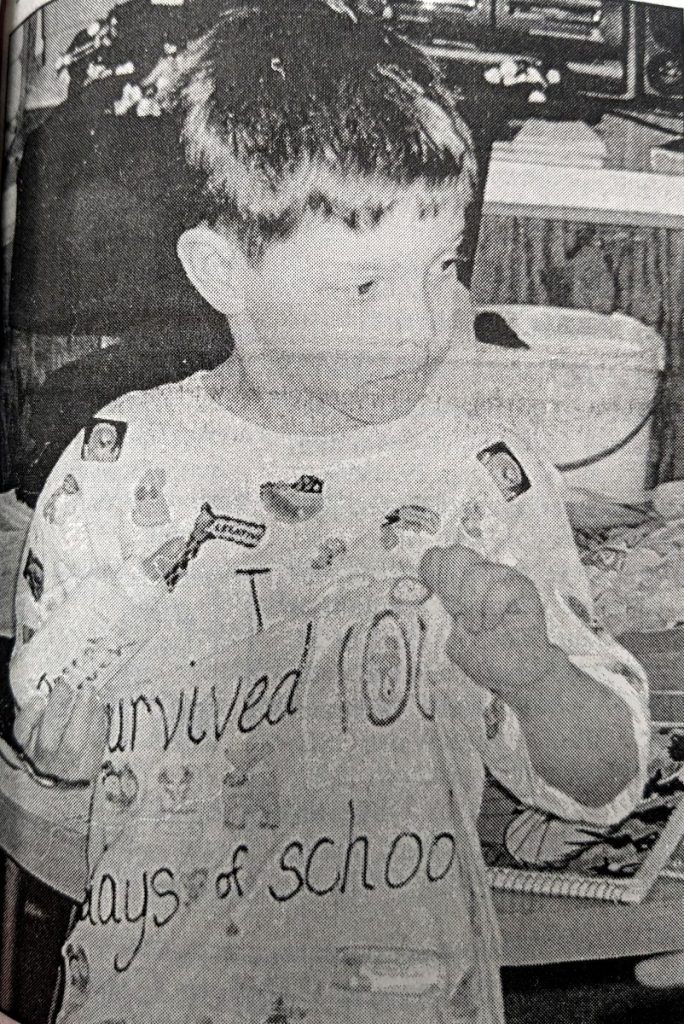
25 YEARS AGO: 100 Days and Counting … – Will Fischer shows his sentiment on the 100th day of school at North Nodaway Elementary — he has survived!