Benefit changes bring possible financial help for veterans
FORUM FILE PHOTO
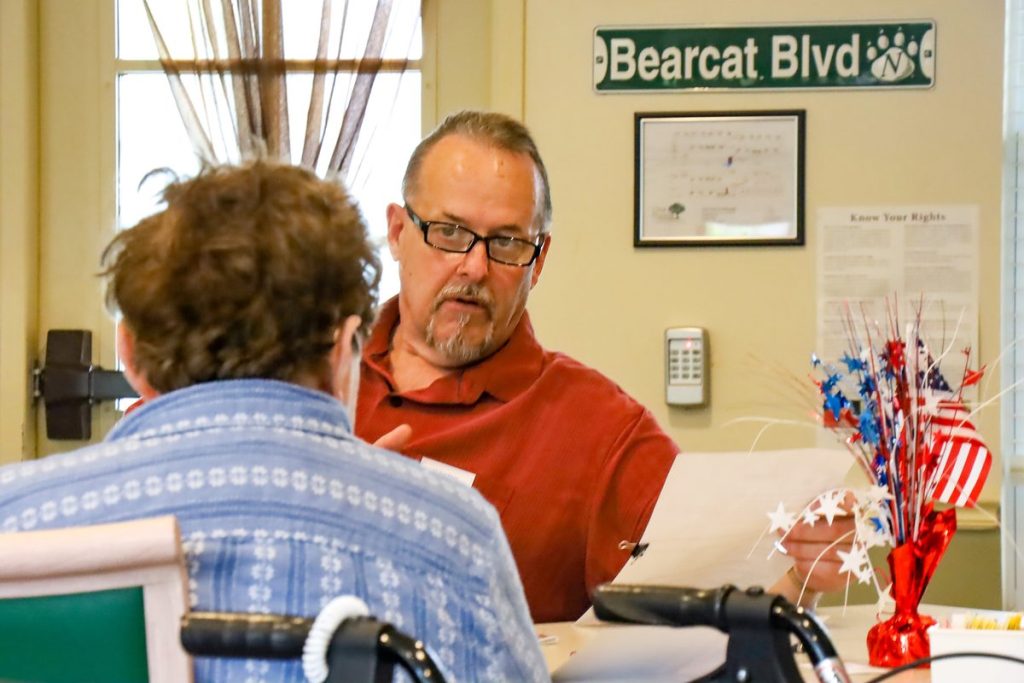
Veterans Service Officer Gregory Fisher talks with local veteran Susan Noakes during a Vets to Vets Cafe presentation held at Oak Pointe Assisted Living last month. Fisher has office hours in Valk Center, Room 106, on Northwest Missouri State University’s campus on the first and third Monday of each month.
MARYVILLE, Mo. — Military benefits are constantly being updated and many veterans and their families may find now to be a good time to look at their benefits with the passage of the PACT Act last year.
The PACT Act is a new law that expands Department of Veterans Affairs health care and benefits for veterans exposed to burn pits and other toxic substances. President Joe Biden signed the PACT Act in August 2022 to ensure veterans can receive high-quality health care screenings and services related to potential toxic exposures.
The most current data from the National Center for Veterans Analysis and Statistics — which tracks data for all veterans in the United States — shows that as of Sept. 30, 2022, there were 1,120 veterans living in Nodaway County and 134 in Worth County.
Am I eligible for VA disability compensation?
You may be eligible for VA disability benefits or compensation if you meet both of these requirements:
Both of these must be true:
- You have a current illness or injury (known as a condition) that affects your mind or body, and
- You served on active duty, active duty for training, or inactive duty training
And at least one of these must be true:
- You got sick or injured while serving in the military—and can link this condition to your illness or injury (called an in-service disability claim), or
- You had an illness or injury before you joined the military—and serving made it worse (called a pre-service disability claim), or
- You have a disability related to your active-duty service that didn’t appear until after you ended your service (called a post-service disability claim)
Presumptive conditions
For some conditions, the VA automatically assumes (or “presumes”) that your service caused your condition. These are called presumptive conditions.
If you have a presumptive condition, you don’t need to prove that your service caused the condition. You only need to meet the service requirements for the presumption.
For more information, visit va.gov/disability/eligibility.
With 10 years serving as a Veterans Service Officer, U.S. Air Force veteran Greg Fisher is up to date on the new PACT Act changes and can help veterans, spouses of veterans and children of veterans to help update the benefits they can or should be receiving.
“These are not benefits that are given,” he told The Forum in early June. “These are benefits that are earned. … You did what was asked of you.”
But while doing what was asked, veterans and their families may have been affected by conditions that deteriorated their quality of life for decades or even resulted in death.
“It may have (taken) decades to get it done,” Fisher said.
Using an example of Agent Orange exposure, Fisher said that the government has completed biological and statistical studies over many years to determine that there are far more veterans diagnosed with diabetes than the general population and it has been attributed to wartime Agent Orange exposure.
He said the PACT Act opened up Agent Orange, especially locations and the length of time served in those areas that will allow for a presumptive service connection.
“The PACT Act, that’s something entirely new,” Fisher said. “A lot of veterans have maybe heard rumblings of something (that) happened, but they don’t know what. It would absolutely behoove those veterans to take a peek and see.”
He noted that hypertension was recently added as a presumptive, “and that’s about as common as a pocket on a shirt.”
Of just as much importance he said, is the fact that many veterans, who have died with many of these conditions like diabetes or lung cancer, didn’t know they could have been receiving benefits.
“The surviving spouses can apply for what’s called DIC, that’s Dependency and Indemnity Compensation,” Fisher said. “So that’s a benefit for the surviving spouse of a veteran who passed away from a service-related condition.”
He further explained that even if a veteran’s death wasn’t known to be service-connected at the time of their death, but the condition is one of the presumptives, their widow or widower can apply for that compensation, which maxes out at just over $2,000 per month plus health insurance.
Gulf War Dates/Locations
For VA benefit purposes, Gulf War service is active military duty in any of the following areas in the Southwest Asia theater of military operations at any time from Aug. 2, 1990 to present. This includes veterans who served in Operation Iraqi Freedom (2003-2010) and Operation New Dawn (2010-2011):
Iraq, Kuwait, Saudi Arabia, the neutral zone between Iraq and Saudi Arabia, Bahrain, Qatar, The United Arab Emirates, Oman, Afghanistan, Israel, Egypt, Turkey, Syria, Jordan, Gulf of Aden, Gulf of Oman, Waters of the Persian Gulf, the Arabian Sea and the Red Sea, the airspace above these locations.
VA offers eligible veterans a free Gulf War Registry health exam to find possible long-term health problems related to Gulf War service. These veterans may also be eligible for the Airborne Hazards and Open Burn Pit Registry.
SOURCE: PUBLICHEALTH.VA.GOV
There are a lot of particulars with forms and how each case is handled, which is where agents like Fisher come in.
In Maryville on the first and third Monday of each month, Fisher said that he generally sees 5 to 10 veterans who find him in Valk Center, Room 106, on Northwest Missouri State University’s campus, but he’s certain there are people out there who haven’t seen the latest changes to VA benefits.
“I still have vets come in who never signed up for anything,” he said. “There are benefits available and typically those benefits, by and large are unknown to the veteran. It could mean health care if the veteran wants it, or it could be health care as a second opinion.”
He said a veteran can engage with VA health care to the extent that they wish. They’re not required to have VA health care, but it is provided for them to use as much as they would like.
“It’s no more than a phone call establishing an appointment,” he said. “… VA health care is just that. It’s health care. It’s not insurance. There’s no monthly premium.”
A frequent obstacle to veterans, Fisher said, has been the inconvenience of the application. Now with the Community Care Network, veterans may be able to continue seeing their own doctor if they are approved by the VA to provide services.
“It’s pretty handy,” he said. “The convenience factor is there.”
He stressed that the VA would need to authorize the medical professional as being a part of the network before it would pay for those services.
For more information about benefits, call Fisher’s office at 816-387-2841 or email him at [email protected].