Workshop maps out resources for people in crisis
MISSOURI DEPARTMENT OF MENTAL HEALTH
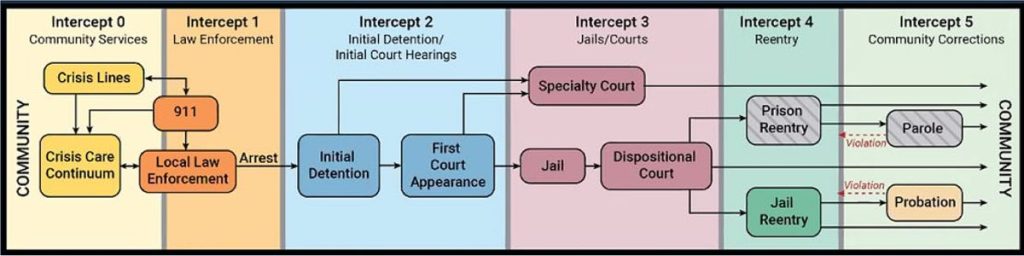
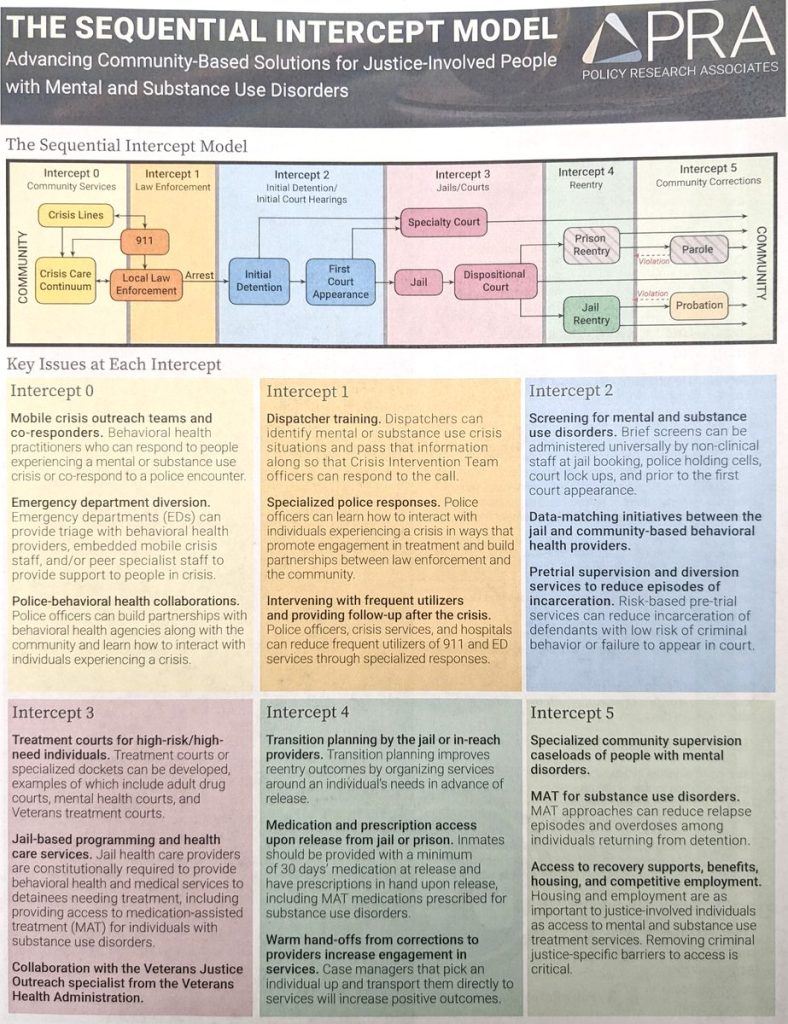
An example of an intercept flowchart using the sequential intercept model. Each point on the chart represents a different opportunity to intercept and divert a person in crisis to resources that could help them get the care they need.
MARYVILLE, Mo. — Representatives from Nodaway County agencies and organizations involved in health care, education and the justice system met at Northwest Missouri State University on Feb. 23 and 24 to take part in a sequential intercept model mapping workshop that aims to help coordinate resources to assist people in crisis.
The sequential intercept model — SIM — is a method that is designed to connect people in crisis with resources, like mental health or substance abuse programs, before they reach a point where they end up in prison or becoming a danger to themselves or others. The mapping workshops, part of a statewide initiative, focus on creating a comprehensive inventory of all locally available resources, and then mapping out how to connect people in crisis with those resources as efficiently as possible.
Nodaway County is one of the first mapping workshops to be held across the state, and was the first benchmark set out by Robert Rice, associate circuit judge of the 4th Circuit, during an effort to set up the Northwest Missouri Cooperative Mental Health Board. The four-county initiative started in earnest late last year.
Rice told The Forum that the workshop’s primary goal was to map out the ways a person in crisis in Nodaway County could be diverted along a sequential progression, centered on the justice system, to available resources that could help them.
“When we do have cases where someone’s emotionally upset, is that something that can be treated and handled in a non-traditional court outcome, as opposed to a standard fine or confinement?” Rice said.
For example, the first “intercept” stage might include community services like a crisis hotline. Ideally, a person in crisis could call the hotline and be diverted to the appropriate local care resources before they proceed deeper along the progression.
Another part of the workshop’s most important work was to get everyone in the county who might encounter people in crisis together in a room and make sure everyone knew what agencies provide which resources and when they can be utilized.
“I was worried because it had such a court system spin on it that some people might lose interest because it’s a little bit outside of their everyday experiences and practice, but that’s what made it so compelling is that they could see what we’re seeing in the court system and then we could hear from them what their experiences are when trying to offer services and stuff like that,” Rice said. “And then, (mapping out) what we do have and what we need to get.”
Rice said one of the major challenges for agencies is that there is no central authority overseeing and keeping track of all resources available in a given area.
“And that it’s not necessarily a linear path of services,” he said. “Like there’s a bunch of organizations out there that can help in some way, but it’s not necessarily organized.”
Last month’s workshop saw representatives from stakeholder agencies across the county, for the first time, create a central list and general flowchart for how to “intercept and divert” people in crises at varying stages, including those that don’t involve the justice system at all. In particular, Rice used school counselors as an example.
When a student shows signs of needing access to mental health resources, counselors will then have a flowchart that can help them decide which local resources would be best and have access to more information on how to get the student the help they need.
“So what I appreciated was learning how much was out there and how much we do need to work on coordinating all the resources out there so that when someone needs help, we can get that person (help),” Rice said.
In the future, the cooperative mental health board can likely take on some of that coordination effort, Rice said, which was a major part of the reason the board was created.
During the workshop itself, the representatives from the various agencies and organizations broke into small groups to focus on creating action plans tailored to specific priority areas.
The results from the workshop will be compiled into a final report expected to be issued later this month.
GEOFFREY WOEHLK/THE FORUM
Rice said that one of the chief goals of the newly formed Northwest Missouri Cooperative Mental Health Board was to act as a top-level organizer to better coordinate resources throughout the board’s four-county region of Gentry, Holt, Nodaway and Worth counties. SIM workshops for the other counties are expected to be held later this year.
GEOFFREY WOEHLK/THE FORUM
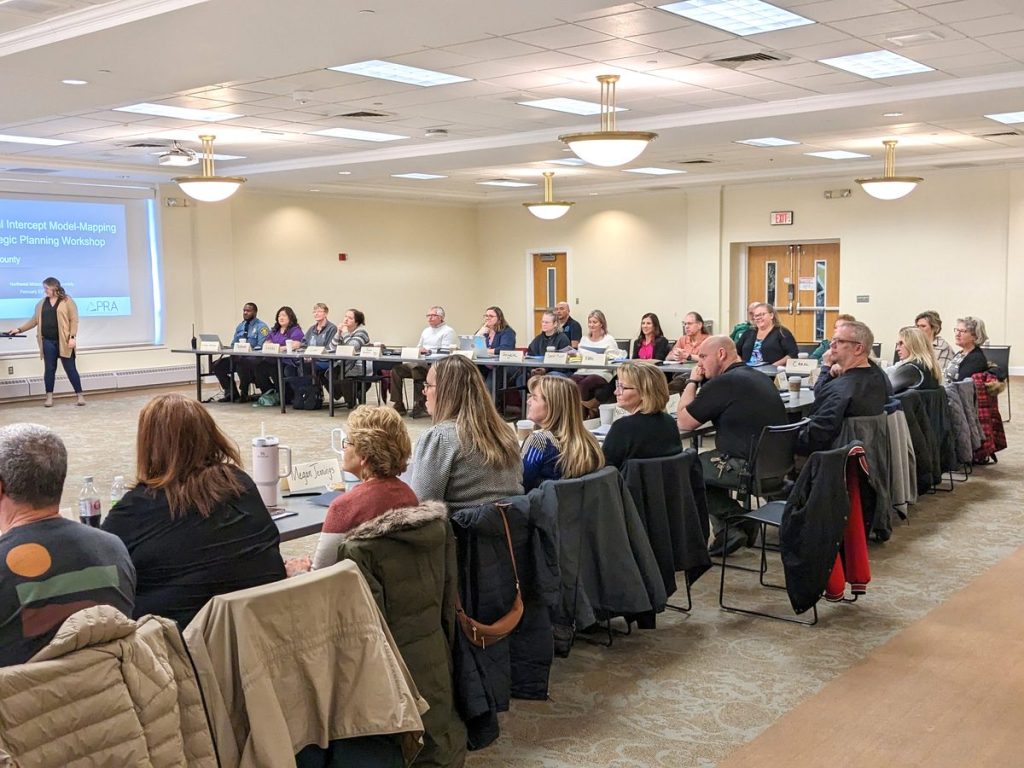
Representatives from dozens of agencies and organizations that frequently come into contact with people in crisis in Nodaway County attended the SIM workshop in Maryville on Feb. 23 and 24. The two-day workshop saw the representatives break into small groups and discuss focused priority areas and create action plans for addressing them. The results will be compiled into a report later this month.
GEOFFREY WOEHLK/THE FORUM
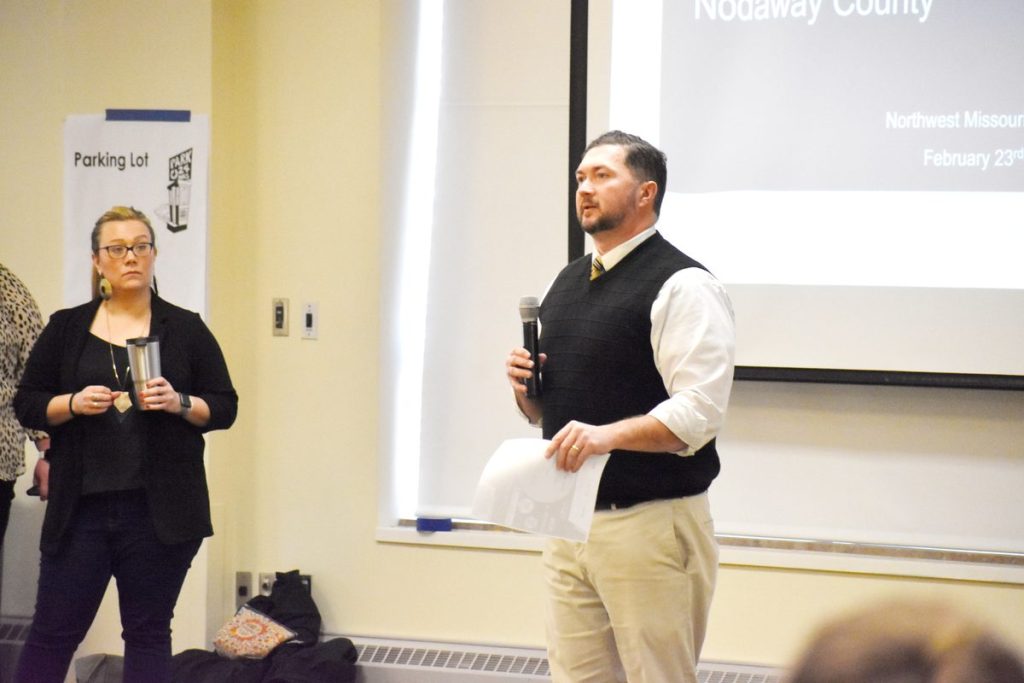
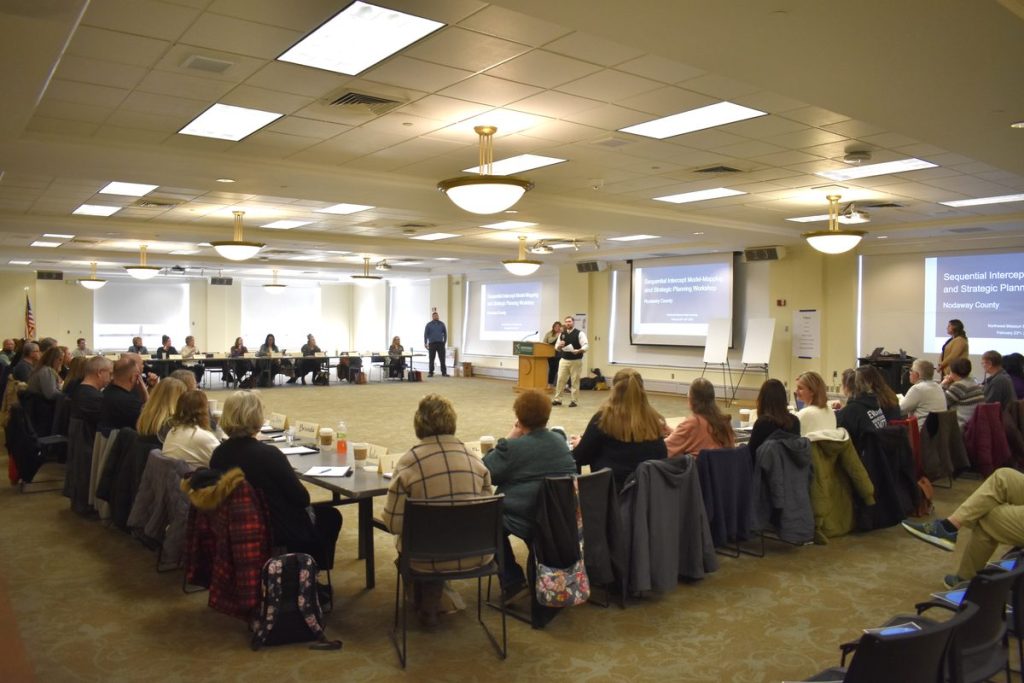
Robert Rice, associate circuit judge for the 4th Circuit Court, speaks during the SIM mapping workshop held at Northwest Missouri State University on Feb. 23. The two-day workshop was aimed at organizing substance abuse and mental health care resources across the county and creating priority action plans to better utilize them in a coordinated manner.
POLICY RESEARCH ASSOCIATES
Representatives from agencies across Nodaway County used the sequential intercept model to map out available resources that could help with people who need assistance with mental health or substance abuse issues. This document, distributed to each attendee, goes into detail with examples of what resources could be available at each intercept point.