County works to create small business grant program
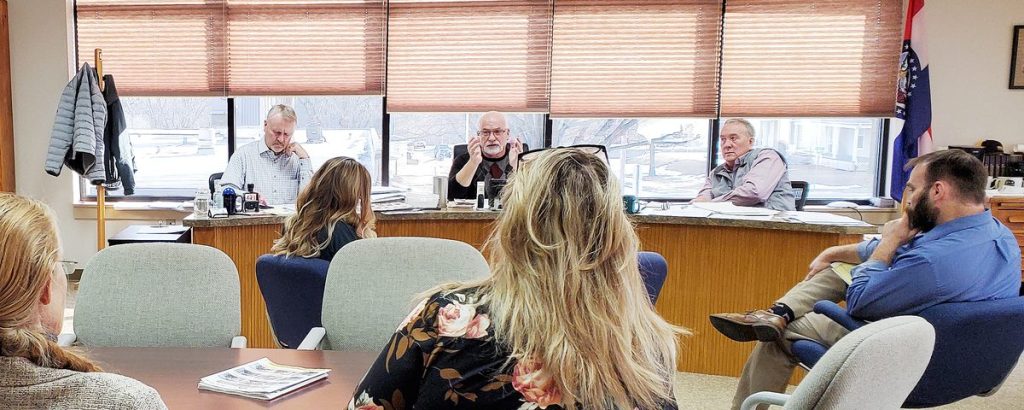
SKYE POURNAZARI/THE FORUM
Nodaway County Commissioners Chris Burns, Bill Walker and Scott Walk hear from local small business owners, Amy Gessert, executive director of the Greater Maryville Chamber of Commerce, and Josh McKim, executive director of Nodaway County Economic Development on Jan. 27 in the Nodaway County Administration Center. The commission plans to offer grants to businesses; however, it is unknown at this time what the process or amounts will look like.
MARYVILLE, Mo. — Nodaway County Commissioners Bill Walker, Chris Burns and Scott Walk offered their support for a grant program that will help local small business owners, though at this moment it is unclear what the program will look like.
Last week, Josh McKim, executive director of Nodaway County Economic Development, Amy Gessert, executive director of the Greater Maryville Chamber of Commerce, and Nodaway County Treasurer Marilyn Jenkins — along with several local business owners — spoke with the commissioners about setting up a local small business grant program similar to what it did in the past with CARES Act funding.
These grants would be provided using American Rescue Plan funds the county received, but it is not yet clear how much would be available for the grant program.
The commission agreed to start taking applications after hearing from four local business owners who detailed their struggles during the pandemic, several of them experiencing a loss of foot traffic and supply chain issues.
“We’re looking for ideas how to do this; we need to get started, because we have the money and we’re wanting to spend it,” Walker said.
McKim opened the conversation stating that 2021 wasn’t tremendously better than the first year of the pandemic and that local business owners have found it continuously difficult to keep their doors open.
“What’s nice about this timing is that as ARPA has had time to mature, some of the guidelines that have come out have really loosened up, some of the regulations especially in our rural areas,” he said.
McKim suggested a business grant program, similar in nature to the Small Business Administration’s, but much more simplified than the county’s previous grant program which used CARES Act funds.
“It was a long process to go through all that, so we tried to think of ways that maybe we bring an option that would be a little easier, (so) we looked at what the SBA is doing,” he said.
McKim suggested the commission look at gross monthly receipts over an eight-week period comparing 2021 to 2019, to help them identify businesses that are struggling.
“A lot of our small businesses have figured out over the last couple years to really operate by the skin of their teeth,” he said. “They have really cut down a lot, so even a little bit of money is going to go a long way to supporting businesses because they’ve figured out how to continue to operate and operate leanly.”
Gessert drafted a short questionnaire for applicants to fill out accompanying their receipts instead of having a business owner bring in all of their bills, which would then need to be combed through by county staff.
She explained the questionnaire offers space for a business owner to explain their story, whether it’s supply chain issues or something else that has been the main pandemic issue for them. Then it will be quicker for the county to be able to access that information.
“Being able to do something like that makes it fairly easy for the applicant, but it also makes it fairly easy for you guys,” McKim said.
Four local business owners were on hand to tell the commissioners about their struggles: Melody Blair, owner of Minnie Lane; Kyle Mayes, owner of Cobbler Cottage; Holly Kay Cronk, owner of Ferluknat Farm; and Jennifer Gillespie, owner of La Chic. Each of them spoke about difficulties they’ve run into.
Gillespie explained that she ordered items for the Christmas season in February last year and only received 28 percent of her products.
“The companies didn’t get it,” she said. “I was devastated. It was like I was having a party and it was too late to cancel. So I truly sat at my desk and had tears coming down my face because I didn’t know what to do.”
She spoke about one of her distributors from which she received zero percent of her order because he had to leave a container in China. The cost to ship a container went from $4,000 before the pandemic to $33,000-$37,000 last year.
“He had to leave all of it in China, could not even bring it back,” Gillespie said. “He just left it.”
She said it’s now $25,000 to ship a container. When she asked how he was going to be able to stay in business, the distributor’s response was raising prices.
“In a small town if we charge a bunch for our goods, no one will buy them, no one,” Gillespie said.
The supply chain isn’t the only pandemic-related thing affecting her. Gillespie noted that foot traffic is just down across the board.
Gillespie said she could lose up to $130 per appointment when there’s no one in one the chairs of her salon.
“We’re worse off now than we were this time last year,” Gillespie said. “I’m really concerned.”
Blair said she has experienced the same thing with regard to the foot traffic. Since most of her items are purchased from Nodaway County residents, the supply chain isn’t a major concern for Minnie Lane. But her framing business deals with supply issues regarding framing materials.
She told the commissioners that she kept track of sales daily, until it became somewhat depressing and she shifted to a weekly basis.
“If I were to show my numbers to people, there is no reason whatsoever that I do what I do,” she said.
Blair said she’s never bought anything from Amazon, “I don’t know how.” But now she’s running into the problem of not being able to purchase her products from local residents to fill her store.
“I try to support all the other small businesses,” she said. “When I go for office supplies I pay a little more, but I go to MTE versus Walmart versus online. I think we all need to do a little more of that so that we can help each other out.”
Mayes said he lost an annual boot order from a local major employer, which didn’t directly relate to the pandemic, but pair that with the supply chain issue he’s experiencing from his suppliers and it’s been a very bad year.
Holding up his hands, he said “I have these, which I can make a living on,” he said. “But the retail part of my business is bad.”
Mayes has called boot companies who have told him orders are six months out. One factory in Pennsylvania said they can’t get enough people to work. Since his business is small, it relies on a lot of special orders, but with that timeline he’s seeing potential buyers resort to buying online.
“I have loyal people, who like to come to me and buy from me just because it’s me; I’m special,” he said with a smile. “They (don’t) have to do that, and if they have to wait, they’re not going to do that — and you can’t blame them.
“Every day we look out the window. … We don’t see people go by; we don’t see nothing. It’s like a ghost town uptown.”
Cronk explained that she’s had a difficult time just paying her property taxes and that it took out whatever “slush fund, what little emergency fund we had, just to do that.”
Primarily a custom studio fabric store, she is experiencing a bit of a supply issue.
“My biggest thing is fabric has gone up so much in the last four years since we started,” Cronk said. “… When I first started when I was a little kid it was criminal to think that you’d pay more than $3.75 a yard for fabric. Now I’m probably looking at having to start selling it at upwards (of) 14 bucks a yard and that’s just for basic quilting fabric. … So that’s going to hurt.”
Jenkins said help now is great, but the commission should also consider helping again later in the year, perhaps with some funds for advertising.
No decision was announced, but Walker did say the county plans to do something and should start accepting applications soon.
“I say we just start getting it out there,” he said.