Virus cases rise after holiday
1-6 COVID update New cases list.png
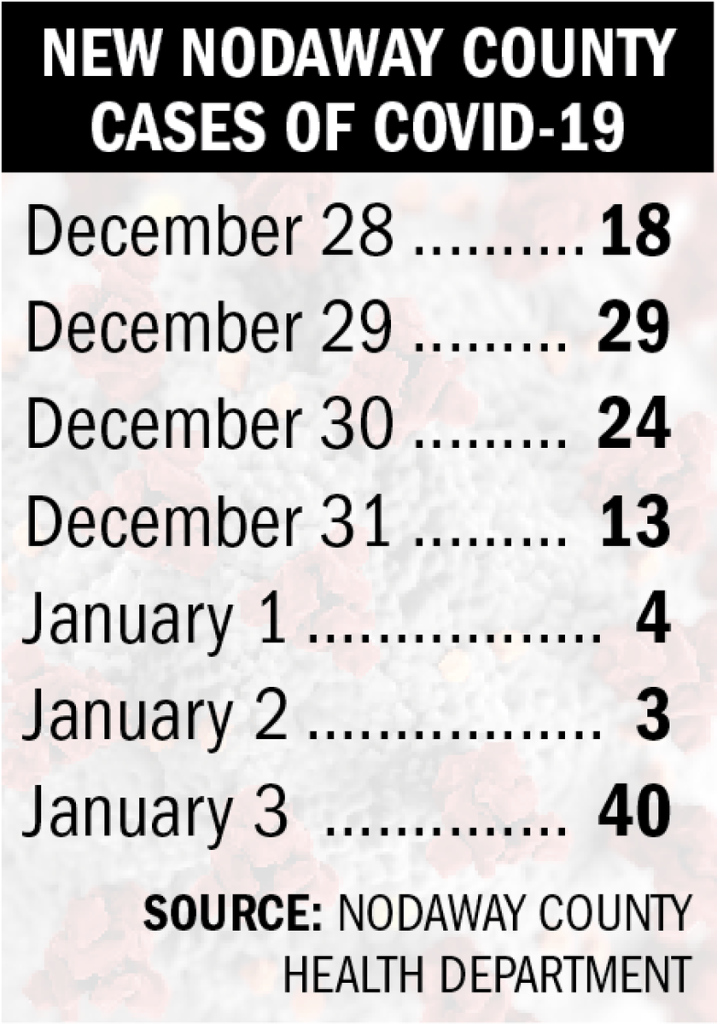
MARYVILLE, Mo. — Continuing the monthslong trend, COVID-19 case numbers have climbed higher in Nodaway County as the omicron variant spreads further throughout the state.
As of Jan. 3, the most recent data available from the Nodaway County Health Department, there were 126 active cases of COVID-19 in the county. On that day, the Monday after New Year’s weekend, 40 people tested positive for COVID-19 — the fifth time 40 or more positive tests were reported in one day since the pandemic began.
In the most recent report, nine were hospitalized, continuing a trend of high hospitalizations over the past few months. Thirty-seven have died since counting began last spring.
Across the country, the omicron variant of the virus has helped to spread infections more widely, including in Missouri.
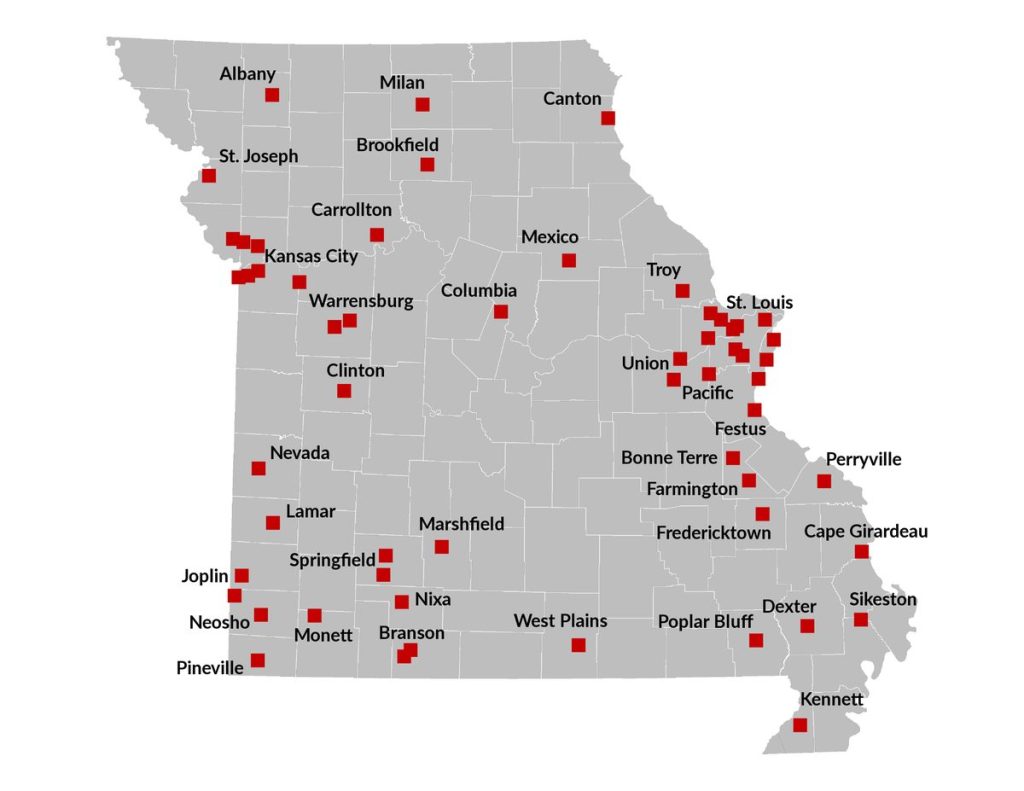
According to the Sewershed Surveillance Project, omicron was detected at the wastewater treatment facility in Albany — the closest to Maryville the variant has been detected so far. The project, a joint effort by the University of Missouri and the Missouri Department of Health and Senior Services, uses samples collected from participating wastewater facilities across the state, and analyzes them for viral load and variant mutations. For the past two weekly collection periods, likely due to the holidays, several facilities around the state — including Maryville’s — have no reported data.
Data from the project is available at arcg.is/1P9bPz0.
Local health officials have continued to stress the importance of mitigation measures in stopping the spread of COVID-19 and stopping those who catch it from suffering its worst effects, especially by getting vaccinated, which studies have shown help to guard against the most severe effects of COVID-19.
New dashboard
Northwest Institutional Research at Northwest Missouri State University has moved its online COVID-19 data-tracking dashboards to a new location with added functionality.
The Nodaway County dashboard is now located at tabsoft.co/3DWhq7F.
The dashboard with university-specific information is now located at tabsoft.co/32uZ3Kc.
Vaccinations
Individuals ages 5 and up are now eligible to be vaccinated against COVID-19.
The Centers for Disease Control and Prevention now recommends all adults ages 18 and older should receive a booster shot for COVID-19, regardless of which vaccine an individual first received.
Those who received a Pfizer or Moderna vaccination series initially will become eligible six months after the final dose, and Johnson & Johnson recipients are eligible two months after receiving their shot.
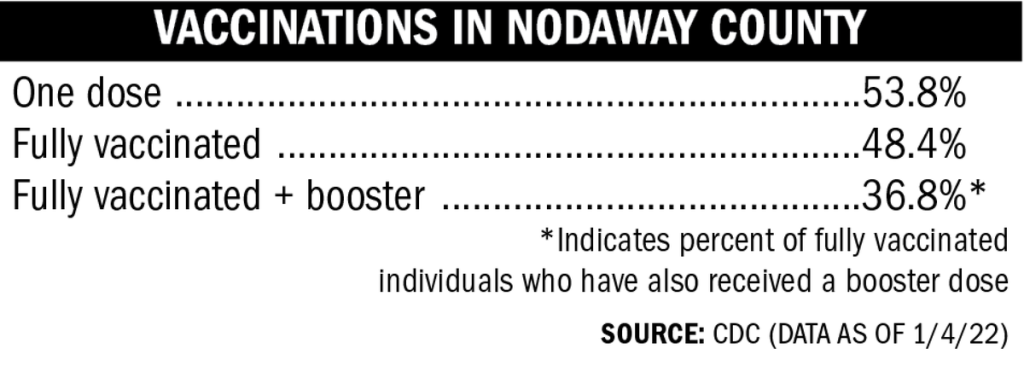
As of Jan. 4, a total of 11,423 Nodaway County residents have received at least one dose of a COVID-19 vaccine, or about 53.8 percent, according to the CDC’s online vaccination dashboard. About 48.4 percent of county residents — 10,280 — have been fully vaccinated. Of those who have been fully vaccinated, 3,784 have received a booster dose, or about 36.8 percent of fully vaccinated individuals in the county — higher than the percentage at both the state and national levels.
In Missouri, about 62.3 percent of residents have received at least one dose, and about 52.9 percent are fully vaccinated. Of the fully vaccinated, about 33.8 percent have received a booster.
Across the country, the CDC estimates 73.9 percent of Americans have received at least one dose, 62.3 percent have been fully vaccinated, and 34.7 percent of fully vaccinated individuals have received a booster.
Contact the Nodaway County Health Department at 660-562-2755 to make an appointment for vaccination or for more information.
For more information on booster shots, visit cdc.gov/coronavirus/2019-ncov/vaccines/booster-shot.html.
1-6 COVID update vaccinated.png
SEWERSHED SURVEILLANCE PROJECT
Locations in Missouri where the omicron variant was detected from data collected the week of Dec. 27. Note that samples are only collected from participating wastewater facilities, so the map only shows locations where the variant has been detected during that week’s collection period and does not indicate that the variant is not present in other areas or during different time periods. No data was reported from Nodaway County in the most recent sample analyses.