Beatty follows call to ‘go try everything’
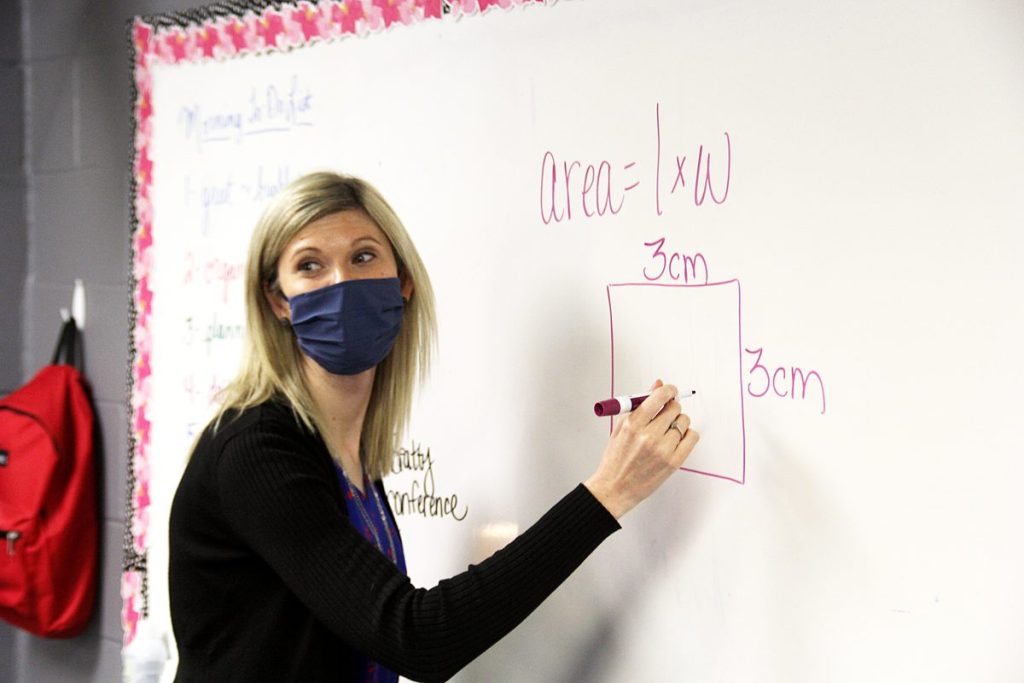
GEOFFREY WOEHLK/THE FORUM
Beatty credited women at each of her professional stops, and her time as a student, with helping her become a better teacher. “… (there’s) something different about each one of them, like they’d each given me a piece of them … that made me the best person I could be,” she said.
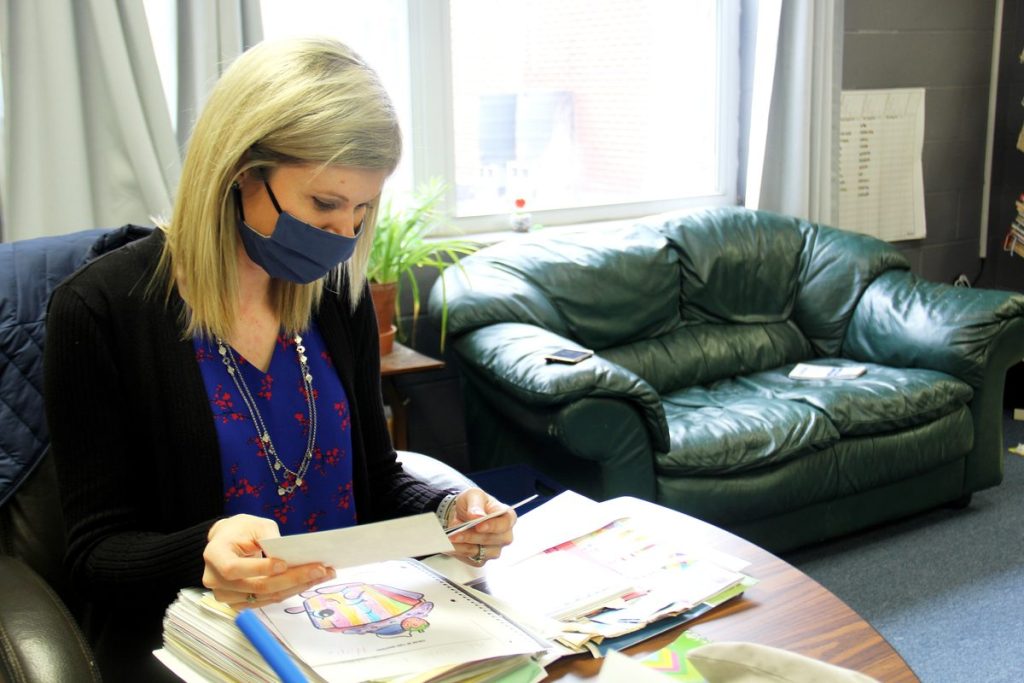
RAVENWOOD, Mo. — On a shelf in Heidi Beatty’s third grade classroom, tucked away with all the other products of what she affectionately calls “years of love and accumulation” around her desk, is a binder that, like Beatty herself, seems to be bursting at the seams, overflowing with pieces of positivity that can barely be contained.
The oldest exhibits in the binder are Post-it notes from Lynette Tappmeyer, for whom Beatty was a graduate assistant while studying at Northwest Missouri State University.
“One of the things she taught me, she used to have Post-it notes around in her classroom,” Beatty said. “And these Post-it notes would have positive notes to herself. … And one of the things she told me was to buy yourself … a folder that you could put things in when you have hard days. Because in teaching, there are going to be lots of hard days. And she said, then you open this (folder), and it reminds you why you can start fresh the next day.”
Beatty bought the folder and started filling it immediately — starting with Post-it notes from Tappmeyer that are still in there — and 15 years later, the folder has become a binder overstuffed with positive memories from the classroom.
“On the days when it’s not so hot, you know, when you’re like, ‘Am I really making a difference? Are kids truly learning? Did I make the right decision?’ I pull this open and I see all the things — I mean, I have my first letter when I got accepted for my first teaching job,” Beatty said. “… I have thank-yous from people, I have different observations I’ve gotten in the past — I don’t know. I just kept it all.
“So if there’s ever a hard day, or ever a hard week, or a hard month — or like this year when I pulled this out a few times, because this has definitely been a hard year — I read things and I remember the exact kid who wrote them to me, you know? And now these kids are probably much older, they wouldn’t probably remember that at all. … But man, that piece of advice she gave me, that’s like the best piece of advice. This will go with me forever.”
‘Go try everything’
When Beatty was teaching third grade at Horace Mann Laboratory School in Maryville, she frequently brought her classes on field trips to her family farm.
“I planned a field trip while I was a teacher at Horace Mann to come to my farm, and we drove the Northwest Bearcat bus; they got stuck in my backyard,” Beatty said. “But we spent the day at my family farm. Because how many of them have ever been on a family farm?
“… This one girl that came to our farm, … I just saw on her Facebook page this spring that she’s going to be a veterinarian. And guess what? She was the first person on our farm — I remember this, in third grade that wanted to milk the cow. And she did an amazing job.”
Because she has primarily taught elementary students, particularly third graders, Beatty said one of the most rewarding parts of teaching — seeing who her students grow up to become — takes a little bit of patience. But sometimes, it was there the whole time.
“And so then in third grade, to know now that she’s now a 12th grader and going to be a veterinarian, did I have a part?” Beatty said. “I don’t know. … But, I even have chills telling you about it, because if you had asked me that year what she was going to be, I would’ve told you a veterinarian without even thinking about it. I don’t know if she would’ve, but then how great that I see that she is going to school to be one.”
Although it’s obvious to anyone who’s ever been in a room with Beatty who the teacher is — go ahead, try to not sit quietly and learn something — she said it wasn’t always clear to her, even if maybe some others had an inkling that she didn’t.
It wasn’t until her adviser at Northwest, Patricia Wyatt, gave her a nudge into education that Beatty knew her path led to the front of the classroom.
“She was really big on, ‘You need to explore everything!’ You know, like, ‘Go try everything,’” Beatty said. “Well, I already knew what I wanted to do — I’d signed up for all the classes that I could in the communication department; I liked the teachers there. But she stuck me in this education class somehow.”
She liked it, and took another, then another, and before long, changed her major from public relations to elementary education.
“I just liked the young kids,” Beatty said about her decision to focus on elementary schooling. “They were just eager to please, and the world is their blank slate. You can help make it whatever they want it to be, you know?”
As a graduate assistant, Beatty said Tappmeyer taught her how to approach students in a new way.
“She was wonderful to work with, and I learned a lot from her, especially how to love kids — because I think I was pretty black-and-white,” Beatty said. If things were supposed to be taught a certain way, then they should be learned a certain way: x, y, z, she said. “But she did a good job of reminding me that you have to love all kids and see the whole child as a person I’m teaching, like every part of them. And so she really taught me a gift that I don’t know that you can learn in the classroom as a student. She taught me that the positivity and the light you bring to that kid’s life is really what matters.”
Whether that was through excelling in academics, helping with emotional development, or any number of other avenues, Beatty said, each child deserves the same effort from her and the same chance to succeed in their own way.
It’s a bottom line she said was reinforced while working at Savannah Middle School during a brief stint teaching sixth grade. Principal Lisa Blair, Beatty said, would wake up at 5 a.m. each morning and bring students to school, then stay until the late hours of the night.
“She had nothing but like a desk and her computer, and I was always like, ‘Don’t you care to decorate your office?’ and she was just like, ‘Nope, I have what I need,’” Beatty said. “And on the wall, she had painted, ‘Is this what’s best for students?’ And if you came in her room and asked her for money for something … or asked her to help you with a problem, she’d just point to that. And if you could answer that question for her, she would make it happen for you.
“… So anything I do, even if it’s hard — and there’s a lot of hard things in teaching — I ask myself, ‘Is this what’s best for students?’ And if my answer is yes, then I have to find a way to make that happen.”
Always learning, forever growing
It’s unlikely that anyone who has ever met Beatty — whose regular speaking cadence features a speed that doesn’t leave much room for anything but earnestness — has accused her of being short on ideas, the words to express them, or, crucially, the will to see them through.
It’s a trait that Beatty said has served her well. Since just starting out as a teacher, when Beatty described herself as doing “everything 150 percent,” she hasn’t slowed down, seeking more and more diverse experiences to learn from — continuing to “go try everything.”
“Every year, they’re like ‘Do you want to do any (professional development)?’ And I never say no, because there’s always something I can learn, always something I can improve, always something I can do better,” she said. “I don’t ever want to be stagnant in that spot, you know?”
That includes taking up weather as a subject area the past few years. Last year, she was one of eight teachers across the country to win a grant from the American Meteorological Society to attend the organization’s annual meeting.
“And I ended up presenting at this national conference in January,” Beatty said. “… But I mean, I talked to people who are not educators, which is a little scary: you know, a teacher talking to a teacher, or a teacher talking to a student is one thing, but a teacher talking to scientists? I mean, NASA, NOAA, all these legit scientists were there, listening to me teaching how I teach third grade science.
“… Am I a better science teacher now? Yes, I even ended up taking a college class while I was doing it. Just so many experiences, I never want to turn anything down — you just never know what you can gain from it.”
The efforts, Beatty said, have had tangible benefits for students, resulting in initiatives like an outdoor classroom and equipment for weather lessons.
At Northeast Nodaway for nearly the past 10 years, Beatty’s impact is felt well outside her own classroom, becoming head of the district’s Community Teachers Association and growing it to one of the largest, most inclusive and most effective teachers organizations in the county — most notably, not limiting membership to teachers — including paraprofessionals, other staff members and even dues from the principals and superintendent.
Funds raised go toward the group’s many active initiatives, including the holiday adopt-a-family program that provides presents to families who need help affording them, and others like helping to celebrate Read-In Day last week.
Now, not only does Beatty see students from her former classrooms growing into who they will become, she also sees former student teachers and younger teachers that she’s mentored grow into their own.
“It makes me feel good,” Beatty said. “I mean, I don’t make all the right choices, probably, I don’t make all the right decisions. But I work really hard, so I try really hard to be the best I can be every day. So I hope that if I model that for them, then they go do that.”
Cup runneth over
“When I first started out, I thought, ‘I’ll get a job here at Northeast Nodaway, this is where I live’ and I would never leave,” Beatty said. “But now, having all these experiences that I love, (there’s) something different about each one of them, like they’d each given me a piece of them … that made me the best person I could be.”
Part of her inspiration now, she said, is her two children in preschool — Jackson and Allison, and making new opportunities possible for them in the same way.
“I always ask (Allison) what she wants to be,” Beatty said. “And I tell her, you know, she can be anything she wants to be. … And every day it changes, of course. But I love that. I love that women before me have paved all of these opportunities that wouldn’t be possible. And there are things, I mean, I’m teaching these gentlemen and ladies to be things that aren’t even created yet. Like there are jobs that they’re going to have that are not even invented yet. So, Jackson and Allison are probably going to be these things that haven’t been created yet.”
Beatty said that unlike many women from previous generations, she’s been able to do the same thing as she hopes Allison will be able to do too: go try everything.
“One of the hardest challenges I’ve had to overcome is finding a balance between being a professional — if that’s what you want to call teaching and all the other positions I hold and CTA president and things — and a mom and a parent at home. And a wife,” Beatty said. “They all require 100 percent. So then there’s 300 percent you’re giving every day.
“But … I’m OK with 300. I’ve done my job well if 300 percent has been taken from me, because I am choosing to teach, so that fulfills part of my cup. I choose to be a parent — fulfills part of my cup. I choose to be married and be on the farm. … I could say no to any of them, or not grade this tonight, or not do this fun project next Thursday, or not take the kids to gymnastics in Maryville — but I enjoy doing all of those things. Those are important things to me. So I think it’s always a challenge, but I’m up for it. And I still find myself looking for more things to add to a 300 percent full cup.”
At only 35, Beatty’s binder is far from being filled up, as she continues to look for new Post-its to look at on days when 300 percent might seem like too much — and help others fill their own.
“You know, for 180 days, you helped shape their life,” Beatty said of teaching. “Whether or not (it was) good, bad, in between, whether or not they still do that thing you taught them — somehow, you gave them a little piece of you. … So, I just hope a little piece of me and a little piece of what I taught you helps you to be whatever you want to be. Because, you know, anybody can be anything.”
GEOFFREY WOEHLK/THE FORUM
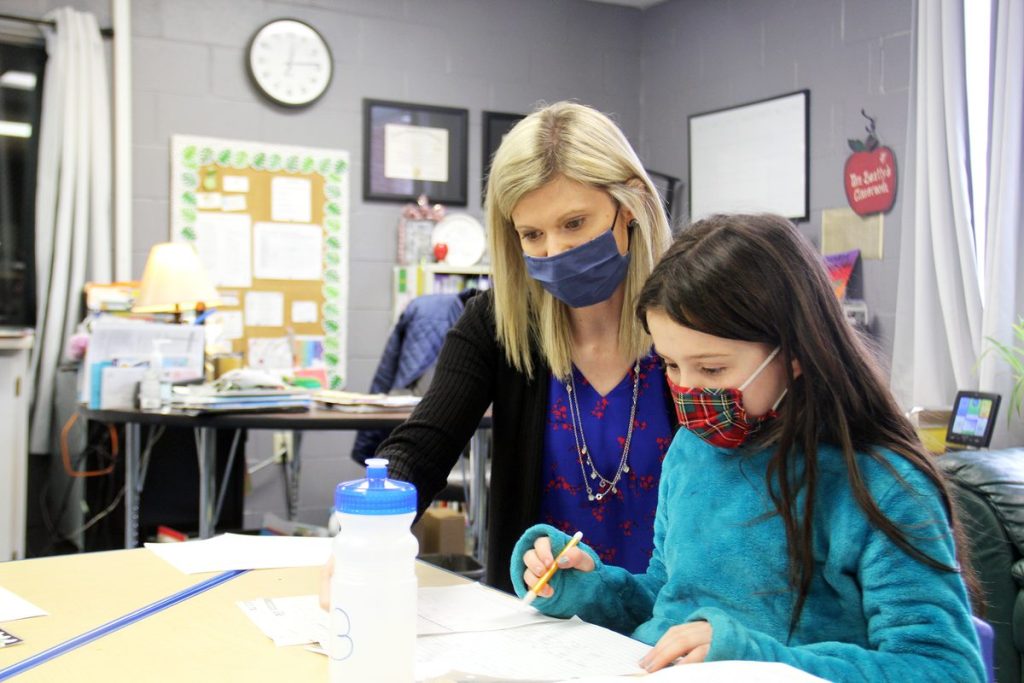
Third grader Kiley Yost works with Beatty on a vocabulary problem.
GEOFFREY WOEHLK/THE FORUM
At her desk, Beatty looks through a binder that holds 15 years of positive memories of her time in the classroom, a keepsake that she made on the advice of mentor Lynette Tappmeyer and has kept adding to ever since.
GEOFFREY WOEHLK/THE FORUM
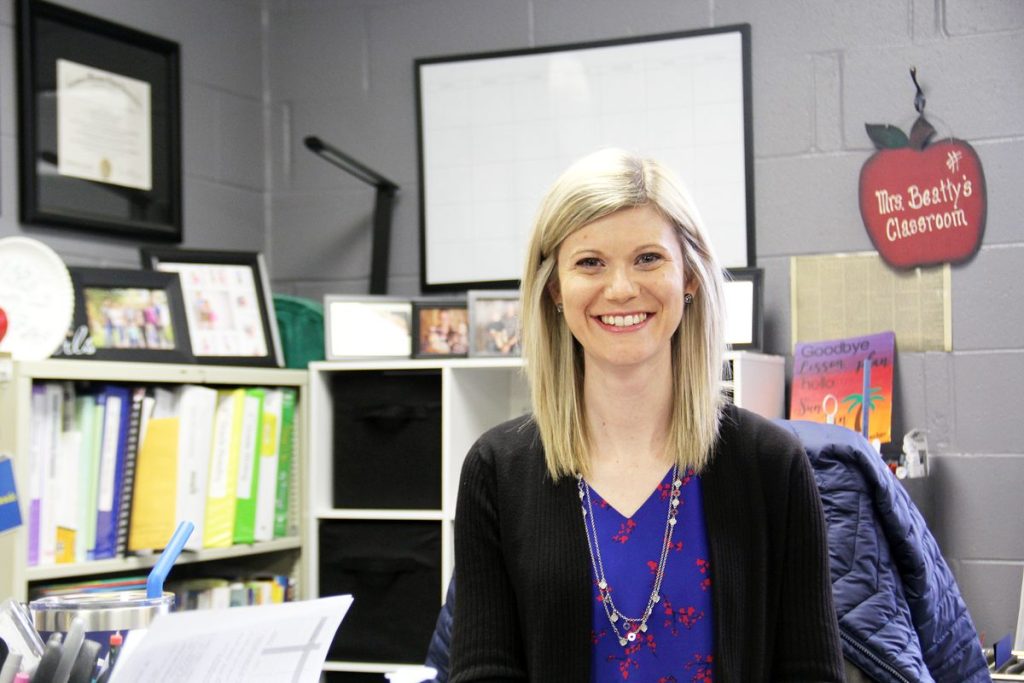
Heidi Beatty, third grade teacher at Northeast Nodaway R-V in Ravenwood, has been a teacher for 15 years, primarily in elementary schools. “… the world is their blank slate. You can help make it whatever they want it to be, you know?” Beatty said of working with young students.