Northwest alumni develop COVID-19 breath test
SUBMITTED PHOTO
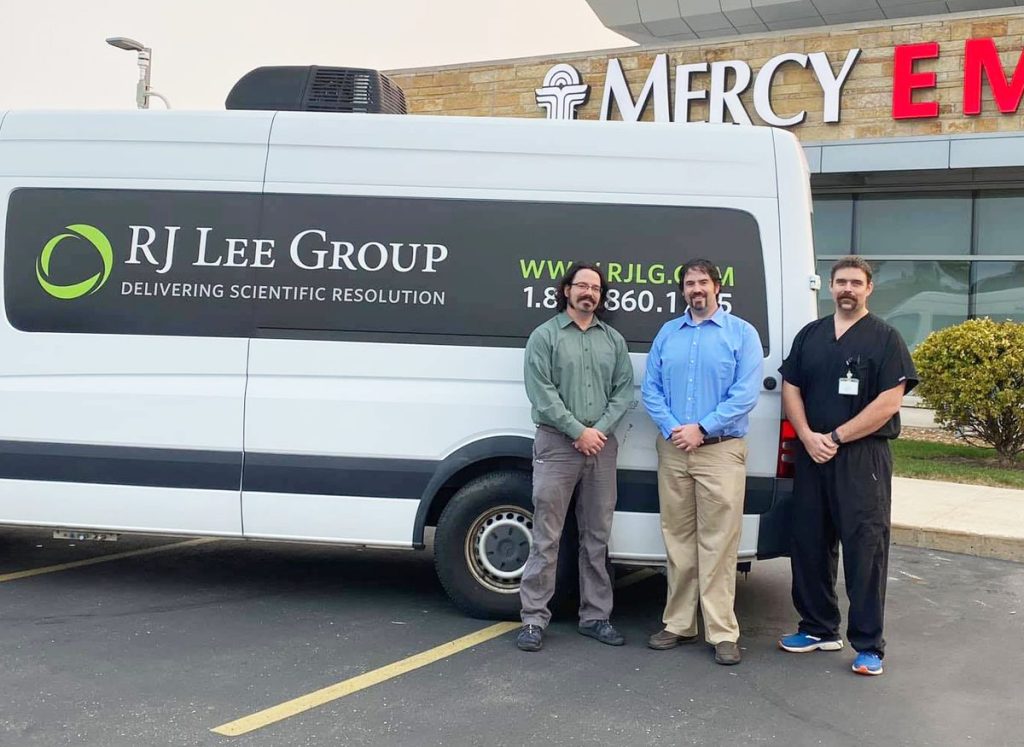
Brothers Jonathan, Skyler and Christopher, shown from left to right, have worked together to create a COVID-19 breath test. Two of the brothers, Jonathan and Christopher are graduates of Northwest Missouri State University. The trio created a working partnership between RJ Lee Group, Mercyhealth, Wistrom Brothers LLC and Practical Sustainability, a chemistry consulting firm in Maryville to create the test.
MARYVILLE, Mo. — It started with an unassuming phone call between two brothers. Jonathan Wistrom — a consultant for RJ Lee Group, a chemical laboratory and forensics consulting firm — was chatting with the company’s CEO, Richard Lee, when Lee posed the kind of question they’d need a doctor to answer, a question that has prompted groundbreaking research in the realm of COVID-19 testing.
The firm, like many businesses, had taken a hit amid the COVID-19 pandemic. Wistrom said revenues dropped nearly 90 percent, as a majority of clients lost business of their own, making the group’s consulting work a luxury most couldn’t afford. Ailing financially and without work to occupy consultants like Wistrom throughout the day, Lee wanted to know what the company should focus its energy on.
“He’s like, ‘Well, what else can we do to help this situation; help people; help get life back to normal?” Wistrom recalled.
Wistrom, a 36-year-old self-described “lab geek” with a chemistry degree from Northwest Missouri State University, didn’t know the answer himself, but he knew someone who did. His brother, Christopher Wistrom, is an emergency room physician at Mercyhealth, a hospital group with outposts across the nation, including in Janesville, Wisconsin, where Christopher, 39, has toed the front line in the country’s fight against the coronavirus pandemic.
When he took Jonathan’s phone call some time in May, chatting with his brother and a group of colleagues from RJ Lee, a 10-minute talk turned into something more, Christopher said. The group of “nerdy nerds,” as Christopher labeled them, quizzed the doctor on all-things COVID-19, while he inquired about the specialized work the laboratory group ventures into. At some point during the phone call, a consultant with the lab group mentioned a gas analyzer, primarily used for environmental sciences, that the group said had a stronger sense of smell than a dog.
Thinking back to an article he’d read about dogs detecting the presence of COVID-19 in virus patients, Christopher developed a thought amid the phone call that has led to months of research and what could be a billion-dollar idea.
“I said, ‘Well, have you ever used (the gas analyzer) on humans before,’” said Christopher, a Stanton, Iowa, native who received his undergraduate degree from Northwest in 2004 before heading to medical school.
“Well, no,” Christopher recalled the group telling him.
“Why not?” Christopher shot back, before detailing his thought process to those present on the call. “Because, in this time frame, with this high-sensitive machine — if it can smell better than a dog, we should be able develop a COVID test for it, right? Because a dog can smell COVID, why can’t the machine?”
In the aftermath of the phone call, Christopher was impressed with the idea he and the other participants had brainstormed. He was convinced someone should run with it, though his thoughts then were largely abstract. Wrapped up in his work as an emergency room physician amid a global pandemic, he had no immediate plans to pursue the idea any further until Jonathan called again, he said, close to a week later.
“He’s like, ‘Hey, remember that conversation?’” Christopher recalled.
“Yeah,” Christopher told him.
“Do you want to do that?” Jonathan asked, according to Christopher.
“You know, I thought somebody should do it,” Christopher told Jonathan then, sometime in the early summer after their initial phone call in May. “Why not us?”
The pair of brothers, both Northwest alumni, spent much of the summer tempering their own hopes and planning for a testing trial that might change the course of history, or at least, the course of a deadly virus’s tear through the United States.
Creating a working partnership between RJ Lee, Mercyhealth, Wistrom Brothers LLC and Practical Sustainability — a chemistry consulting firm based in Maryville — the brothers have launched one of the largest attempts at creating a COVID-19 breath test, one that can detect the virus on the breath of a patient in seconds, serving as a potential game changer in the fight against the coronavirus and a partial piece of roadmap back to normalcy.
“I’m thinking airlines, airports, ports of entry, cruise ships, stadiums,” Christopher said. “I mean, up here in Wisconsin, we’re in Packer Country, man. It’s the way for us to get out of limbo and back to Lambeau. We want that. We want that normalcy.”
After engineering the gas analyzer to test for the physiological changes in a person’s breath caused by COVID-19, the team of researchers, headed by Jonathan, Christopher and Skyler Wistrom — the youngest of three brothers who serves as the business manager at Practical Sustainability — sought approval from an independent review board and began testing COVID-19 patients at Mercyhealth North in Janesville soon after.
“We asked the question, basically, ‘Can it be done?” Christopher asked. “Within the first four hours of pulling samples, it was very obvious that it could be done.”
Over several months of testing starting in September, the group’s COVID-19 breath test — unique in that it doesn’t scan for antigens or antibodies — was used on nearly 1,000 patients who were set to receive a PCR test, the gold standard in the realm of virus testing. The breath test shows 85 percent sensitivity and specificity among all tested, with each figure jumping close to 95 percent in the 60-and-above age group.
The unlikeliness of these findings isn’t lost on the brothers, who have worked their way from the southwest corner of Iowa to the doorstep of a scientific breakthrough — one that started with a brief phone call that was never meant to be the breeding ground for this kind of innovation.
“Dude, the Wall Street Journal called me today,” Christopher told The Forum on Tuesday. “I’m not kidding. I am a small town kid from a town of 700. I turned wrenches with my grandparents and my father well-into college. I just sort of forgot when to quit going to school, dude. I don’t come from wealth. I don’t come from a great, big background. Some idiot let me into medical school and I refused to fail, OK? The Wall Street Journal called me today. I’m blown away, man.”
The work, of course, is not finished. With the first round of testing complete in Janesville, the group of researchers is getting set to conduct further studies at additional hospitals, including the Henry Ford Health System in Detroit, where Christopher completed his residency. The group is aiming to expand testing, particularly in the under-60 age group, where researchers hope increased testing levels might bring a higher degree of sensitivity and specificity ratings.
If everything goes perfectly, Christopher said, the group hopes the breath analyzer is FDA approved, manufactured and marketed by March — paving the way for a world with several COVID-19 vaccines and a rapid-paced testing system in place before next summer, inching the nation toward a return to normal life.
“We need to increase that data set so that we know that it works and works well for all comers,” Christopher said. “And then we get creative, and maybe open up Disney.”