A lesson from 1918
1918 DAILY DEMOCRAT-FORUM
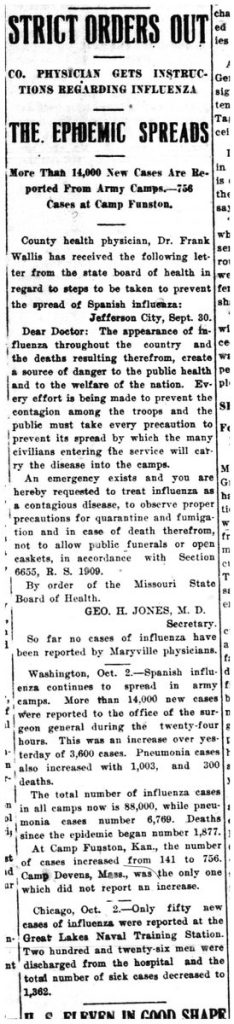
Oct.2 – The epidemic spreads – By October, the nation is in the throes of the deadliest period of the flu pandemic, with all corners of the country — including Maryville and Nodaway County — feeling its effects. According to the CDC, in October alone, an estimated 195,000 Americans die to the flu. Camp Funston The first major outbreaks of the flu were reported from Army camps, beginning with Camp Funston in Fort Riley, Kansas, in March when hundreds of soldiers fell ill while preparing to ship out to Europe near the end of World War I.
Newspapers are both a time capsule — allowing us to see moments frozen in time with the date helpfully printed in the corner — and a time machine — letting us immerse ourselves in a time that’s not our own.
Decades from now, when curious readers, or perhaps students saddled with a history project, leaf through the pages of The Maryville Forum in their 4-D virtual reality suites, we think our weekly coverage of the lives and times of 2020 serve as both a worthy time capsule and machine, capable of transporting those future readers into our shoes, to know the fears, the tribulations, the debates, and the too few joys that are part of our everyday lives during this global pandemic that has turned our world upside down.
We know this because leafing through the pages of our town’s newspaper of record from more than 100 years ago, we find those same fears, those same tribulations and those same debates, as the people of Maryville in 1918 dealt with the all-too-similar effects of a global flu pandemic.
Across the newspaper clippings presented here, and the full set of more than three dozen available on maryvilleforum.com, you’ll see the beginnings of the 1918 flu pandemic in Maryville at the beginning of October, and follow the city’s response through the end of November as residents deal with the increasing virus threat and the end of a long, brutal, overseas war — a two-month slice of an unfamiliar time in a place we all know well.
You’ll become familiar with some local residents, like city physician Dr. F.M. Ryan, who find themselves thrust into a situation they never could have imagined, with responsibilities they weren’t fully prepared for — sound familiar?
And although much will seem familiar or even indistinguishable from something you’d see in today’s Forum, there’s much that won’t, too.
Unlike today, when the county health department is in communication daily with the public, reporting case numbers and conducting contact tracing, the Maryville and Nodaway County residents of 1918 did not have access to such information. There are no cumulative totals, or running tallies, or other handy measurements to help readers wrap their heads around the scope of the pandemic locally.
And much of that lack of information comes down to how the practice of journalism has evolved over the past 102 years as well. What you won’t see in the 1918 editions are staples of our newspaper today: interviews with residents, extensive quotes and explanation to hold public officials accountable and put their answers in context, and, perhaps most notably, no pictures.
There may not be any new lessons to be learned from the experiences we share — and those we don’t — with our fellow citizens of more than a century ago (though there almost certainly are), but as the quarantined residents of 1918 clogged the phone lines and we slow down our internet to a crawl while cooped up inside, maybe just making the connection — even across more than a century — is more than worth it during a pandemic, no matter what year it is.
We thank our friends at Northwest Missouri State University’s B.D. Owens Library for their help in assembling the clips, taken from microfilm stored at the library, for this project.

1918 DAILY DEMOCRAT-FORUM
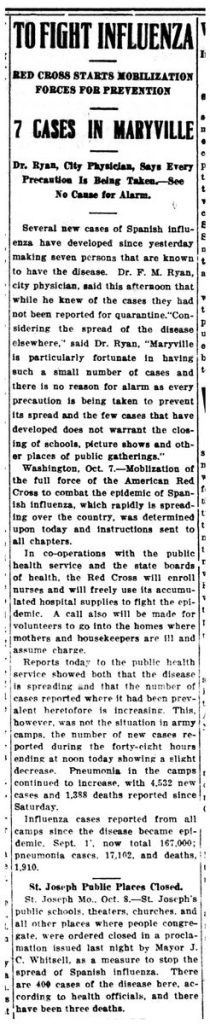
Oct. 7 – The flu reaches Maryville, with the first reported cases in town. Experience of 1890 – The first truly global epidemic made its way across the world in 1889-1890, killing an estimated 1 million people worldwide. Though believed at the time to be influenza — and popularly called the “Russian influenza” or “Asiatic influenza” — some scientific evidence has suggested that it may have actually been closer to the coronavirus strain affecting us today — COVID-19 — than to a strain of the flu. Quarantine – In 1918, anyone diagnosed with the flu would be ordered by the city physician to quarantine, along with their entire household. Placards announcing the house’s quarantine status were placed outside to warn off visitors. Today, this practice would violate health privacy laws, and thus be frowned upon. Ordered closed – This is the first mention of any schools or other buildings being closed (or cloesd) in the area, but a recurring theme in these reports will be the lack of information from more rural areas about the extent of the outbreak. While exact numbers are not always available at this time even in Maryville, the outlying areas are almost never described with numbers at all, just general impressions from the city’s doctors who go out to treat patients in the county. Keep the lights burning – Although 1918 wasn’t a presidential election year, there were still important issues on the ballot, including a local one: a measure that would pay for an electric company to light up Maryville’s street lights at night. The measure, clearly supported by the newspaper in the news section — something that would not happen in today’s Maryville Forum — would pass, replacing the city’s kerosene lanterns with electric bulbs. Spanish Influenza – Although colloquially referred to as the “Spanish Flu” in the United States, the name has nothing to do with where the virus originated. Instead, the first cases were reported in the U.S., France, Germany and the United Kingdom — all of which were involved in World War I and had imposed censorship on newspapers to discourage negative reporting during wartime. Spain, however, was neutral in the war, and so the effects of the sickness in that country were widely and freely reported on, making it seem to readers as if the sickness was particular to Spain at first. Rules – Although some of these suggestions probably would not be repeated today, many of them are familiar to anyone who has seen warnings from the health department about stopping the spread of COVID-19: avoiding crowds (and picture shows!), washing your hands and keeping your feet warm. Well, maybe some of those are more familiar than others.
1918 DAILY DEMOCRAT-FORUM
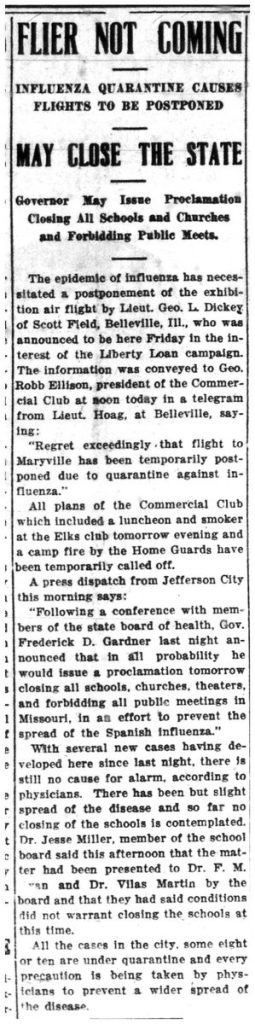
Oct. 8 – Three new cases are reported, but city physician Dr. F.M. Ryan says there is no reason to panic or shut down any businesses. Just like the beginning of the COVID-19 pandemic in Maryville, the rural area of northwest Missouri lagged behind other places in seeing virus numbers rise, but it wouldn’t last. According to the annual report issued by the State Board of Health of Missouri for 1918, influenza would be listed as the cause of death for 59 Nodaway County residents that year. And unlike COVID-19, the flu proves to be particularly dangerous for relatively young people: 1918 Nodaway County deaths due to influenza Under 1 year: 1 1 year: 2 2 years: 1 3 years: 2 4 years: 0 5-9 years: 3 10-19: 8 20-29: 22 30-39: 10 40-49: 6 50-59: 0 60-69: 1 70-79: 3 Full force – Thousands of women served as nurses during World War I. Then, they were stretched even thinner as higher and higher demand for nurses back home continued to rise amid the pandemic. Still, despite the pressing need, the “full force of the American Red Cross” would not include any Black nurses until after the war was over, when only 18 were admitted at first.
1918 DAILY DEMOCRAT-FORUM
Issue a proclamation – Gov. Frederick D. Gardner would not issue such a proclamation the next day, but instead issue a proclamation that merely urged local officials to put in place measures like closing public places and putting a cap on public gatherings — not a mandate. Some eight or ten – Unlike in 2020, when the county health department issues daily reports on any new cases of COVID-19 reported in the county, there was no such uniform reporting apparatus for the public in 1918. Instead, informal reports collected by the Democrat-Forum from local doctors were the most complete count the public had access to. Unfortunately, that meant the number of cases was often more of a range rather than an exact figure, and even then, usually only accounted for the cases reported to the city physician by other doctors or by his own patients.
1918 DAILY DEMOCRAT-FORUM
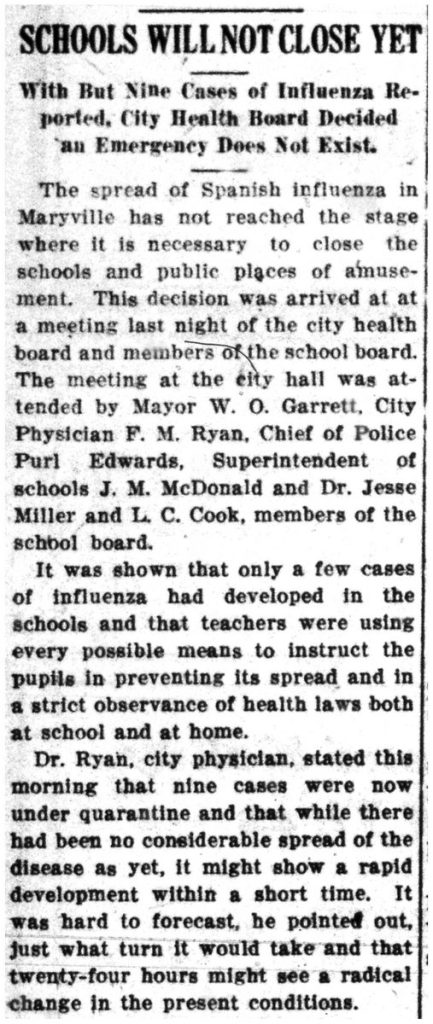
Oct. 10 – Schools wont close – As numbers rise modestly, public officials in Maryville try to keep public places operating, and the city doctor cautions that the situation is day-to-day — conversations that could be transplanted wholesale to 2020 with very little in the way of changes.
1918 DAILY DEMOCRAT-FORUM
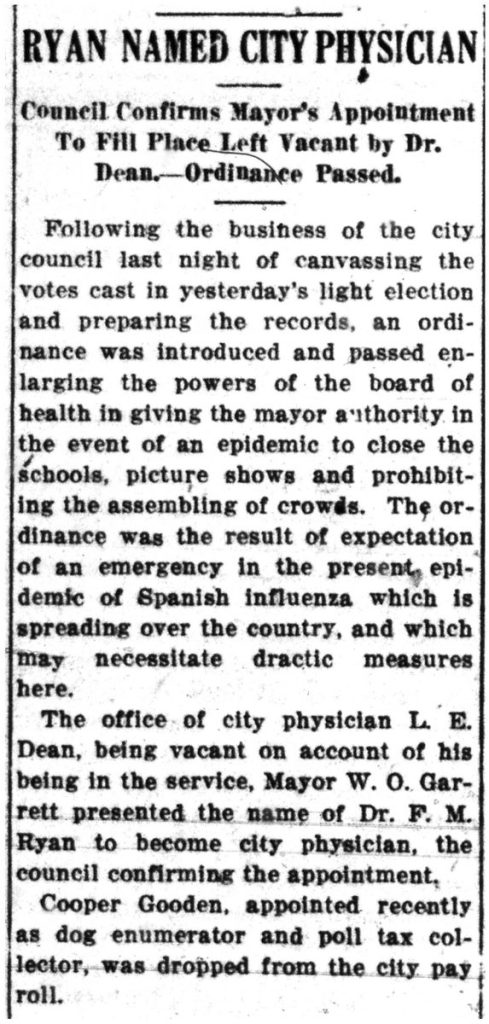
Oct. 10 – As has been noted already, Dr. Ryan, who is an important local figure in the city’s response to the 1918 epidemic, was serving as the city physician, a position that no longer exists. It appears that Ryan was serving in the position on an acting basis while Dr. L.E. Dean was serving in World War I. At a Board of Aldermen meeting, the city codifies Ryan’s appointment, along with ending pay for a city position that — regrettably — has also not been reinstituted: dog enumerator.
1918 DAILY DEMOCRAT-FORUM
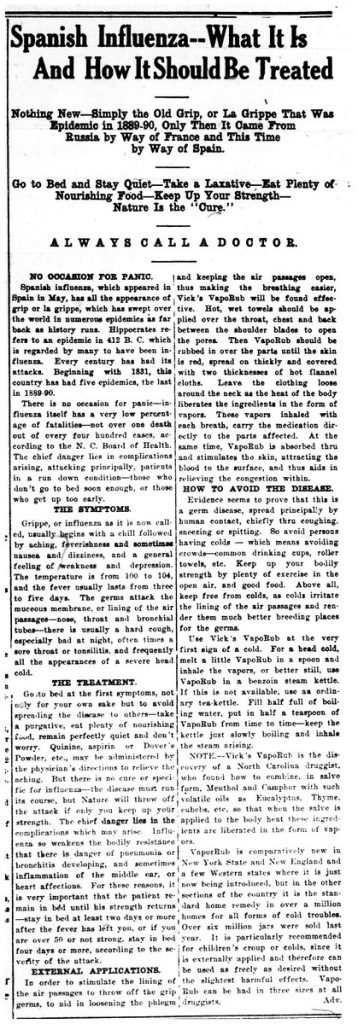
Oct. 11 – What is flu? – An advertisement extolls the virtues of Vick’s VapoRub to help with flu symptoms (and repeats the incorrect claim that the flu came “by way of Spain”). Vick’s VapoRub would see sky-high sales during the pandemic, including in Maryville.
1918 DAILY DEMOCRAT-FORUM
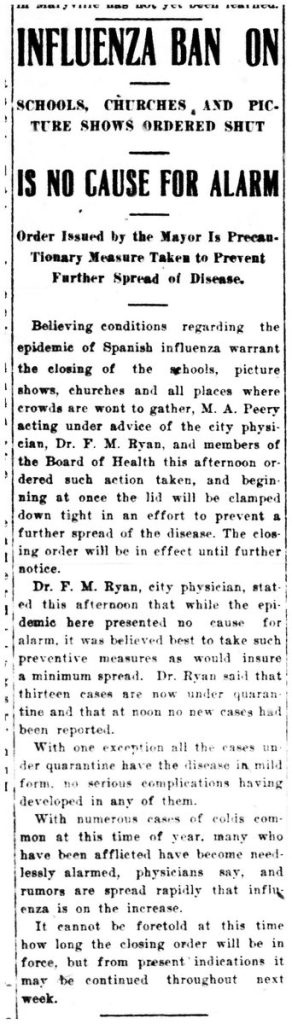
Oct. 12 – Influenza ban on – The closing of public places — instituted after 13 cases were diagnosed in Maryville — would continue longer than the newspaper report pictured here anticipated. Doctors and even the newspaper reporters themselves seem to take great care throughout the pandemic that things are under control, and there is no cause for alarm.
1918 DAILY DEMOCRAT-FORUM
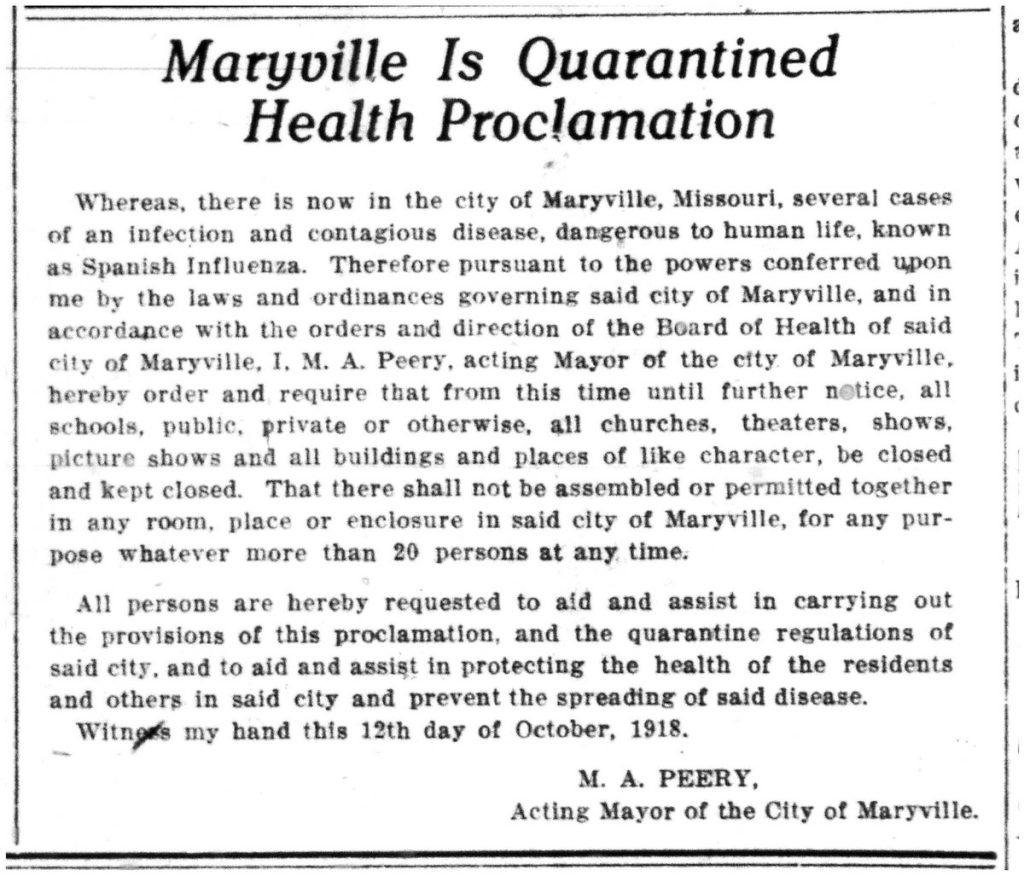
Oct. 12 – Proclamation – The official proclamation shutting down most public gathering places and putting a cap on gatherings at 20 people.
1918 DAILY DEMOCRAT-FORUM
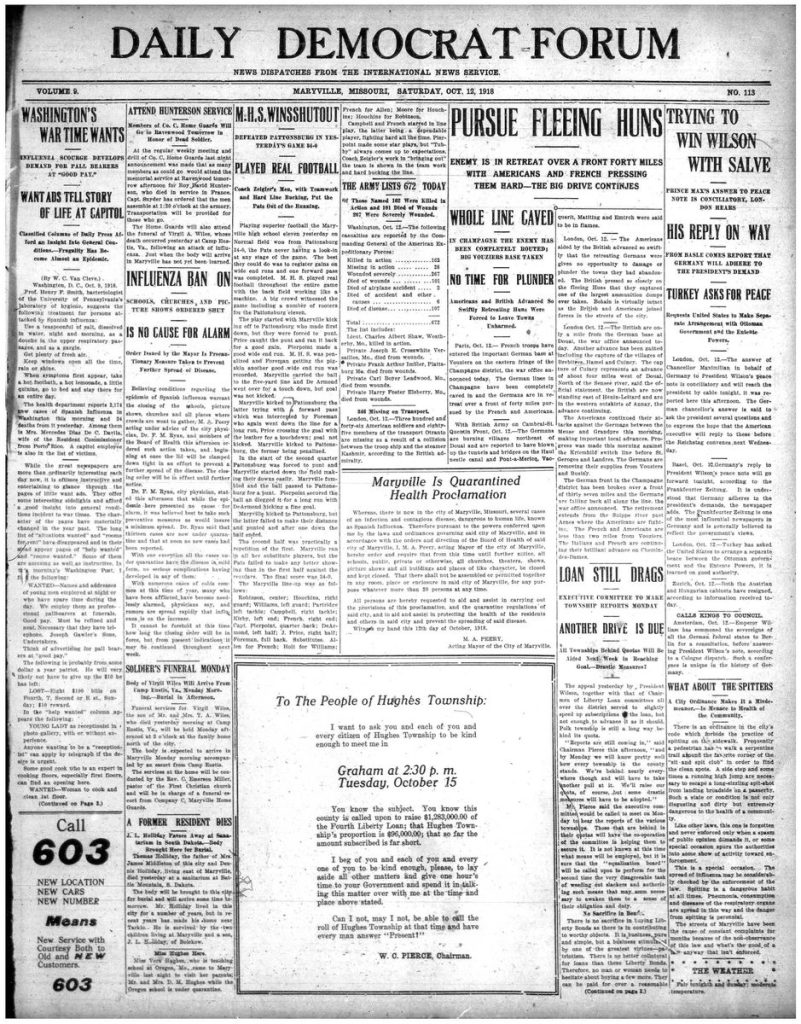
Oct. 12 – Shutdown – Just two days after Dr. Ryan says there is no need to shut down public places, the city does just that, issuing an order to close schools, churches, picture shows and all other public gathering places, and places a cap on any indoor gatherings of people at 20. This is the front page of that edition, which also gives a window into the other goings-on of the time — locally, across the country and the world. Co. C Home Guards – The Home Guards were Missouri Union militia raised during the Civil War, and their surviving members continued to gather after the war as American Legion members might today. Hunterson Service (Top second column from left) – Funerals, including for service members whose remains were returned from the front in Europe, would be banned as well by Maryville city officials. But in outlying areas, that was often not the case, and the funerals would be suspected by public health officials of being what we would call today “superspreader” events. M.H.S. Wins Shutout (M.H.S. Wins Shutout, top third column from left) – This being a Maryville newspaper, even in 1918 the high school football team was both front-page news and successful, in this case shutting out Pattonsburg 34-0 in a rout. The game of “real football” played here, though with many of the same fundamentals, would look very different from the sport played today. The first thing spectators would likely notice is of course the lack of pads and, if they were wearing any headgear at all, players would at best be wearing a thin leather cap. The game itself would look different too, with the forward pass a rarity, instead relying on bruising blocking and running. PURSUE FLEEING HUNS – Daily dispatches were printed in the paper to update readers on the state of World War I. By this point, the United States had joined the war and was sending thousands of Americans to Europe every day. The news from the international wire services were providing mostly good news for American readers these days, though government censors had made sure that most news coming from the front was positive one way or another. In this case, it was mostly true, with Allied forces pushing Germany toward an armistice in just another month. LOAN STILL DRAGS (2nd column from right, halfway down) – Liberty Loan drives raised billions of dollars for the war effort by encouraging citizens to buy government bonds — “Liberty Bonds.” The government set target quotas for local areas, including as small as townships, like any organization sets fundraising goals. WHAT ABOUT THE SPITTERS (last column on right, all the way down) – A review of the current city ordinances shows that this rule is no longer on the books, perhaps because, by all accounts, it appears the “sit and spit club” hasn’t been in session for years.
1918 DAILY DEMOCRAT-FORUM
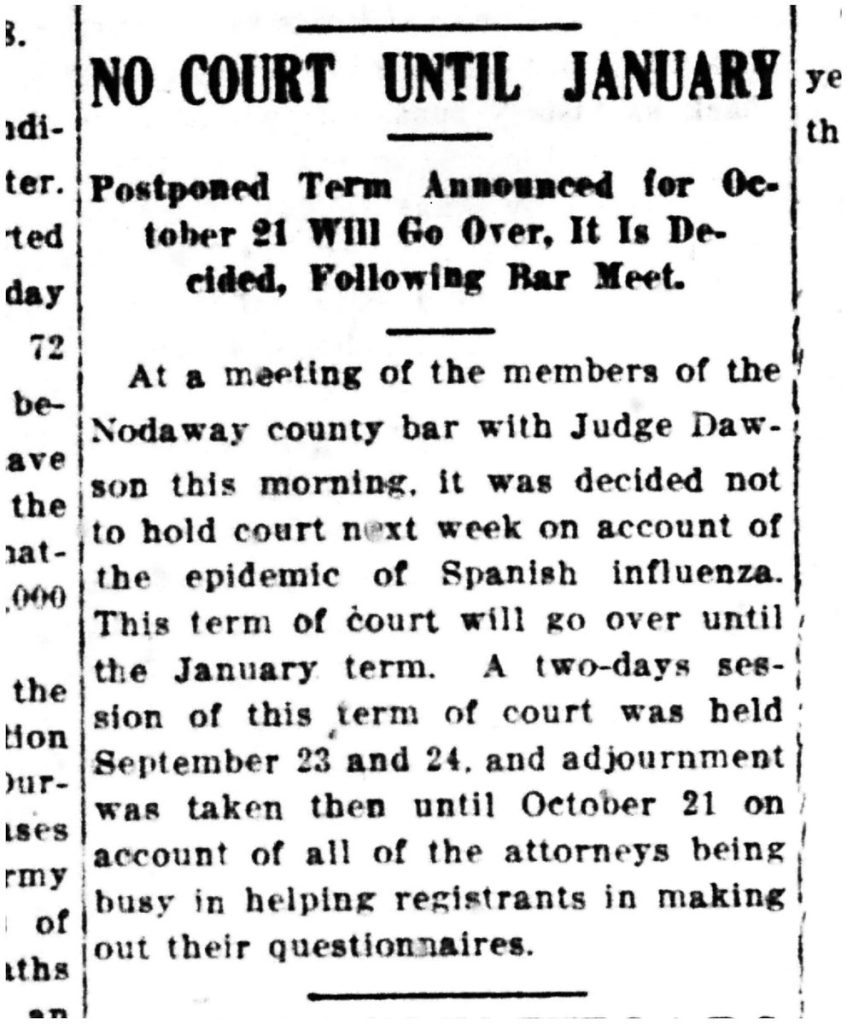
Oct. 14 – Court closes – Just like in 2020, courts were initially closed during the pandemic to help mitigate the spread of the flu.

1918 DAILY DEMOCRAT-FORUM
Oct. 14 – National death total – The influenza continues to spread nationwide, and the response is hindered by the lack of doctors, nurses and other health care workers, many of whom are across the Atlantic serving in World War I.
1918 DAILY DEMOCRAT-FORUM
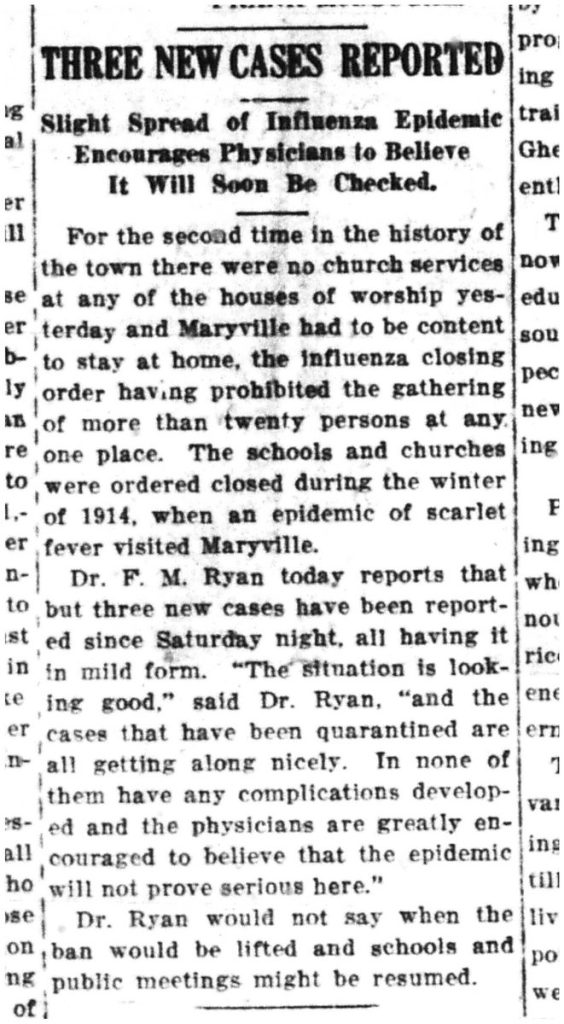
Oct. 14 – Three new cases – Three new cases are reported as the lockdown continues, prompting the newspaper to compare it to an outbreak of scarlet fever in Maryville in 1914.
1918 DAILY DEMOCRAT-FORUM
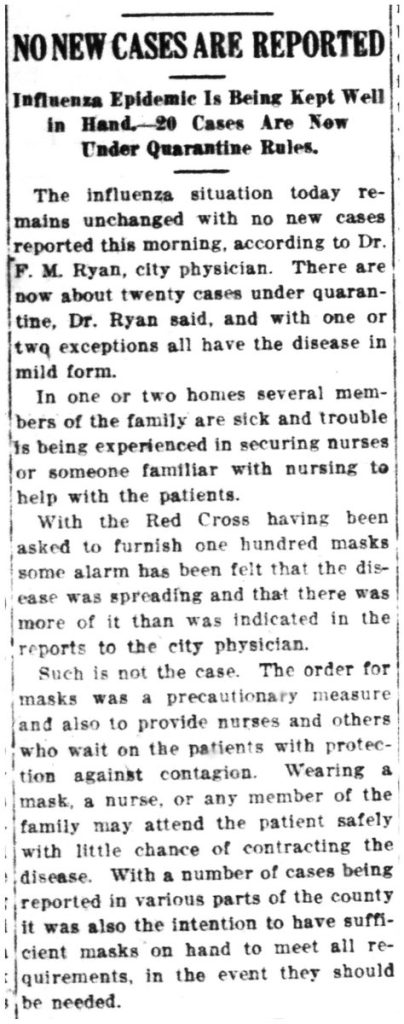
Oct. 16 – No new cases – The count in Maryville is up to 20, including a couple of more serious cases. Additionally, the newspaper reports a lack of health care workers to care for patients, and masks ordered for them. No mask mandate would apparently be considered for the general populace in Maryville, though the virtues of family members and health care workers wearing masks when around those with the flu are explained clearly here.
1918 DAILY DEMOCRAT-FORUM
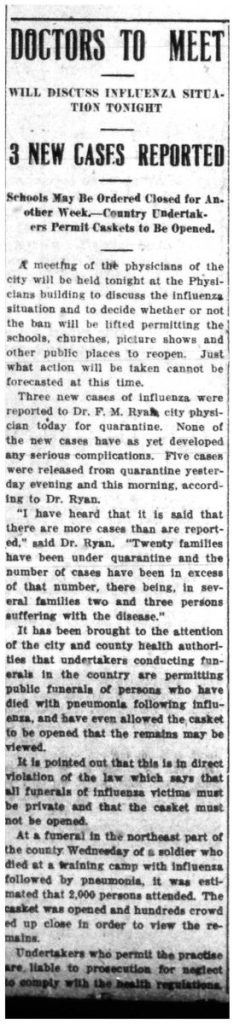
Oct. 18 – Doctors to meet – City doctors meet to discuss whether to recommend ending the shutdown or continuing it, and the first major rift appears between city residents and those in the outlying areas — a recurring theme that will pop up again and again over the coming weeks. This disagreement is over open-casket funerals, and one in particular that reportedly attracted thousands of attendees.

1918 DAILY DEMOCRAT-FORUM
Oct. 19 – Ban remain on – The city physicians recommend keeping the shutdown going, though new cases remain low. Keep to ourselves – Dr. Ryan’s advice calls to mind the pleading of doctors in 2020, asking residents to stay home and avoid crowds.
1918 DAILY DEMOCRAT-FORUM
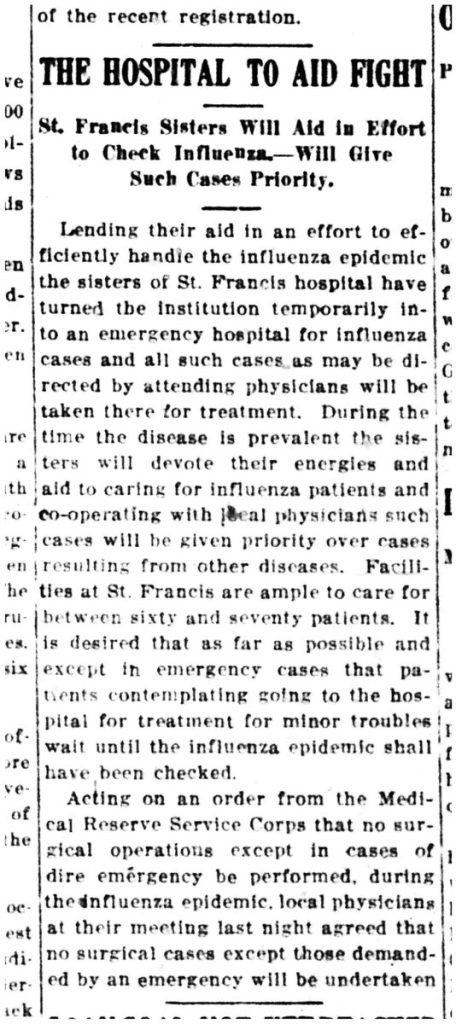
Oct. 19 – Hospital aid fight – St. Francis Hospital in Maryville pledges to prioritize influenza patients, and asks other non-emergency patients to stay home if possible.
1918 DAILY DEMOCRAT-FORUM
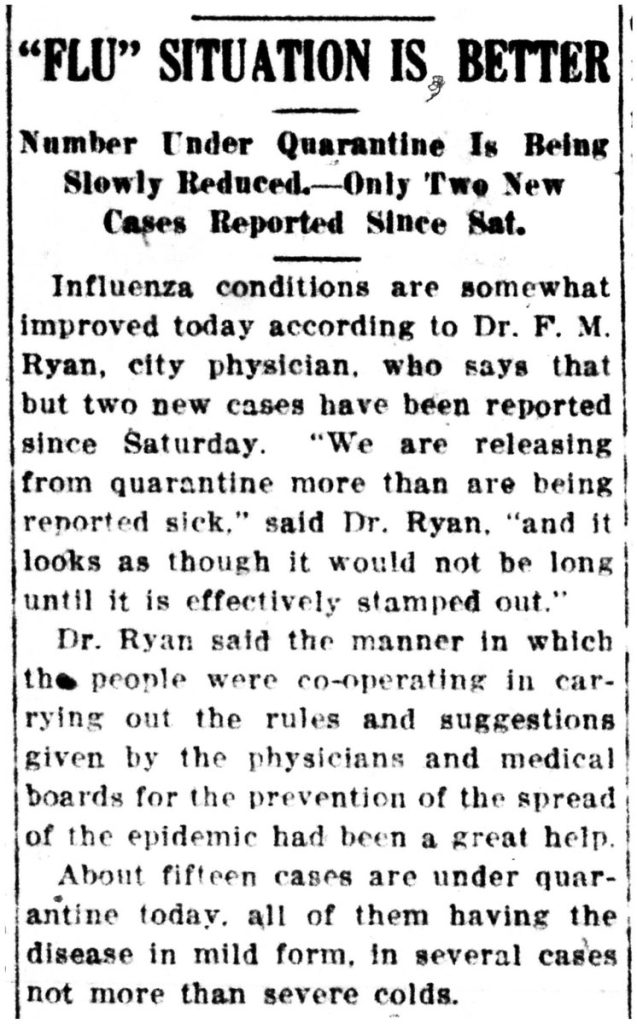
Oct. 20 – Flu situation better – Dr. Ryan predicts that the flu may soon be stamped out, but unfortunately his prediction does not prove true.
1918 DAILY DEMOCRAT-FORUM
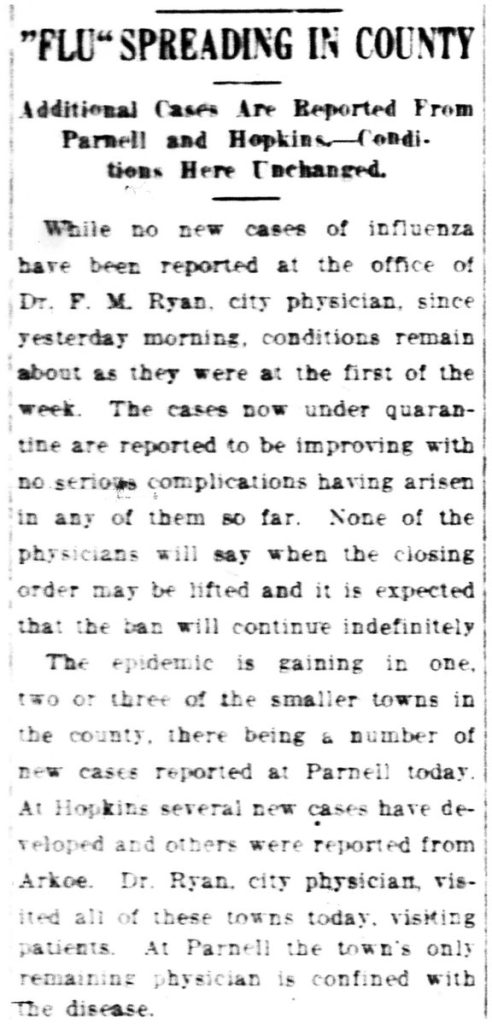
Oct. 23 – Flu spreading in county – The spread of the flu continues in smaller towns throughout the county. With exact numbers unavailable, it’s impossible to tell just how much, but later entries seem to indicate that with fewer preventative measures in place, smaller communities were hit relatively hard by the sickness.
1918 DAILY DEMOCRAT-FORUM
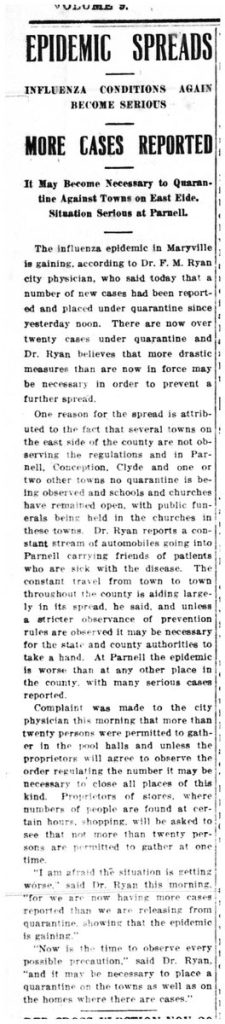
Oct. 24 – Epidemic spreads – Just days after saying the flu may soon be stamped out, Dr. Ryan says that more drastic measures may be needed, even suggesting a town-wide quarantine. One reason – To Dr. Ryan, the disparity between measures taken in Maryville and other areas of the county continue to stand out in stark contrast, in some ways reflecting a similar debate happening right now during the current pandemic. In Parnell – Once again, concrete information about the state of the virus in smaller communities in Nodaway County is hard to come by, instead described in vague terms. It stands out as one of several examples of how the practice of journalism has evolved since 1918: in today’s Forum, readers would (hopefully) never find such an assertion unsourced or without some kind of supporting data. In 1918, reporting like this was the norm. Complaint was made – As is the case now, some people continue to gather despite the ordinances and recommendations, while others call for stricter enforcement of those ordinances.
1918 DAILY DEMOCRAT-FORUM
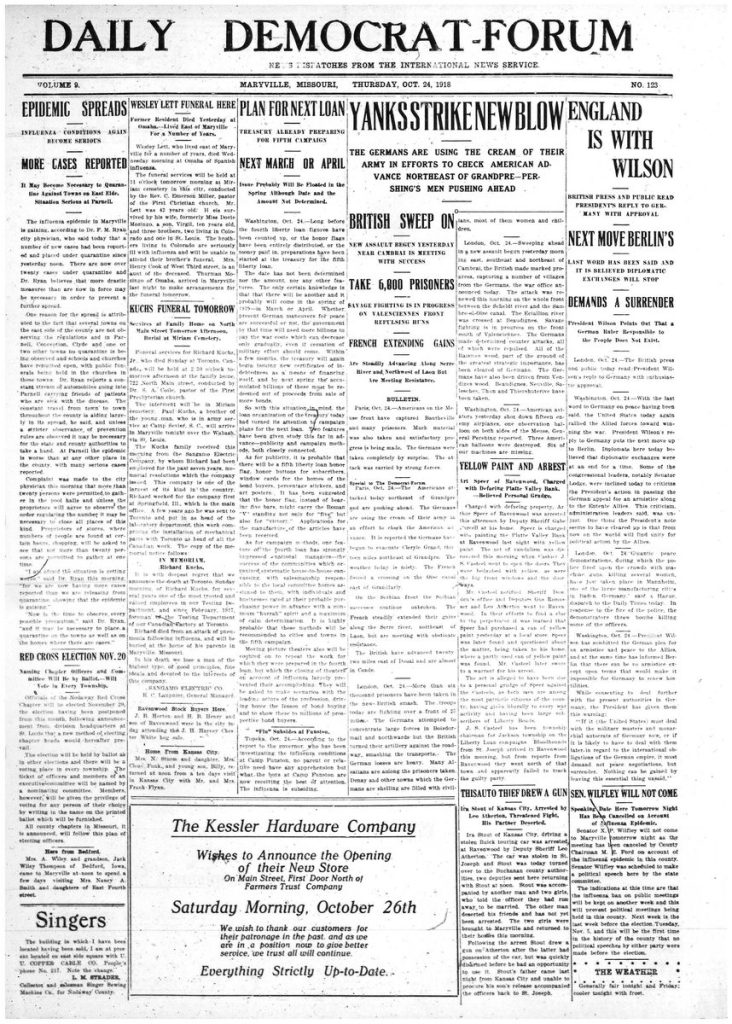
Oct. 24 – Epidemic spreads front page – The front page shows that the flu situation has become “serious.” News from Europe continues to be positive for American readers, with Gen. John J. Pershing continuing his drive toward the east, and England backs President Woodrow Wilson’s demand for a German surrender. YELLOW PAINT AND ARREST (Second column from right, halfway down) – Odd crimes are of interest to readers in any era, and this one would undoubtedly be trending had it happened in 2020. SEN. WILFLEY WILL NOT COME (last column on right, all the way down) – Missouri Sen. Xenophon Pierce Wilfley — the only U.S. Senator to have sported a first name beginning with “X” — may have found his election chances hampered by being unable to make political speeches by this one, as he would not even gain the Democratic party’s nomination to retain his position. He was appointed to fill the seat after the death of Sen. William J. Stone, who died in April, and would serve for only five months. Republican Seldon P. Spencer would win the special election to serve the remaining two years of Stone’s term.
1918 DAILY DEMOCRAT-FORUM
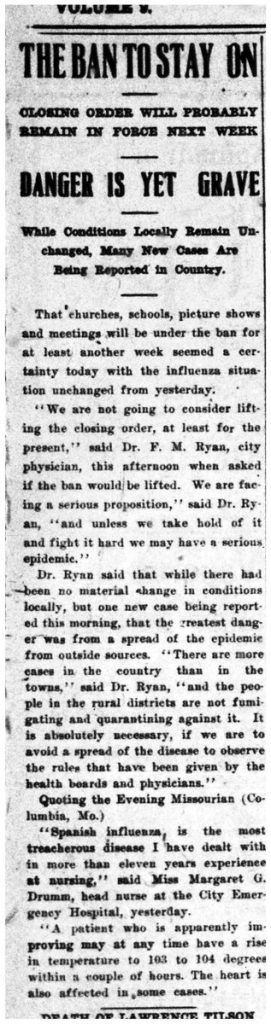
Oct. 25 – Ban stays on – Dr. Ryan makes another plea to county residents to take steps to mitigate the spread of the flu as county health officials recommend the lockdown of public areas continue.
1918 DAILY DEMOCRAT-FORUM
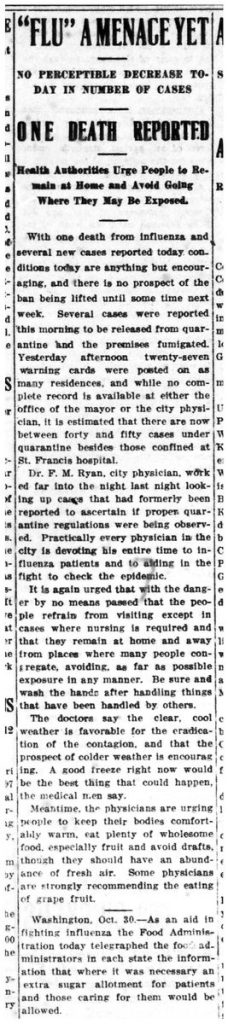
Oct. 30 – Flu menace yet – Maryville sees its first official reported death from influenza. No complete record – As numbers appear to skyrocket — evidently more than doubling in less than a week — the exact count becomes more difficult to pin down. Note that the 40-50 cases are in addition to those at the hospital. Worked far into the night – Like the local health department employees today, Dr. Ryan found himself working long hours just to keep up with tracking ongoing cases. In 2020, the county health department has hired 8 additional workers to help with contact tracing and other demands related to COVID-19.
1918 DAILY DEMOCRAT-FORUM
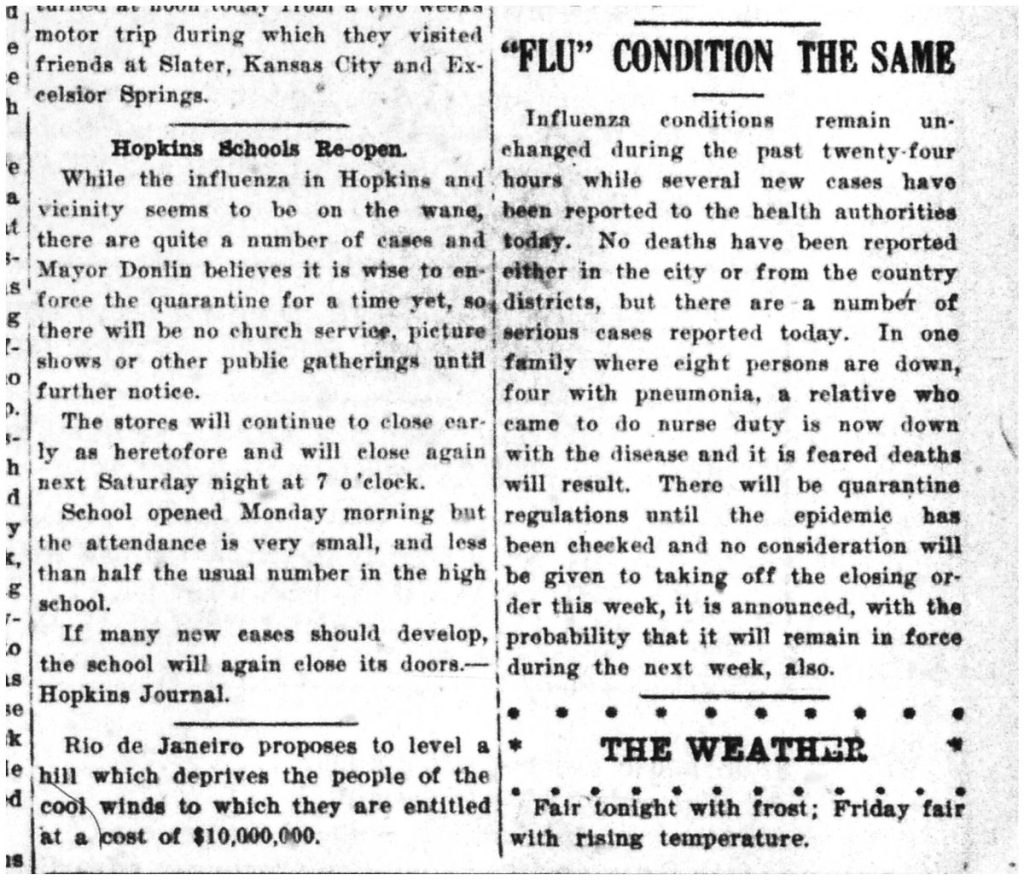
Oct. 31 – Hopkins closings – The first mention here of any specific measures in outlying communities, and information on them remains spotty.
1918 DAILY DEMOCRAT-FORUM
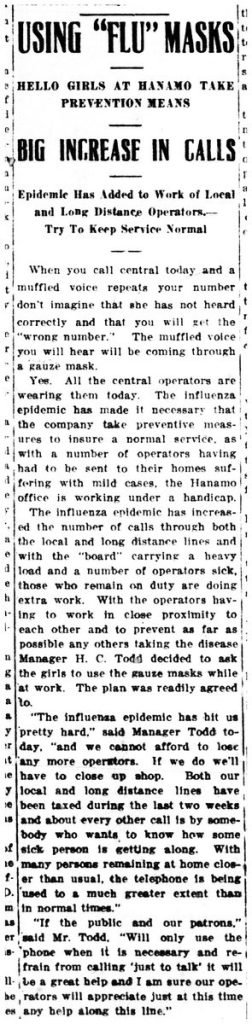
Oct. 31 – Flu masks – Although masks were evidently not considered for the general populace in Maryville, switchboard operators in Maryville began using them to stop employees from getting sick. Hello girls – “Hello girls” was a nickname used at the time for switchboard operators, typically female, who usually answered with “hello.” Instead of dialing someone’s telephone number, callers would connect with a switchboard operator, who would physically connect the call to the requested phone line on the switchboard. HANAMO – An acronym, “HANAMO” stood for Holt, Andrew, Nodaway, Atchison — the counties that the telephone company served — and Missouri. The switchboard was based in Maryville. A much greater extent – Much like during the lockdowns in 2020 when users frequently taxed their internet service providers’ networks, when most people were stuck at home in 1918, they too longed to reach out to socialize. And the best way to do it was by telephone — much to the chagrin of HANAMO Manager H.C. Todd.
1918 DAILY DEMOCRAT-FORUM
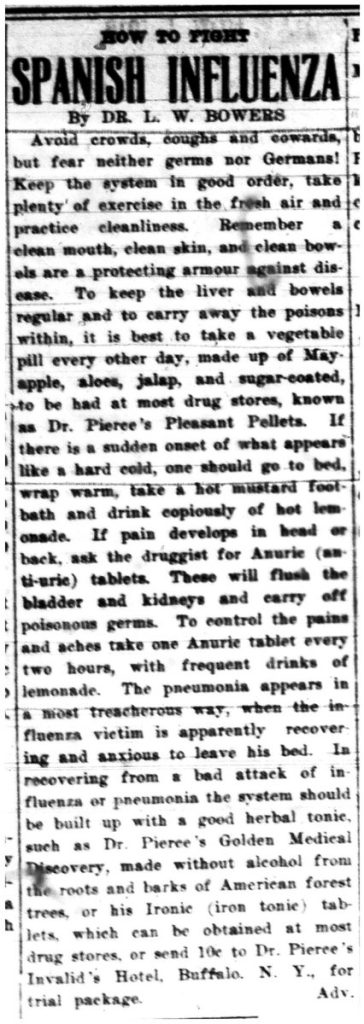
Nov. 1 – How to fight – An advertisement, Dr. L.W. Bowers gives advice on how to combat the flu — some pieces of advice more scientifically sound than others.
1918 DAILY DEMOCRAT-FORUM
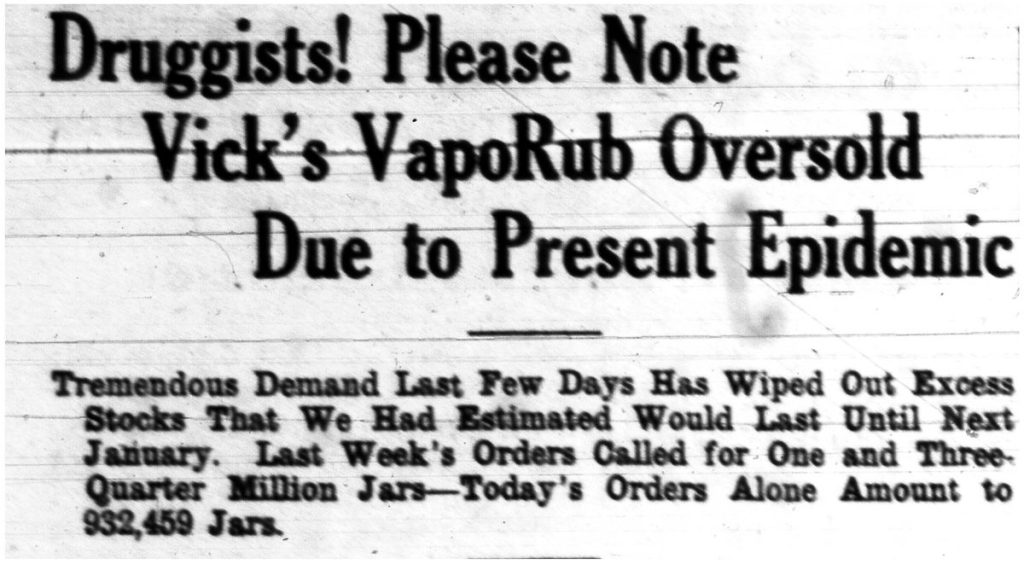
Nov. 1 – Vicks shortage – Treatment of flu symptoms with Vick’s VapoRub cause a widespread shortage.
1918 DAILY DEMOCRAT-FORUM
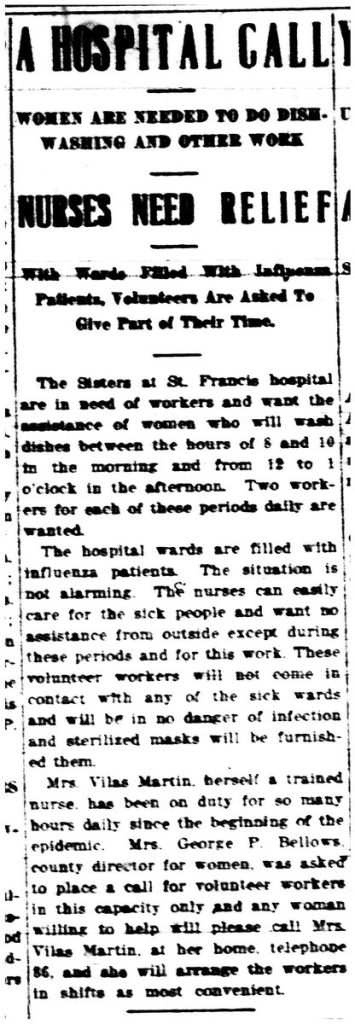
Nov. 1 – Despite the wards being filled with influenza patients and the hospital in need of more employees, “the situation is not alarming.” It’s important to remember that the figures reported by the newspaper only include the tally from the local physician — which theoretically includes reports from other city doctors, but not patients at the hospital, which appears here to be filling up.
1918 DAILY DEMOCRAT-FORUM
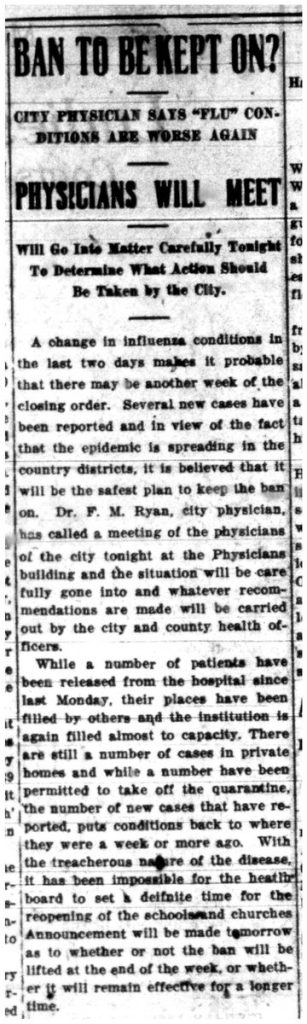
Nov. 7 – Physicians meet – A month to the day from the first reported case in Maryville, and the city’s doctors are set to meet again to discuss whether to recommend extending the closing order that originally went into effect on Oct. 12. Almost to capacity – Although specific numbers from the hospital are still elusive, previous articles had estimated the hospital’s capacity for flu patients at 60-70, but later, the hospital is described as “filled” with somewhere between 30-40 influenza patients.
1918 DAILY DEMOCRAT-FORUM
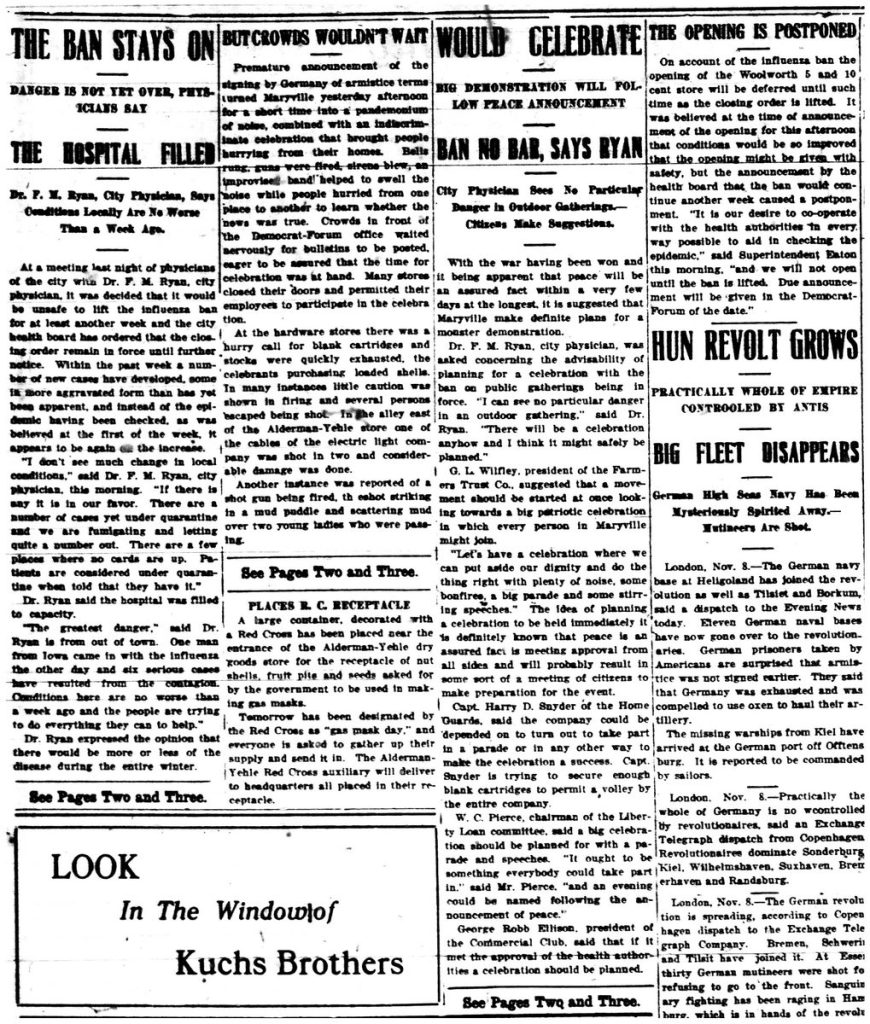
Nov. 8 – Ban stays on – The ban stays on, residents jump the gun — so to speak — on news of an armistice and the city must wait further for a Woolworth’s. BUT CROWDS WOULDN’T WAIT (second from left, top) – On Nov. 7, the United Press wire service prematurely announced that Germany had signed an armistice, but other major wire services — like the Associated Press — did not follow suit. Reportedly, the Allies had sent terms for the Germans’ surrender, but the Germans did not sign the armistice until Nov. 11. The Democrat-Forum did not report the erroneous information in its paper, but covers the fallout here that includes some evidently close calls from celebratory gunshots. Outdoor gatherings (WOULD CELEBRATE, second from right, top) – With the public bursting to celebrate the end of World War I, when it eventually comes a few days later, Dr. Ryan notes that outdoor celebrations would be safer. HUN REVOLT GROWS (right column, down halfway) – At the end of October and early November, revolts among German sailors in Wilhelmshaven and Kiel spread across the country, and help spur the declaration of a republic and the abdication of Kaiser Wilhelm II in a matter of days.
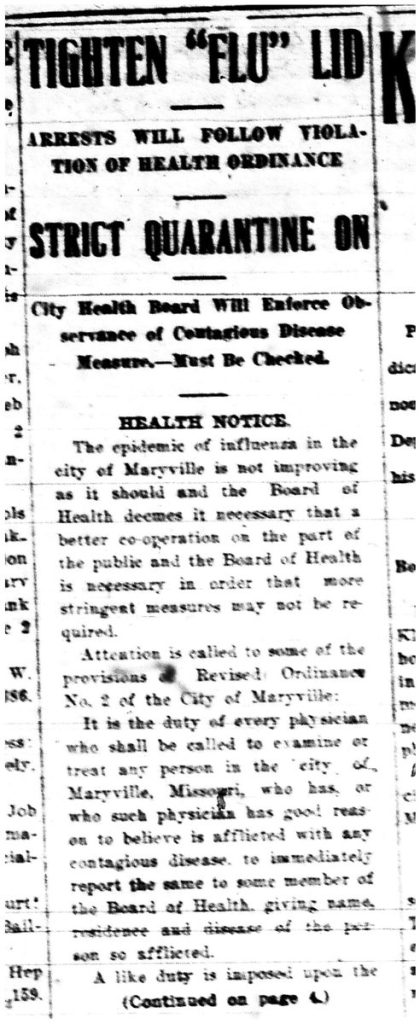
1918 DAILY DEMOCRAT-FORUM
Nov. 9 – Health notice – With the flu situation worsening and the cause suspected to be travel and lax following of health ordinances, the health board announces more stringent enforcement, including the threat of arrests for violating the health codes.
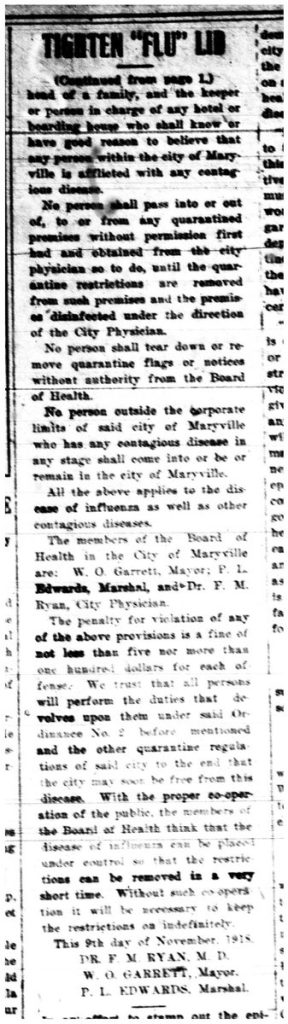
1918 DAILY DEMOCRAT-FORUM
Nov. 9 – Health notice – Continued, the health board pleads with the public to follow the rules so that the lockdown conditions can be lifted sooner, otherwise it could continue “indefinitely.” Fines for not following the ordinances range from $5-100. Accounting for inflation, $5 had the buying power of about $86 in today’s dollars, and $100 had the buying power of more than $1,700 in today’s dollars. To provide some perspective, a loaf of bread would have cost about a dime in 1918.
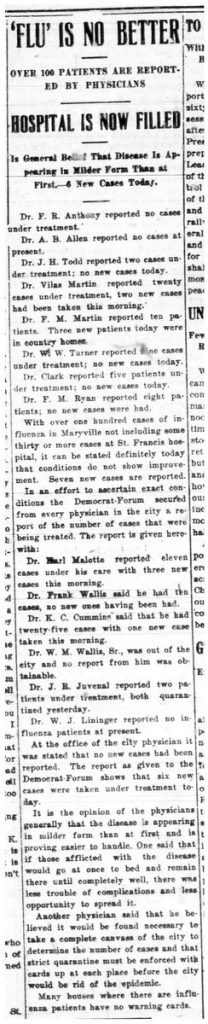
1918 DAILY DEMOCRAT-FORUM
Nov. 13 – Hospital filled – This may be when the number of cases reached its peak in Maryville, though it’s difficult to tell since reporting is far from exact. But with the hospital “filled” and more than 100 patients reported by local doctors, the article notes around 130 total active cases — though it should be noted that the “some thirty or more cases” at St. Francis hospital is about half of what the hospital had estimated it could handle about a month ago. According to U.S. Census information, Maryville had around 4,700 residents at this point. Ascertain exact conditions – The effort is notable here as this is the first time the newspaper has offered a seemingly comprehensive and precise figure for the number of cases in the city. It’s unclear how many doctors’ patients their previous numbers had included. City physician it was stated – This too casts some doubt on previous reporting, indicating that the numbers may have been higher than estimated earlier (as explicitly denied by Dr. Ryan to the Democrat-Forum) because the supposed “total” obtained from the city physician’s office did not match up with the total obtained from the doctors themselves. Why this happened is not explained here, though a similar situation today would likely be an above-the-fold revelation.
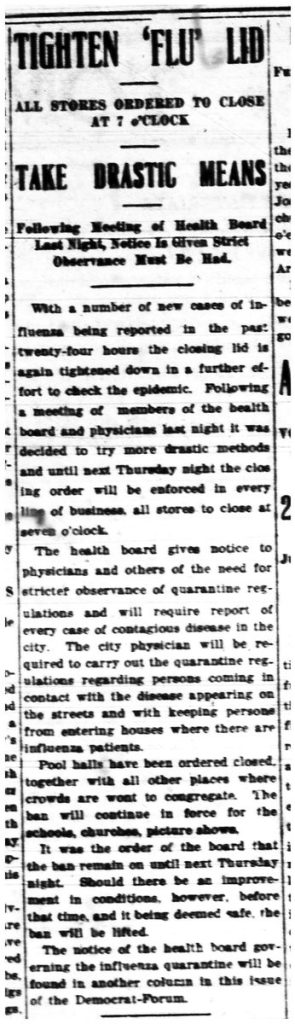
1918 DAILY DEMOCRAT-FORUM
Nov. 15 – Drastic means – Stores are ordered to close at 7 p.m., and pool halls, which previously were noted for being allowed to stay open and sometimes attracting crowds larger than permitted, are shut down alongside schools, churches and picture shows.

1918 DAILY DEMOCRAT-FORUM
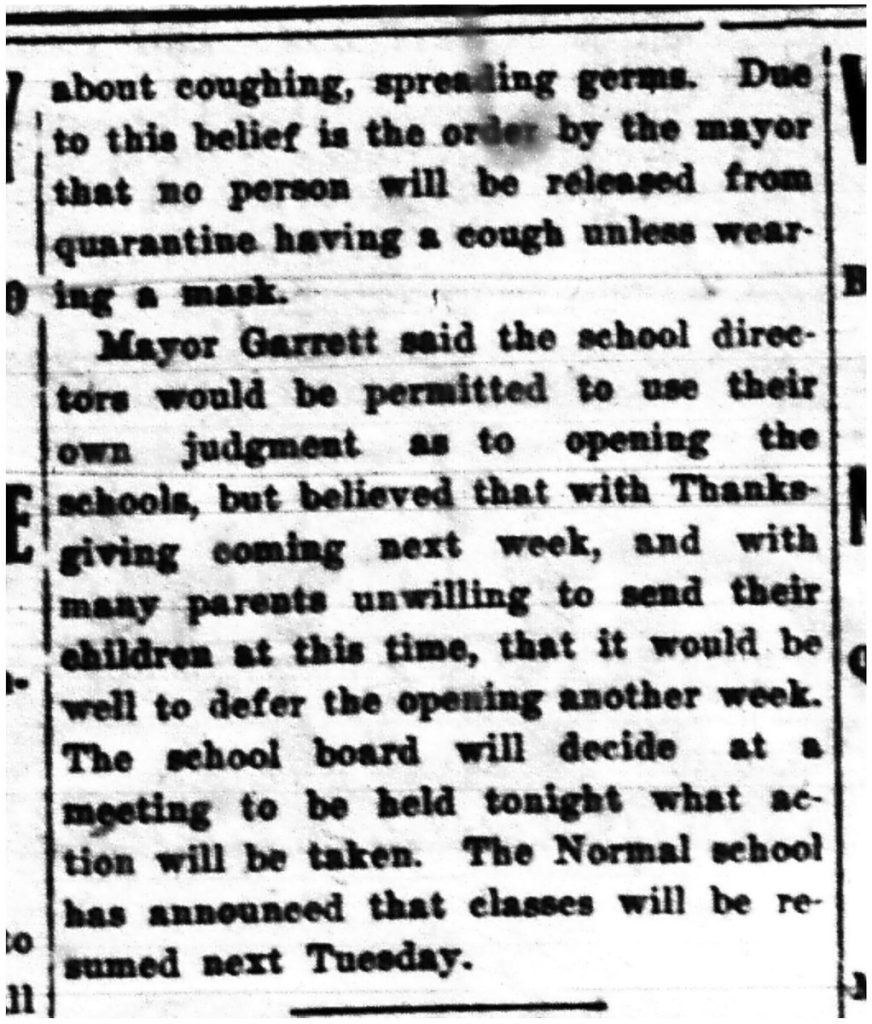
Nov. 22 – Ban lifted (part one) – After 41 days of a shutdown of most public places, and a week of more stringent measures, schools and churches are allowed to reopen. Mayor W.O. Garrett — recently elected in 1918 to his first of seven terms as mayor — says the idea is to shift toward stricter quarantine regulations while loosening restrictions on businesses and other entities that were “hurting things generally.” Although a mask mandate for the general population was apparently never on the table, those exiting quarantine are required to wear a mask under these loosened rules, otherwise they’re sent back to quarantine. Once again, the tension between county and city officials comes to the fore here.
1918 DAILY DEMOCRAT-FORUM
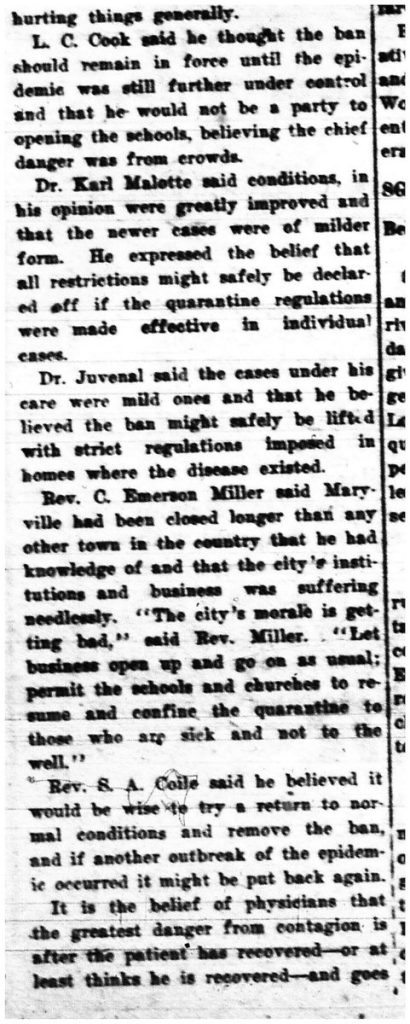
Nov. 22 – Ban lifted (part 2) – Not everyone was on board with the lifting of the shutdown, and some were in favor of even further loosening of restrictions. Rev. C. Emerson Miller makes an argument that would not be out of place in 2020, citing what sounds like “pandemic fatigue” and the economic effects on businesses.
1918 DAILY DEMOCRAT-FORUM
Nov. 22 – Ban lifted (part three) – The article explaining the loosening of the ban.