Groups see little guidance on virus
GEOFFREY WOEHLK/THE FORUM
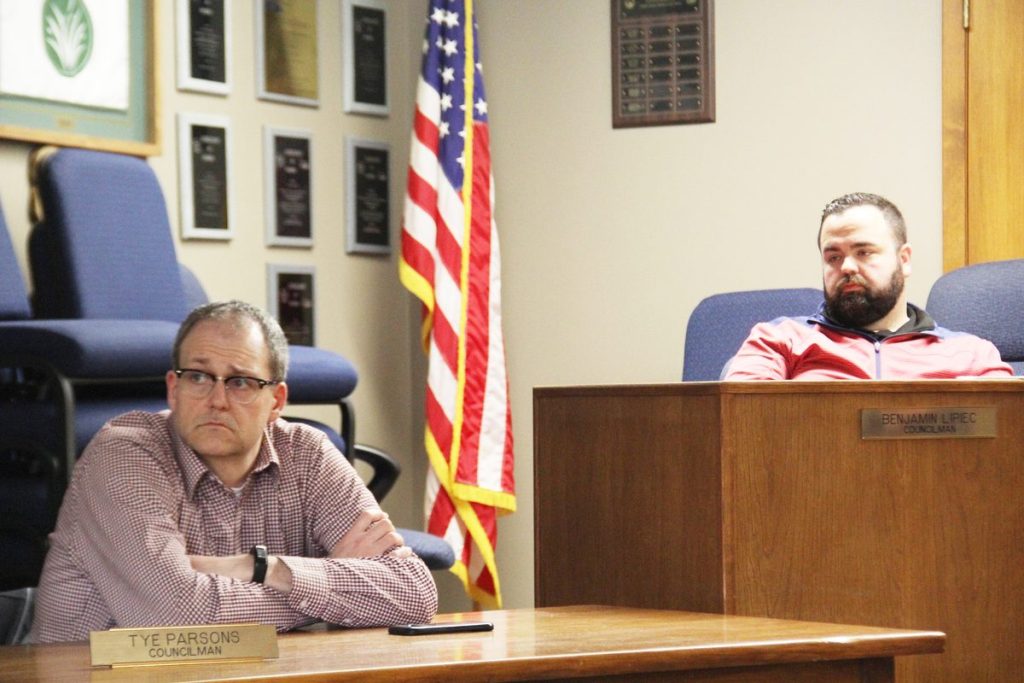
Maryville City Council members Tye Parsons and Ben Lipiec consider the city’s response to the coronavirus pandemic during a special council meeting on Wednesday afternoon. Parsons expressed frustration with the lack of clear recommendations from upper levels of government.
MARYVILLE, Mo. — At a special city council meeting held Wednesday to address the city’s response to the coronavirus pandemic, City Councilman Tye Parsons voiced the feeling of many local organizations and businesses as they consider the difficult decision of whether to close, or how to keep operating.
“In my opinion, we’re getting conflicting messaging from the federal level, the state level, from the local level — you’ve got different cities doing different things, you’ve got different states doing different things,” said Maryville City Councilman Tye Parsons at a special meeting held Wednesday. “If it’s truly a nationwide or a worldwide issue, it doesn’t make sense to me that the response is piecemeal, especially with the lack of ubiquitous testing, and some of those things.
“And so, we hope for the best, we hope there aren’t cases (of COVID-19) in Nodaway County, but we don’t know. So not knowing, do we err on the side of caution, or do you wait and see? And that’s the balance, and I completely respect that, but I don’t want to wait too long. Again, I don’t know what the trigger is, I don’t know how you actually make the call, but that’s what concerns me, is that we don’t have consistent messaging. It would be so much easier if some authority above us said, ‘Here’s what you’re gonna do.’ Well great, we’ll do it. But we’re not getting that messaging, not from the White House, not from the state of Missouri.”
Without a firm recommendation from anyone else, when the Maryville R-II school district decided to shut down at the beginning of this week, the district set off a domino effect that influenced most other closings across the county, starting with every other school in the county.
On Sunday, Maryville schools announced they would be closed the next day while determining the next steps. On Monday, a group of area superintendents met at Northwest Technical School, where a panel of medical professionals and health department officials briefed the school administrators on the most recent information about the virus.
“They basically outlined the CDC guidelines and recommended that each local district should make the decision that applied appropriately to their situation,” said West Nodaway Superintendent Shannon Nolte in an email. Those CDC guidelines do not recommend school closings, saying that modeling does not show a significant difference in the virus’s spread whether schools are closed or not. “We were following the Nodaway County Health Department recommendations and CDC guidelines but ultimately thought it was better to be proactive instead of underreacting later and being caught in a more serious situation.”
The Missouri Department of Elementary and Secondary Education also has assured school districts that attendance figures would not be held against them when determining funding levels next year. But other than that, and echoing the CDC guidance, districts have received little in the way of advice about how to navigate a closing, left to figure out how best to continue feeding students and what staff should continue working.
Nolte said that the group of superintendents brainstormed ideas about how to deal with continuing food distribution and staffing, but each district has approached the issue slightly differently. Several school districts, for example, are offering free meal service at various locations — some at the school, some at a church, some at multiple locations, but starting at different dates. Jefferson C-123, on the other hand, is charging students the same price they would pay at school.
At the state level, very little in the way of recommendations is making its way to local decision-makers. The governor’s office has so far taken a laissez-faire approach, even Gov. Mike Parson continues a tour across the state, meeting with local officials and reporters. At each stop, Gov. Parson has reiterated that it is up to local businesses and organizations what measures they want to take.
That lack of advice meant that the schools’ decisions to close had an outsized effect on other agencies. More than one member of the Maryville Parks and Recreation board, which voted to close the Maryville Community Center Monday evening, cited Maryville R-II’s decision as a precipitating factor in shutting down their own operations. And others voiced their unhappiness with a lack of direction from state and federal officials, making precedents like the one set by the school districts the only example to follow.
“I really think it’s up to every business, and that’s what they’re telling people,” said MPR board member Kelly Quinlin during Monday’s meeting. “Like some businesses, like our insurance company … completely stopped working last week. Like they said, ‘Sorry, we will not be paying your bills.’ But then other companies are like ‘No, no, no, we’re going to keep going.’ So I think they put it up to the businesses and their choice and what they want to do, and that’s what’s hard and frustrating.”
The MPR board’s decision was the first one made in full public view, giving a window into what local officials must consider when deciding whether to close. The overriding concern, naturally, was the safety of patrons. But setting their own precedent for other organizations also was an important factor.
“I feel like it sets a tone … we’re setting the example of how everyone should be doing (this): We shouldn’t be gathering,” said board member Rachelle Wilmes. “So if we say it’s OK to gather in certain areas and not others … that’s probably not the idea that we want people to think.”
Locally, the city affirmed Wednesday that it strongly recommends following federal guidelines, which leaves the ultimate decision up to individuals, but advises against gatherings of 10 or more people and going to frequented public places like restaurants and bars.
Lily White, executive director of the Greater Maryville Chamber of Commerce, said Tuesday that she has not been contacted by local officials with any recommendations about how local businesses should operate. But she said economic officials and the Missouri Chamber of Commerce, which is in contact with local chambers daily, have said businesses in northwest Missouri do not need to close since there have been no positive tests in the area, unless local officials direct them to do so.
Some local businesses, she said, have changed how they operate, including offering only drive-thru at some fast-food restaurants, and some local retailers opting to move most sales online. Many others have continued to operate unchanged. White said no sit-down restaurant had indicated any dining room closures, bars have stayed open and grocery stores have seen their shelves emptied daily of food, cleaning items and, of course, toilet paper.
The local chamber is gathering a list of changes to local business operations during the pandemic on its website at maryvillechamber.org/maryville-strong