Lawmakers review 2018 session
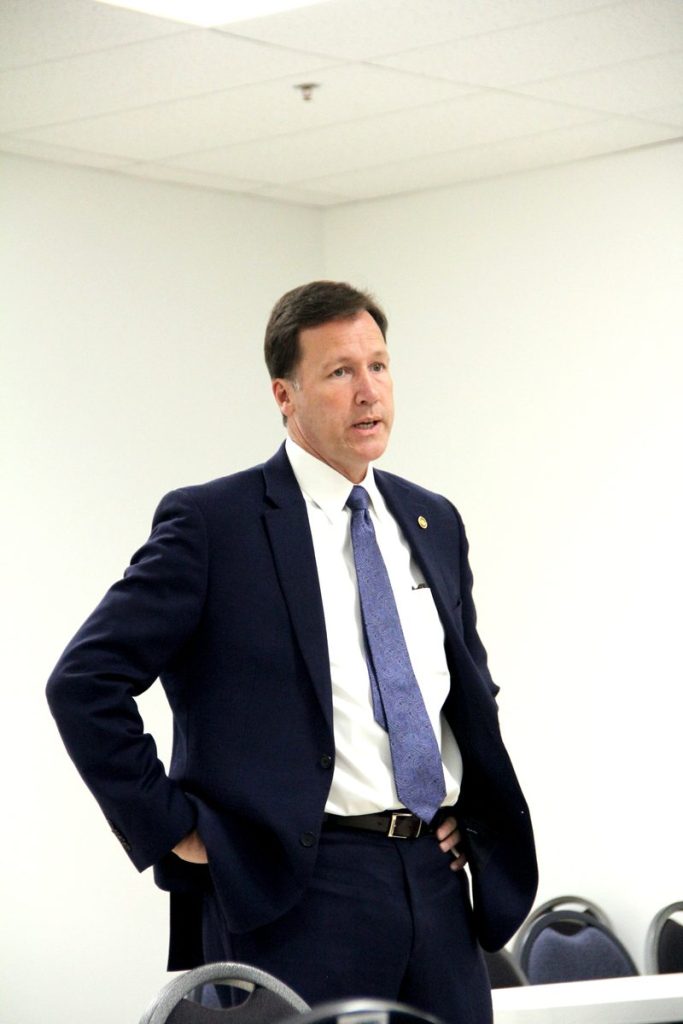
SKYE POURNAZARI/THE FORUM
During a legislative coffee hosted by the Greater Maryville Chamber of Commerce, Missouri State Representative Allen Andrews explains his stance on Proposition A ballot issue coming up for a vote of the people on Aug. 7.
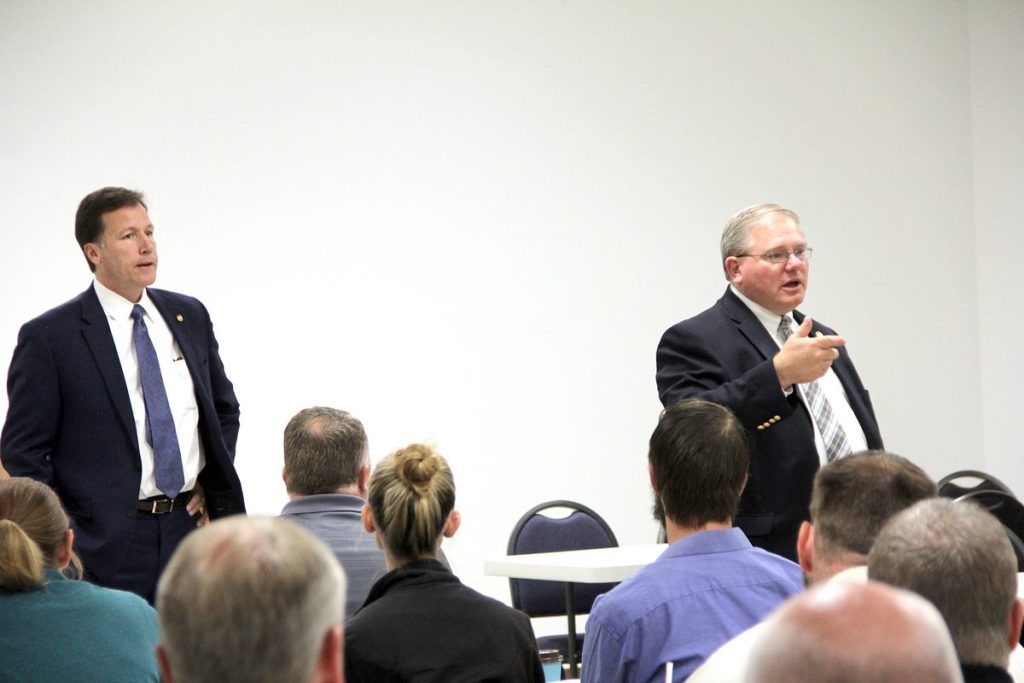
MARYVILLE, Mo. — Missouri State Senator Dan Hegeman, 12th District and State Representative Allen Andrews, 1st District, spoke Tuesday morning during a post-General Assembly session legislative coffee hosted by the Greater Maryville Chamber of Commerce at the Nodaway County Administration Center.
Topics addressed by the lawmakers at the coffee included the upcoming Aug. 7 vote on ballot measure Proposition A, a fuel tax increase ballot issue, economic development, increased broadband internet access and higher education funding.
Proposition A, asks:
“Do the people of the state of Missouri want to adopt Senate Bill 19 (“right-to-work”) as passed by the general assembly in 2017, which prohibits as a condition of employment the forced membership in a labor organization (union) or forced payments of dues in full or pro-rata (fair-share); make any activity which violates employee’s rights illegal and ineffective; allow legal remedies for anyone injured as a result of another person violating or threatening to violate employees’ rights; and which shall not apply to union agreements entered into before the effective date of Senate Bill 19?”
Hegeman said Senate Bill 19 passed last year and has been put on the ballot for approval by the people. By taking those steps, he said, “It stalled right-to-work in the state of Missouri until we have this affirmation vote in August.”
He explained that, “right-to-work means that we won’t be a closed-shop state anymore. A person will have a choice of whether or not to join a union.
“It’s freedom of association, not forced association into a union,” Hegeman said. “In my mind, it makes the union leadership be more responsible to the union membership. … I just find it difficult to think that people shouldn’t have that opportunity, that freedom to choose whether they associate with an organization or not.”
Andrews told the crowd that the issue is highly divisive on both sides, “Literally, I could say explosive, hate mail, hate email coming from the opposition on that so the emotions run pretty high,” he said. “Of course, I’m a, ‘Yes’ for Prop A. I believe that Missouri must be, not needs to be, must be a “right-to-work” state to continue to grow our economy the way it needs to be and be competitive to our surrounding states.”
Seeing all the “No” signs and hearing from people who are confused on the issue is pretty disheartening, he said.
“A lot of times, people are uninformed of really what that sign actually means,” Andrews said. “That’s the concern going forward. I just hope that people are able to cast an informed vote on that proposition.”
According to the Missouri Secretary of State website, a “Yes,” vote will adopt Senate Bill 19 “right-to-work.” If adopted, the bill will amend state law to prohibit, as a condition of employment, forced membership in a labor organization (union) or forced payment of dues or fees, in full or pro-rata (“fair-share”), to a union. It also will make any activity which violates employees’ rights provided by the bill illegal and ineffective and allow legal remedies for anyone injured as a result of another person violating or threatening to violate those rights.
It will not apply to union agreements entered into before the effective date, unless those agreements are amended or renewed after the effective date of Senate Bill 19. If passed, this measure will have no impact on taxes.
A “No,” vote will reject Senate Bill 19 “right-to-work.”
Andrews said when the legislature voted to go “right-to-work,” for the first time in Missouri history in 2017, “our (state) phones started ringing off the hook. Companies from outside the state looking potentially to move to Missouri just simply because we went right-to-work. It’s imperative that we do this.”
Higher education funding
Turning discussion to higher education funding, Northwest Missouri State University President John Jasinski thanked the lawmakers for fighting the cut to higher education appropriation funds and asked what the budget looks like with regard to support for higher education.
Sen. Hegeman said he hopes the state can maintain if not gain on higher education.
“It seems like the revenues are coming in very well right now. I think we’ll end the year with a 5 percent increase over the year before, so it looks good. … I think Gov. (Mike) Parson is very supportive of higher education. He’s very supportive of infrastructure and the needs there.”
State Rep. Andrews said, he thought higher education was targeted last year in the budget, making sort of an example of the University of Missouri, however, it ended up hurting a lot of the other universities. It seemed to carry over into this year’s budget.
“There was a group of us who rallied together to say, ‘We can’t do it again,’” he said. “So we rallied the troops to push back on that cut and we were able to get a substantial amount of it pushed back.”
Fuel tax increase
A gas tax increase will be on the November ballot. Andrews said, it will be an additional 2.5 cents per year for the next four years, added to the 17-cent base state sales tax, making it overall a 10-cent fuel tax, or 27 cents per gallon more after four years. This will increase state revenues by about $240 million for the road fund and $280 million to the Missouri State Highway Patrol and another $140 million for cities and counties.
“There’s opposition,” Andrews said. “That certainly wasn’t the format that I was hoping that that fuel tax was going to be in. But it’s one of those things where at the negotiating table not everybody is going to get what they want.”
Andrews said, this tax will move the patrol out from under the umbrella of the gas tax and will help to fund that shift. Having done the math, he said the additional cost to the average driving Missourian, will be around $115.
Saying he’s the last one to say we need a tax increase, and he has heard from people around his district who say the current funding needs to be better managed, he thinks it is important to have it on the ballot to let the people decide.
“If you look at the scope of our infrastructure … we have the 7th largest infrastructure system per miles in the entire country and we’re one of the lowest fuel taxes,” Andrews said. “We are doing pretty well.”
Hegeman said he firmly believes it should go to a vote of the people.
“Infrastructure is one basic thing that state government does,” Hegeman said. “It’s fundamentally what we’re supposed to do. You can’t build a road to get to Jefferson City, but the state can. That’s the kind of stuff that we’re supposed to be doing.
“If people want more roadways to be taken care of, they’ll vote in favor,” Hegemen said. “And if not, then we’ll struggle through.”
Economic development and broadband internet
Josh McKim, director of Nodaway County Economic Development, shifted the discussion to economic development asking what the lawmakers see as the big economic issues the legislature will address.
Rural broadband is the big economic driver in northwest Missouri, said Hegeman. He explained the difficulty that the rural electric cooperatives have in the area, with distance and density. It’s cost prohibitive, putting in fiber lines to rural areas due to lack of people along the lines.
Though it is a necessity to facilitate people moving to those areas, and according to Andrews, “absolutely imperative in the world right now,” running fiber to some locations is economically difficult.
State Rep. Andrews said he enjoys the bi-annual coffees and getting to see everyone, but more than that, he appreciates the opportunity to hear form those who have questions and concerns.
“It’s a great way to stay sharp as a legislator, especially during the interim.”
State Sen. Hegeman said the coffee event held twice a year, are a great way to engage with people and draw information from his constituents.
“For me that’s probably the most valuable aspect of it, but also to convey what we’ve been doing,” he said. “It’s a two-way dialogue. In my mind, infrastructure seemed to be what is the big thing right now, and it seemed everybody in the room agreed. It’s what we need to do.”
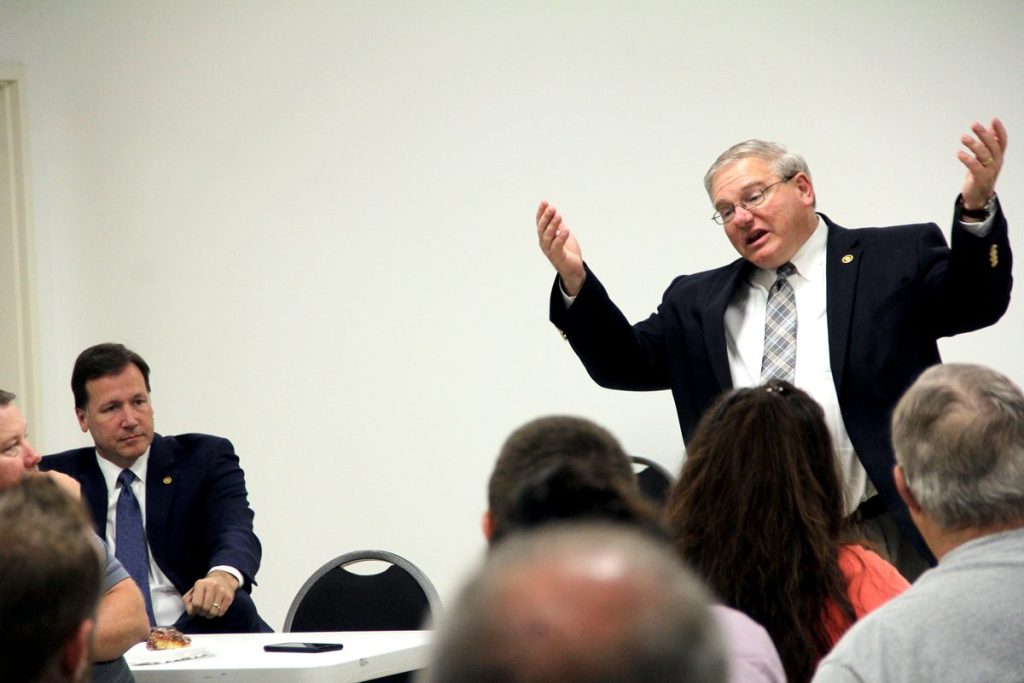
SKYE POURNAZARI/THE FORUM
Missouri State Sen. Dan Hegeman talks Tuesday morning at a legislative coffee hosted by the Greater Maryville Chamber of Commerce, about a fuel tax increase on the ballot in November. He said people will either choose to tax themselves or the state will “struggle through.”
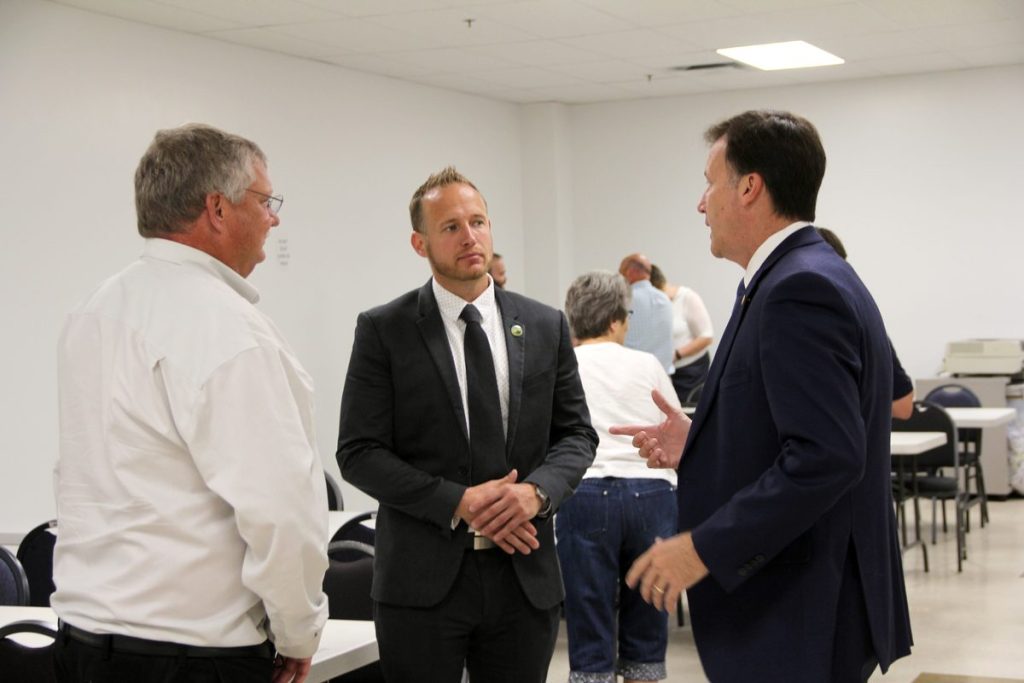
SKYE POURNAZARI/THE FORUM
Shown at a legislative coffee hosted by the Greater Maryville Chamber of Commerce, from left are: Steve Bratt, chief strategic officer for Kawasaki Motors USA; Greg McDanel, Maryville city manager; and Missouri State Rep. Allen Andrews.
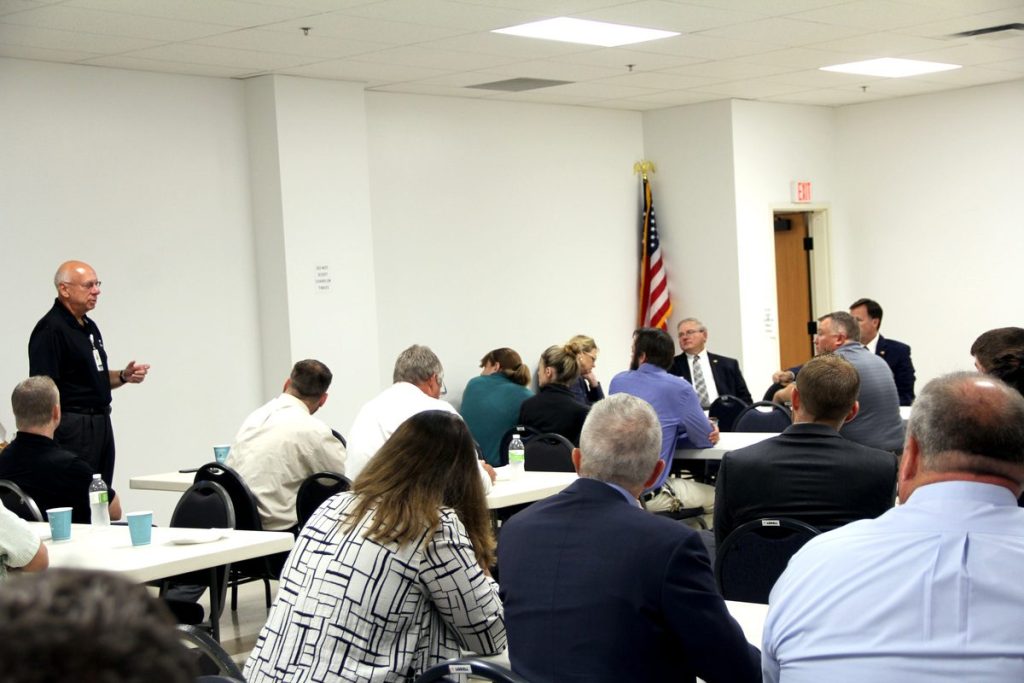
SKYE POURNAZARI/THE FORUM
Mike Baumgartner, President at SSM Health St. Francis Hospital asks a question about Medicare on Tuesday at a legislative coffee hosted by the Greater Maryville Chamber of Commerce.
SKYE POURNAZARI/THE FORUM
Missouri State Sen. Dan Hegeman talks Tuesday morning at a legislative coffee hosted by the Greater Maryville Chamber of Commerce, about a fuel tax increase on the ballot in November. He said people will either choose to tax themselves or the state will “struggle through.”
SKYE POURNAZARI/THE FORUM
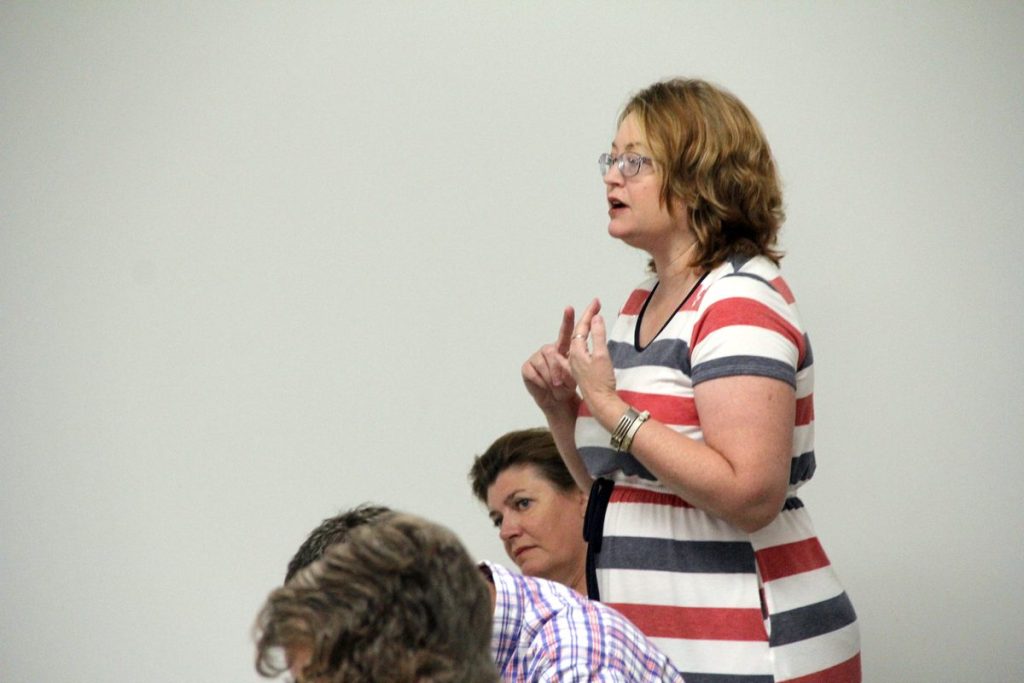
Kim Mildward, functional leader at Northwest Missouri Regional Council of Governments asks a question about programs Talent for Tomorrow and Best of the Midwest, and whether or not they still are viable at a legislative coffee hosted by the Greater Maryville Chamber of Commerce
SKYE POURNAZARI/THE FORUM
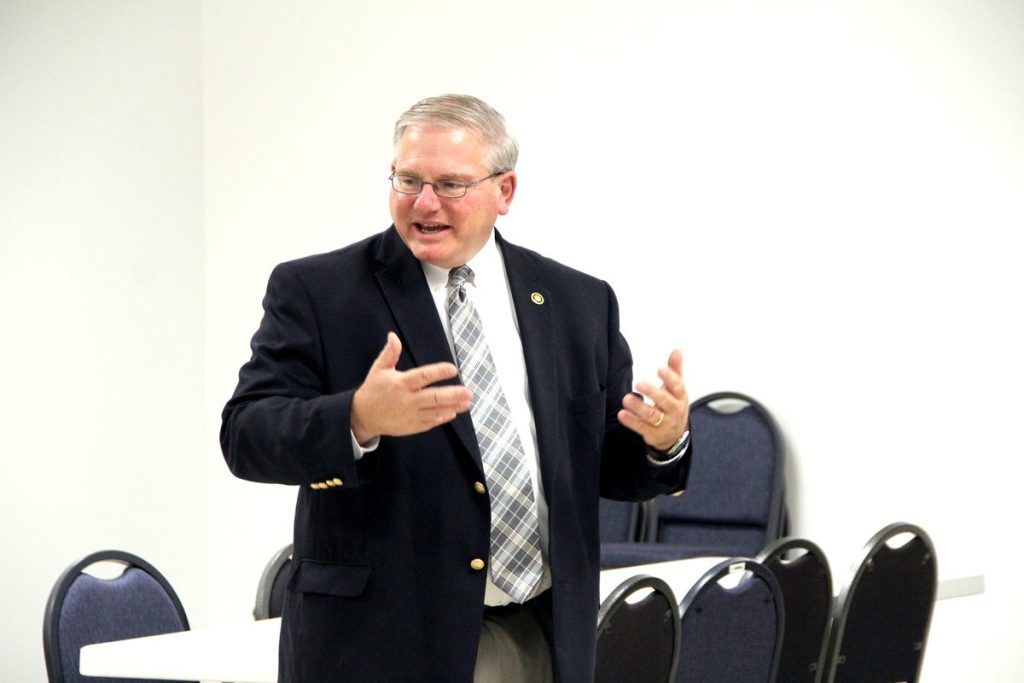
Missouri State Sen. Dan Hegeman talks Tuesday morning at a legislative coffee hosted by the Greater Maryville Chamber of Commerce.