‘A Strategy for the Unimaginable’
SKYE POURNAZARI/THE FORUM
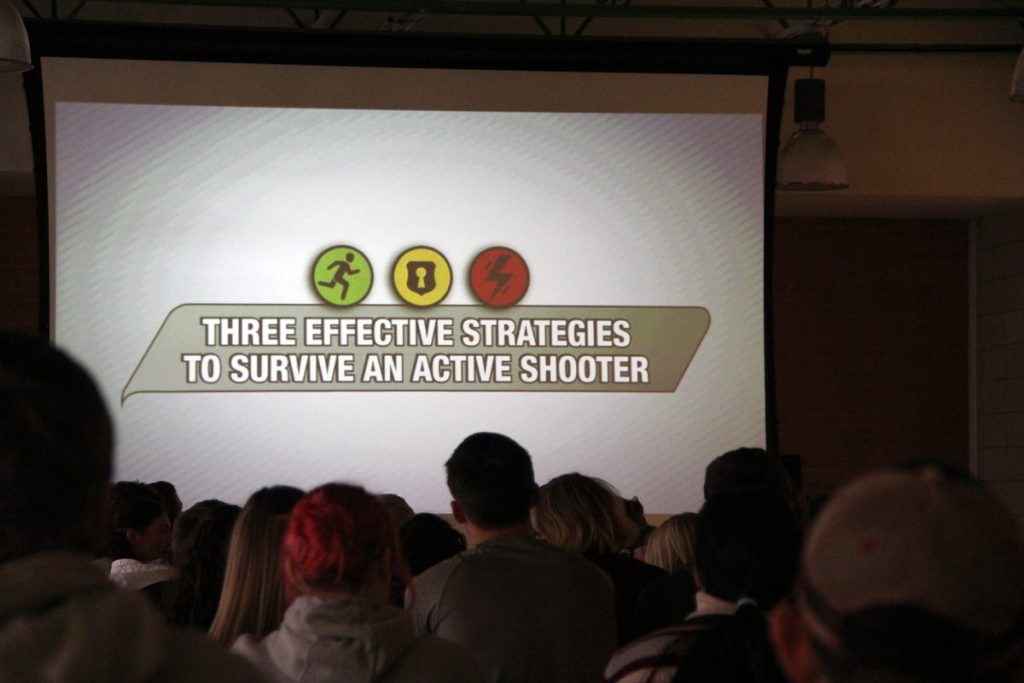
Maryville High School students on Monday morning watch a video as part of a program put together by Ian Myers, the school resource officer. The video explains strategies on how to survive an active shooter scenario.
MARYVILLE, Mo. — Maryville Public Safety Officer Ian Myers, also the SRO at Maryville High School, held an active shooter safety program for several groups of students Monday morning in the school commons.
The program is designed to start a discussion with students about what they should do in case of an active shooter event on campus. Just after the semester began, Myers spoke with the school district about putting the program together for a faculty professional development day.
Soon after, it was decided to put a program together for the students as well.
“They’re a key part of this too,” Myers said. “They’re who we’re trying to keep safe. It makes sense.”
Myers began by telling students about nine Missouri threats that have occurred since the school shooting in Parkland, Florida. Some of those included online threats in the Raytown School District, the Daviess R-III School District lockdown in Jameson, guns brought to school in Lee’s Summit, Missouri and several others. Of the nine listed, four of them occurred in districts comparable in size or smaller than the Maryville School District.
Myers told the senior class it’s not okay anymore to rely on saying, “Look it’s Maryville; it’s a nice small town; nothing ever really happens here.
“We can’t think like that anymore,” Myers said. “I think it’s important that we try to be prepared for something like this. God forbid it does happen … We’re drilling for tornadoes and fires. We don’t want either one of those to happen. Why aren’t we paying attention to something like this? … We need to be prepared for stuff like this.
In preparation for an active shooter, Myers offered a list of general indicators and things that they can look for that might prevent something like this from happening.
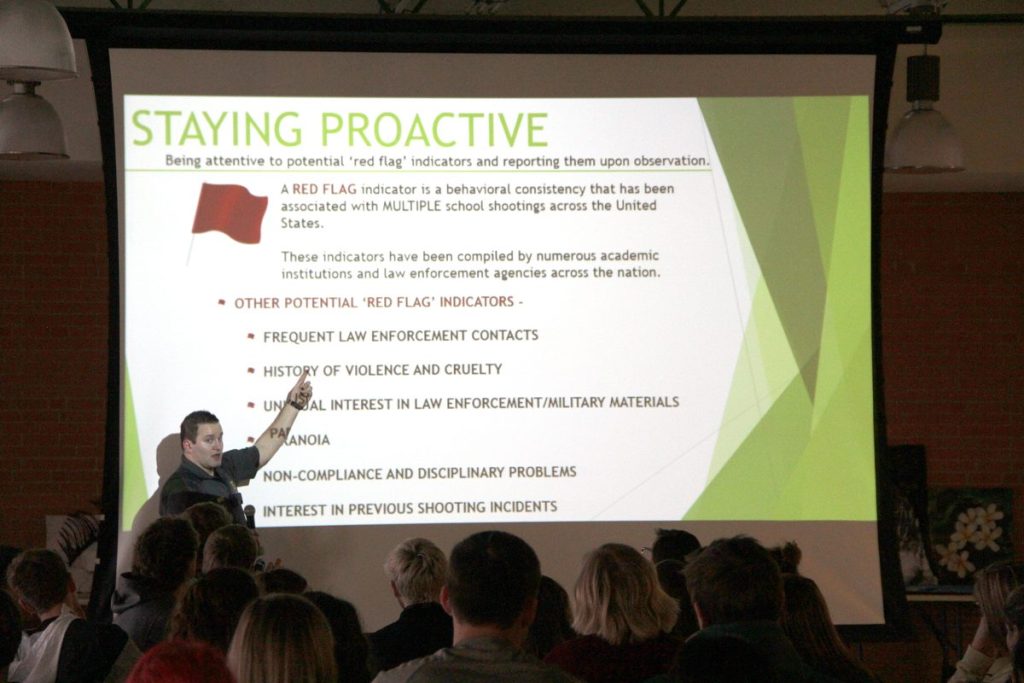
Red flag indicators are a behavioral consistency that has been associated with multiple school shootings across the United States, Myers explained. The following list of red flag indicators has been compiled by numerous academic institutions and law enforcement agencies across the nation, Myers’ presentation stated.
He told the seniors to pay attention to anyone who might have or experience the following:
- Violent fantasy obsession, a tendency to gravitate or produce graphic, violent material such as writings, drawings or reading and viewing materials containing violence.
- Emotional inconsistencies such as mood swings, difficulty controlling anger, unexplained loss of temper, impulsivity and violent threats.
- Fascination with weapons, including those commonly associated with mass shooter incidents, such as semi-automatic firearms – ArmaLite Rifle (AR-15), handguns etc.; handheld weapons – knives, machetes, daggers, brass knuckles.
- Explosive devices, including improvised explosive devices such as pipe bombs and Molotov cocktails.
- Casual discussion regarding combat proficiency, boasting and conversing about various ‘skills’ commonly associated with military or law enforcement tactics such as: sharpshooter, martial arts and/or training with edged weapons.
- Socially withdrawn, preferring to keep to themselves, rather than seek the company of others, frequently isolated from others.
- Suicidal ideation, frequently displaying signs and symptoms commonly associated with depression, expressing hopelessness and despair, revealing or discussing plans of suicide.
- Homicidal ideation, frequently displays contempt for others, which may be without cause at times, expressing violent aggression toward other students, discussing violence openly within a social circle or using violent terms without reservation, such as: kill, shoot, stab and murder.
- Imitation of high profile shooters, frequently imitating other individuals associated with mass shooter incidents, such as: appearance and dress, clothing, grooming etc.; possessions — discussing ownership of firearms and other weaponry, such as knives and improvised explosive devices; ideological imitation – frequently makes comments and engages in arguments with others concerning various topics of a sensitive nature, such as gun control or racially related issues.
- Victim/Martyr self-concept, a basic fantasy in which a student views him or herself as a hero for the oppressed.
- Acting out, expresses humor or anger in situations which do not warrant it, subsequently attacking those who oppose their viewpoints.
- Other potential red flags include: Frequent law enforcement contacts, history of violence and cruelty, unusual interest in law enforcement/military materials, paranoia, non-compliance and disciplinary problems, interest in previous shooting incidents.
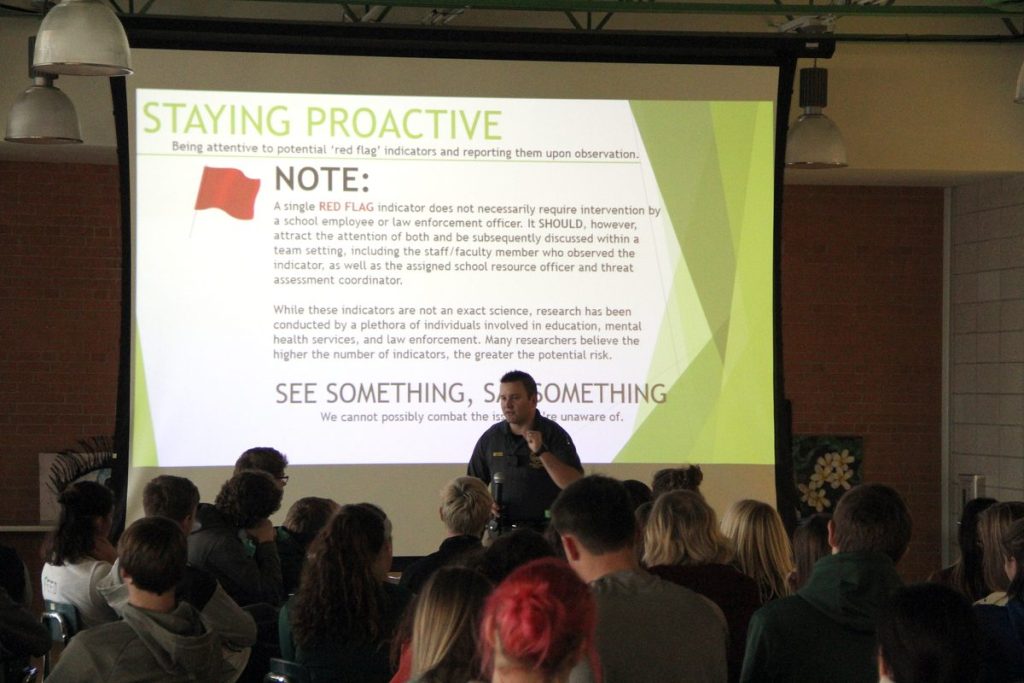
Myers stressed that a single red flag indicator does not necessarily require intervention by a school employee or law enforcement officer. It should, however, attract the attention of both and be discussed within a team setting.
“I need your guys’ help to make this happen,” he said. “Don’t feel like you’re a snitch. Apparently, that’s a thing in Maryville.”
He told the students if they see something, say something. He said if one of them wanted to tip anonymously, the Maryville Spoofhound phone app, has a place where a student can do that.
Run, Hide, Fight
Myers showed the seniors a video defining and explaining three effective strategies to survive an active shooter. The video was created by the Santa Ana School District Police Department.
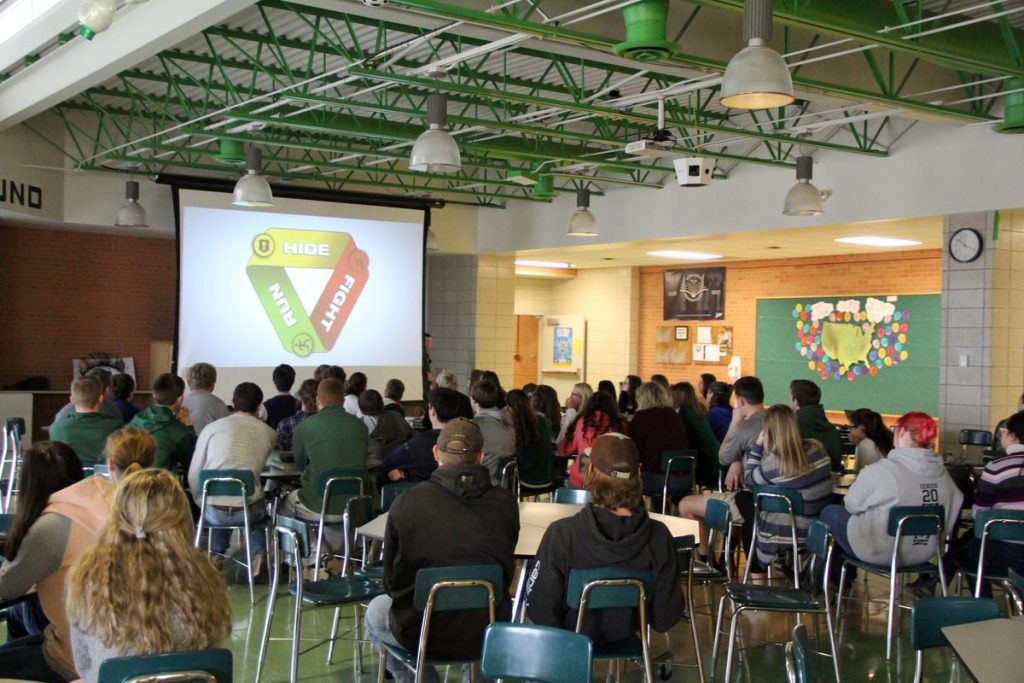
Run, Hide, Fight methodology are three basic options students have in the case of an active shooter event. The video explained that it may be the best option for a student to run.
Sergeant Rex Riley with Maryville Public Safety talked to the students about the Run, Hide, Fight methodology.
He described a scenario in which a shooter is in the hallway outside of a student’s room.
“Pick your moments,” he said.
If a student can run, how should he or she run?, he asked. “You run as fast as you can as if your life depended on it.” He said for them to run to the closest safest exit. “You might have to take the longer way out,” he said.
He said a student should avoid getting into a vehicle and trying to leave, that they would most likely be able to make it farther on foot. He said there will be no set locations for students to meet. Students should look around them and see what is available for the quickest escape.
“You’ve got a residential area to the north here that would be really easy to disappear in and get away and get safe,” Riley offered. “Accountability will come. At some point, we’ll make sure everyone is accounted for so if you’ve got to run, run.”
He said hiding is another option and that sometimes hiding will allow for an opportunity to run.
He said if there is an option to break a window, do it and cover broken glass on the window sill with bags or coats to help safely escape.
If there is no option for running, “Barricade yourselves in that room,” Riley suggested. “Make that room safe for us to be hiding in. … That’s what the hiding portion is, buying time to prepare yourself to fight.”
With the fighting strategy Riley said to, “Fight as if your life depends on it because that’s what it is. Your life depends on it.”
He suggested the students make a plan and think about it between classes.
“One thing common in these situations is that they’re fluid and ever-changing so common sense needs to be used in the moment,” Myers said.
He said that some people may not be up to the task of fighting. He said the idea of having to hurt someone else may not be as easy to overcome for some as it is for others.
“Here’s the thing though,” Myers said. “I want to make sure I drive this home for you guys. If it comes to that situation: You are in this classroom with a group of people and there is somebody trying to get in that room. If it comes down to fighting, I want you to fight like hell. I want you to give it absolutely everything that you have and I want you to be as tough on them as humanly possible.”
He told them he isn’t saying an event like this will happen, “I just want you to be mentally prepared for if it does.”
A student asked, “Hypothetically if this were to happen, what would we do after it happens?”
Myers replied, “You just keep running and running. Just like Forrest Gump. You run and then you run some more. Then once it’s all said and done with and you need to take a breather, you can stop …”
He said he would rather spend four weeks accounting for everyone who fled from the building, rather than account for them because they couldn’t make it out.
He said after an event the phone lines will be tied up, but that students should try to get in touch with friends and family to let them know they’re okay, once they’re a safe distance from the school.
“When these things occur, you will see patrol cars from places you didn’t even know existed,” Myers said. “Response by law enforcement is going to be so overwhelming it’s going to blow your mind. … I assure you, once they get here, and we get the situation under control we’ll come out and look for you guys.”
Sgt. Riley told students that this will be an all-day event, but the timeline of violence is very short anywhere from three to seven minutes, 10 minutes on the long side. He said, statistically the event would already be over, by the time law enforcement arrives.
“We can probably have 10 officers here in a matter of four minutes,” Riley said. “That’s really quick.”
Myers said takeaways for the students should be “See Something, Say Something and to take it seriously.”
“I want to do everything in my power to keep you safe,” he said.
SKYE POURNAZARI/THE FORUM
Maryville High School seniors watch a video Monday morning about the Run, Hide, Fight strategies for actions during an active shooter event. School Resource Officer Ian Myers spoke to all high school students about preventative measures and an overview of active shooter safety.
SKYE POURNAZARI/THE FORUM
Maryville High School Resource Officer Ian Myers on Monday morning emphasizes the necessity for students to say something if they see something. He said the Maryville Spoofhound phone app has a tips section that is anonymous. He did however stress the importance of not joking about this topic. He said he receives all tips from that and will take each one seriously.
SKYE POURNAZARI/THE FORUM
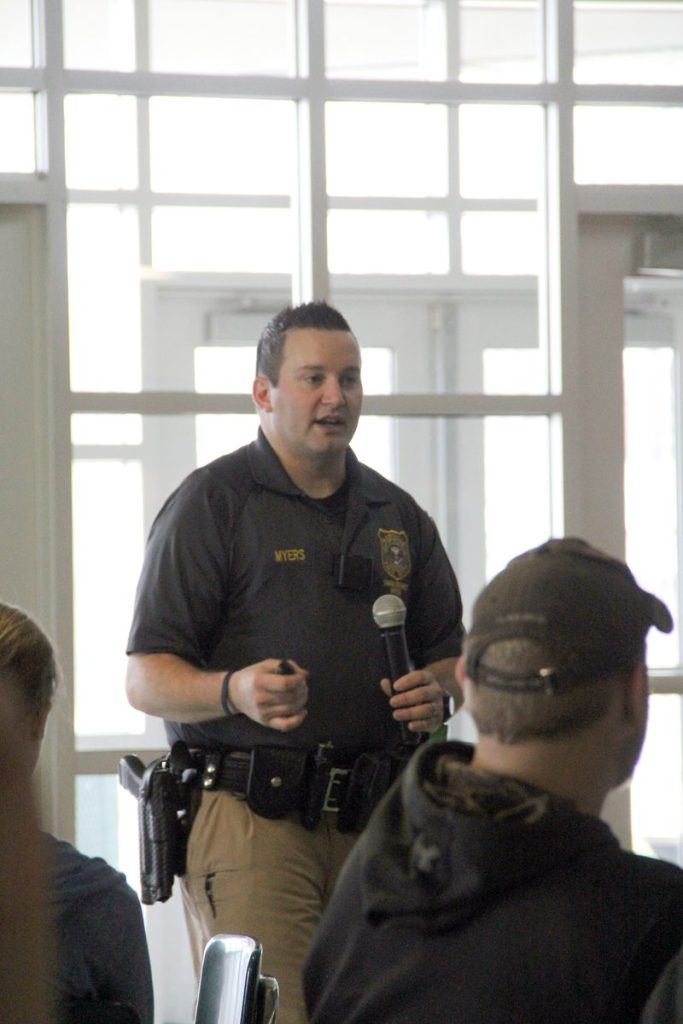
Maryville High School Resource Officer Ian Myers on Monday morning speaks to seniors as part of a program discussing actions that can be taken during an active shooter occurrence. Myers spoke to all high school students Monday to help them think about the topic and learn signs of what to look for in preventive measures.
SKYE POURNAZARI/THE FORUM
Maryville High School Resource Officer Ian Myers points to Frequent Law Enforcement Contacts, and explains that he and Sgt. Rex Riley with Maryville Public Safety would probably know about any students who would have contacts with law enforcement, but it’s the other “red flag indicators” that law enforcement might not know about. Myers said students may help to prevent something if they, “See Something, Say Something.”