
City still working to resolve lake ‘turnover’ issue
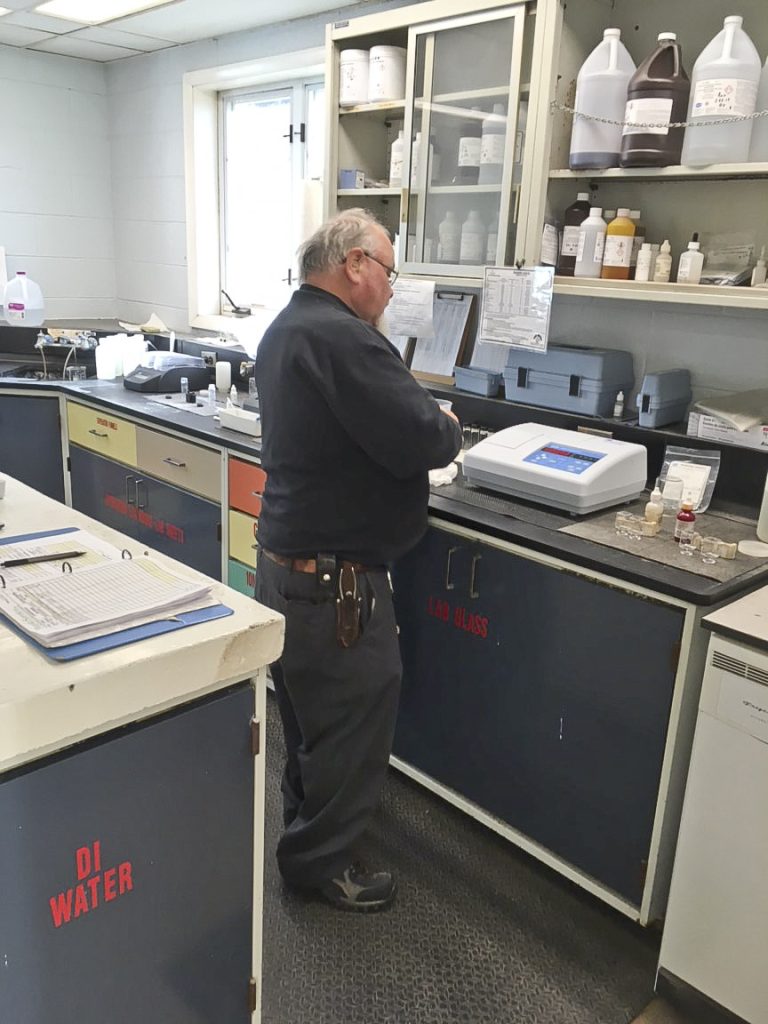
PHOTO COURTESY OF C.E. GOODALL
Herman Crumb of PeopleService, the city’s water services provider, checks the turbity of water samples at the city’s water treatment plant laboratory on Tuesday. PeopleService and city staff continue to work to resolve issues of poor taste and odor resulting from the current “turnover” of Mozingo Lake, the city’s primary water source.
During his report to the Maryville City Council Monday night, City Manager Greg McDanel gave an update on the city’s ongoing efforts to neutralize what has been a longer and more substantial than usual “turnover” effect at Mozingo Lake, the city’s primary water source.
McDanel noted complaints he has been hearing about the taste and odor of the water.
“Mozingo has experienced significant lake turnover this year, which deals with the algae blooms near the intakes,” McDanel said.
He explained that warmer than normal temperatures during the day combined with drastically colder temperatures at night essentially churn the algae blooms in the water creating a compound that alters the taste and the odor of the water.
“This does not impact the quality of the water,” McDanel emphasized. “We test our water daily at various locations … we still far exceed minimum standards for drinking water.
“It’s an inconvenience and the staff is working the problem every day.”
McDanel said that People Service, the city’s water services provider is updating him every day on the efforts and that the issue is not uniform throughout the city.
“It’s something that historically can last three to five weeks,” McDanel said. “We’re hoping we can take care of it any day now.”
He went on to explain that the problem is not uniform throughout the city.
“Some areas have more issues than others.”
McDanel speculated that has to do with the way the system is flushed and because of some of the “dead-end” areas in the system.
“The effects of lake turnover linger longer in those dead-end areas,” McDanel said.
McDanel said that PeopleService, the city’s water services provider, has presented him with an option.
He said a company can be hired to come out with a boat and lay copper sulfate to kill the algae blooms quicker.
That would come at a cost, according to McDanel, of about $5,000.
“If council wants us to do that, we can,” McDanel said. “Otherwise, we will continue adjusting the carbon feed.”
He explained that the process is sensitive, because if too much carbon is used it can damage vital and expensive membranes in the system.
No action was taken immediately by the council.




