NW summer pay policy raises faculty concerns
TONY BROWN/DAILY FORUM
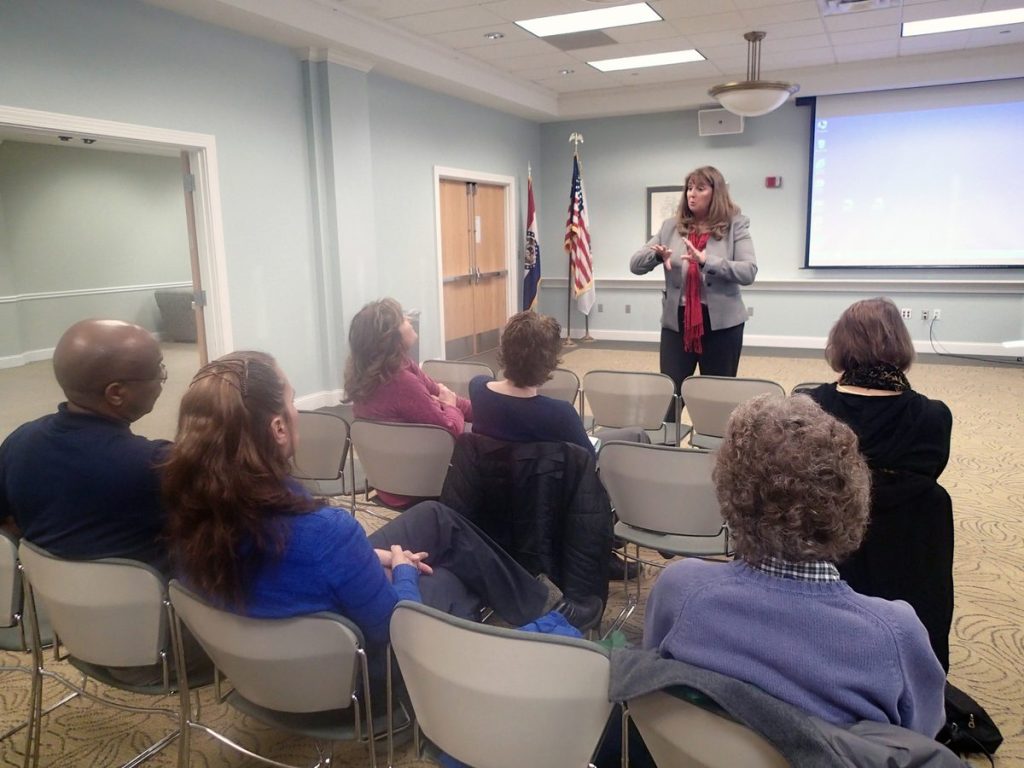
Northwest Missouri State University Provost Jamie Hooyman speaks with faculty members Wednesday morning during an open meeting to discuss a change in the salary policy for instructors and professors who teach courses during the summer term. Some faculty are concerned that the new standard unfairly reduces pay for veteran faculty members with doctorate-level degrees.
Deep state funding cuts for higher education and resulting efforts by Northwest Missouri State University to reduce spending while working to retain programs and staff have created tensions between the administration and some faculty members with regard to the way professors are paid for teaching summer courses.
Early this year, senior Northwest leadership, working in concert with the Faculty Senate, made the decision to set summer instructional pay at a flat rate rather than as a percentage of salary.
In the past, summer term pay was calculated at 2.5 percent of a faculty member’s annual salary per scheduled credit hour or $800 per credit hour depending on which method yielded the higher figure.
The new policy, scheduled to take effect at the end of the spring semester, sets summer teaching pay at $1,200 per credit hour, meaning that all instructors and professors teaching a three-hour course would earn $3,600.
The change means that while some instructors and professors, especially less-experienced faculty members belonging to academic divisions and departments where pay is lower — the arts and humanities for example — will actually earn more during the summer, others will experience a significant cut.
Most affected will be veteran professors, in particular those working within such entities as the Melvin D. and Valorie G. Booth School of Business and the School of Computer Science and Information Services where faculty command higher salaries due both to student demand and competition for qualified professionals from the private sector.
Adding to the controversy is the fact that many summer courses serve graduate students and must be taught by senior faculty possessing doctoral degrees or other high-level academic credentials.
According to Nancy Zeliff, a full professor who teaches courses in information technology and business education, the switch to flat-rate summer pay will create inequities with regard to compensation for those charged with steering students through classes required to complete some of the university’s most popular, and profitable, programs.
During a pair of open faculty meetings this week, Provost Jamie Hooyman explained that the change was made as one of a series of prioritized steps aimed at paring down spending during a time of austerity and “tough decisions.”
She noted that the summer-pay decision was one of a number of prioritized cost-cutting moves that also included voluntary retirement and adjusted course schedules.
Hooyman defended all three moves as good-faith efforts involving Faculty Senate input designed to avoid more severe steps such as layoffs and reductions in core fall-spring salaries.
But she acknowledged that some faculty will see a large reduction in “non-contract” summer pay.
“There’s a top 14 to 15 percent (of faculty) for whom it’s a significant decrease,” Hooyman said during the first faculty session on Monday. “You’re in the room. Who it really affected is your full professors, specifically in (business and computer science).
“You’re right. No one can argue that there’s about 14 to 15 percent of summer teaching faculty members that will have a significant cut.”
Zeliff, for her part, responded that too many faculty were left out of the loop and found out about the new summer-pay policy only after a final decision was made. She also said too few facts had been presented with regard to how the new policy would help relieve Northwest’s financial crunch.
“Where is the data?” she asked. “We have no facts, and we have no data to help us understand.”
Zeliff also referenced faculty institutional satisfaction responses citing “administrative bloat” and specifically mentioned administrative hires associated with the creation last year of a new Office of Diversity, Equity and Inclusion.
Hooyman acknowledged that administrative restructuring at Northwest has led to the appointment of several higher-tier administrators. But she added that these staff members often perform their duties with the aid of fewer mid-level managers than is typically the case at other institutions.
“Northwest has one of the leanest administrations I’ve ever seen,” the provost said.