
Northwest debaters discuss graduate retention
TOM PINNEY/DAILY FORUM
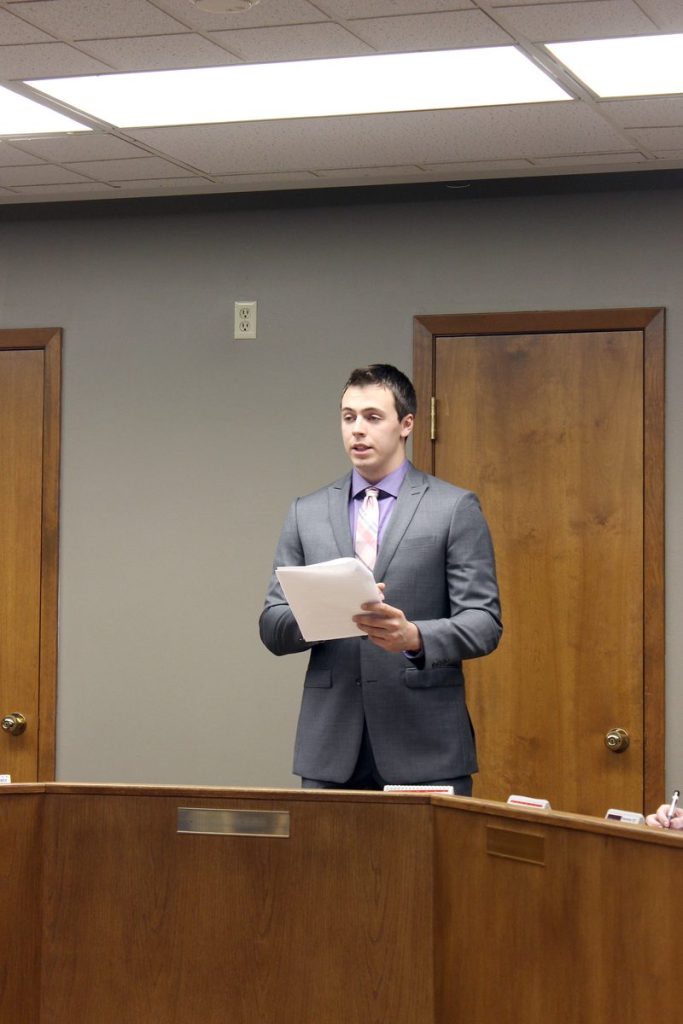
Northwest sophomore Samuel Bergerson presents his case during the first Speaking Bearcats Public Debate. Bergerson and his partner, sophomore Cameron Deatherage, were advocating for the creation of a Collegiate Advisory Board in Maryville.
Northwest Missouri State University’s speech and debate team, the Speaking Bearcats, is looking to get more involved in the community.
As a start to this effort, two of the squad’s debate teams participated in the first ever Speaking Bearcats Public Debate on Wednesday.
The purpose of the debate was to present and argue a local issue. The resolution the teams argued, proposed creating a Collegiate Advisory Board in the City of Maryville to discuss the city’s priorities concerning graduate retention. According to the definition of the committee from both teams, the committee would consist of one member of the city government (either a City Council member or someone from the City Manager’s office), a member of a community organization (such as the Greater Maryville Chamber of Commerce or Downtown Maryville), and five students who would either be voted on by the student population or appointed by the president.
The debate started with a coin flip, as per the rules of the format. As a result of the flip, sophomores Samuel Bergerson and Cameron Deatherage argued the benefits of the Collegiate Advisory Board.
Bergerson, a native of Plattsmouth, Nebraska, said the committee would bring necessary change to Maryville based on other successful committees of the same sort.
“In Rexburg, Idaho, the city created a Millennial Advisory Board similar to what we’re proposing in Maryville,” Bergerson said. “As a result, the millennial population in Rexburg has increased by 26 percent, which is more than the national average of three percent.
“Rexburg is also home to jobs that millennials tend to flock to, such as finance, science and technology, and health care. This shows an increase in careers that are ready for young professionals to take.”
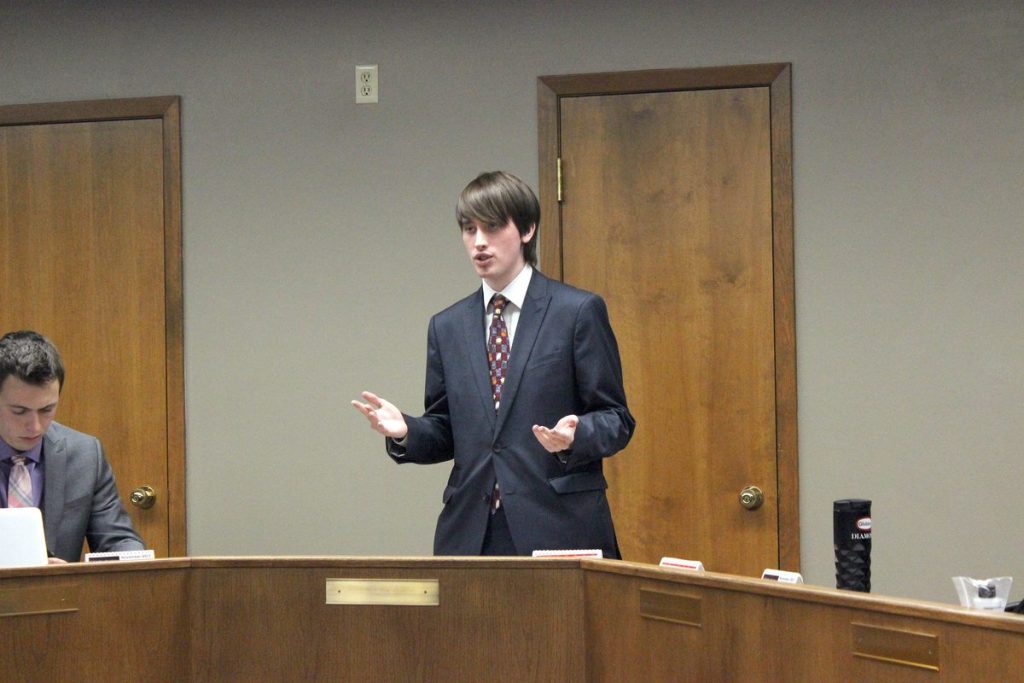
Arguing the costs of the proposal were junior Gavin Hopkins and senior Samantha Gaither. Hopkins, who hails from Ridgeland, Mississippi, said the problem wasn’t with having a committee, but with the committee’s overall goal.
“The proposed committee contains one government official, one city organization member, and five students from the university that are either voted on or appointed by the president,” Hopkins said. “This committee has no real input from the community, such as business owners, and most of the people in the committee have no real ties to Maryville.
“This committee also can’t change the psychology of millennials, who are drawn to big cities because of the opportunities they provide in early careers. We should be focusing on graduate retraction, or bringing graduates back to Maryville after they’ve jumpstarted their careers in larger cities.”
In response to Hopkins’ case, Deatherage, a Kansas City, Missouri native, said the biggest issue was inaction versus action.
“Right now, we’re not really making any active moves to make graduates want to stay in Maryville, and that’s what we really need,” Deatherage said. “Creating this committee will allow students to see that the city has a vested interest in keeping them in Maryville.
“Look not only at Rexburg, but at Grand Rapids, Michigan, where this idea initially came from. Both of those cities are not just still standing, but booming; that means this is something Maryville should try to see if it helps them retain students.”
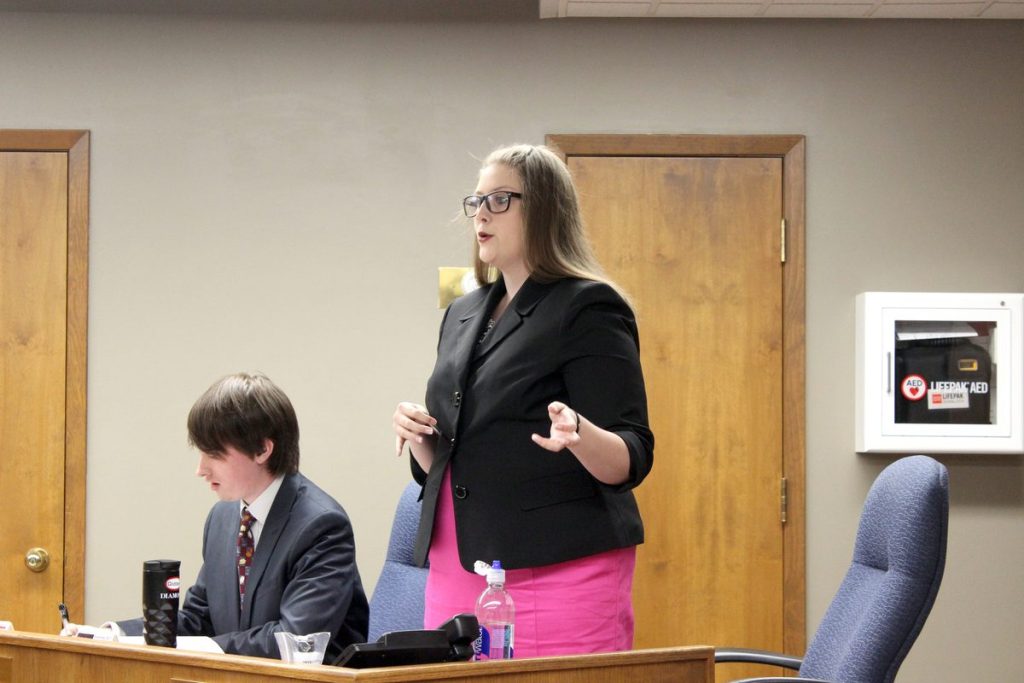
Gaither, also from Kansas City, Missouri, said the problem behind the presented parameters for the committee came down to who would be selected.
“You can’t guarantee that the students selected for the committee will be the best students,” Gaither said. “The students you want — the ones who are involved in the university community through their jobs or their clubs — are already too busy for this committee.
“Because of that, you won’t get people who are invested in Maryville, but you really won’t get people who are invested in the university community either. If the people in the committee aren’t invested in the community or the school, then what makes us think they’d make the right decisions? What would make them show up to the committee meetings?”
The rest of the speeches for the night focused on rebuilding the cases and solidifying the, “voters,” on the main issues that were presented and why each team had control of those issues. At the culmination of the debate, the audience voted with a dollar.
During the voting, the debaters and Northwest’s director of forensics Brian Swafford were available for questions. Most of the audience was interested in the fact that both teams had prepared for both sides of the debate, and one audience member asked where each debater’s personal allegiances lay.
Interestingly enough, each debater was for the committee in some way, with their actual views mirroring the views they were able to present in the debate. Both Bergerson and Deatherage were for the committee as was presented, while Gaither and Hopkins were for the committee with some amendments to the representatives.
After the votes were tallied, Swafford announced that the Pro side of the debate, Bergerson and Deatherage, had won the audience vote. The total proceeds of the vote, $30, will be donated to the Maryville Rotary Club.
Gaither and Hopkins were sponsored by the Maryville Host Lions Club.
TOM PINNEY/DAILY FORUM
Northwest senior Samantha Gaither fields a question from her opponent during the first Speaking Bearcats Public Debate. The debate was held to discuss current issues facing the City of Maryville and to raise money for local charitable organizations.
TOM PINNEY/DAILY FORUM
Northwest junior Gavin Hopkins rebuilds his case. Arguing against the resolution, Hopkins explained that the problem was not the idea of a Collegiate Advisory Board, but the proposed definitions and implementations of said committee.