Burnsides shares Native American heritage
SKYE POURNAZARI/DAILY FORUM
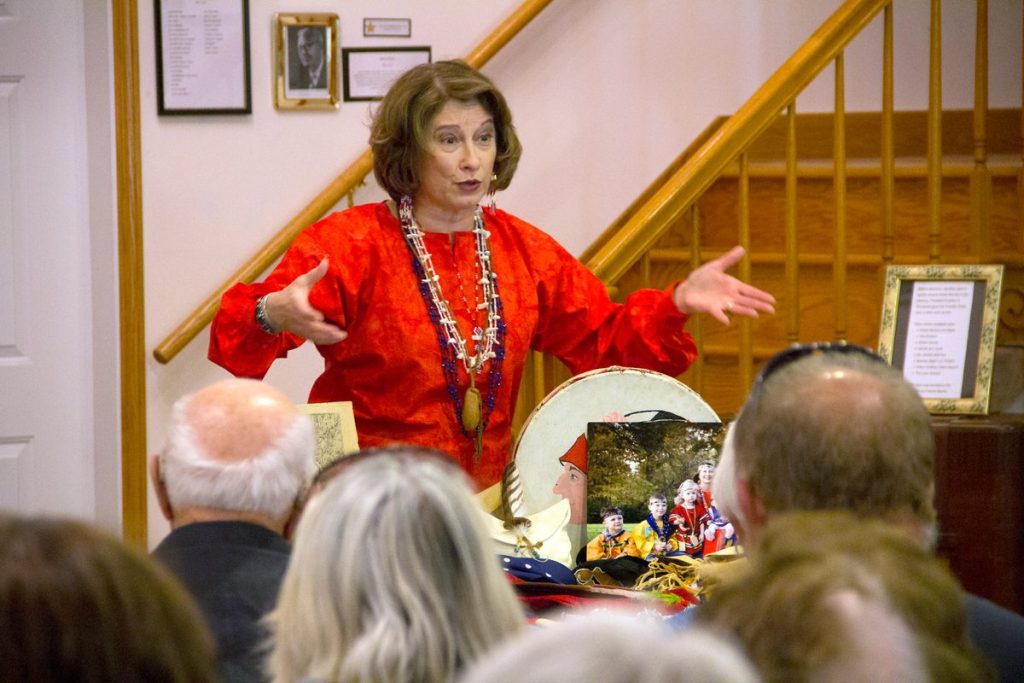
Marla Keiffer Burnsides discusses her Native American heritage with a crowd Sunday at the Nodaway County Historical Society Museum. She brought several items that are important to her family’s traditions.
Marla Keiffer Burnsides and her brother Robert Keiffer share stories and their heritage throughout the region, and on Sunday they spoke to a crowd at the Nodaway County Historical Society Museum.
“I do these programs in honor of my grandmother,” Burnsides said. “She told me, ‘I will tell you these stories and you go out and tell them to anyone who will listen to you.’ I love the stories that she shared.”
Growing up on a farm and going to school in Mound City, Burnsides stressed she and her siblings were taken out of school often to do just about anything on the reservation.
Burnsides’ father, “wanted us to know everything there was to know about being Native American. We spent a great deal of time at the reservation. We attended all the ceremonials. If anything was happening at the reservation, we were taken out of school and attended it. So, I feel very blessed that my dad felt that was so important that we never forget our heritage.”
She is continuing the tradition of passing along the heritage and traditions to her grandchildren. “I want to instill the same type of lessons that my grandmother taught us,” she said.
The program continued with Burnsides keeping the crowd entertained with stories of her life, while also passing along information in keeping with her dad’s belief that they never forget their heritage.
Burnsides discussed the clothing, language and dances of the Ioway tribe.
The Ioway tribe has books written about them. Burnsides brought several histories written about them and said that not all tribes have a history written about them. She tends to tell the stories of her grandmother, because they’re her “very favorite.”
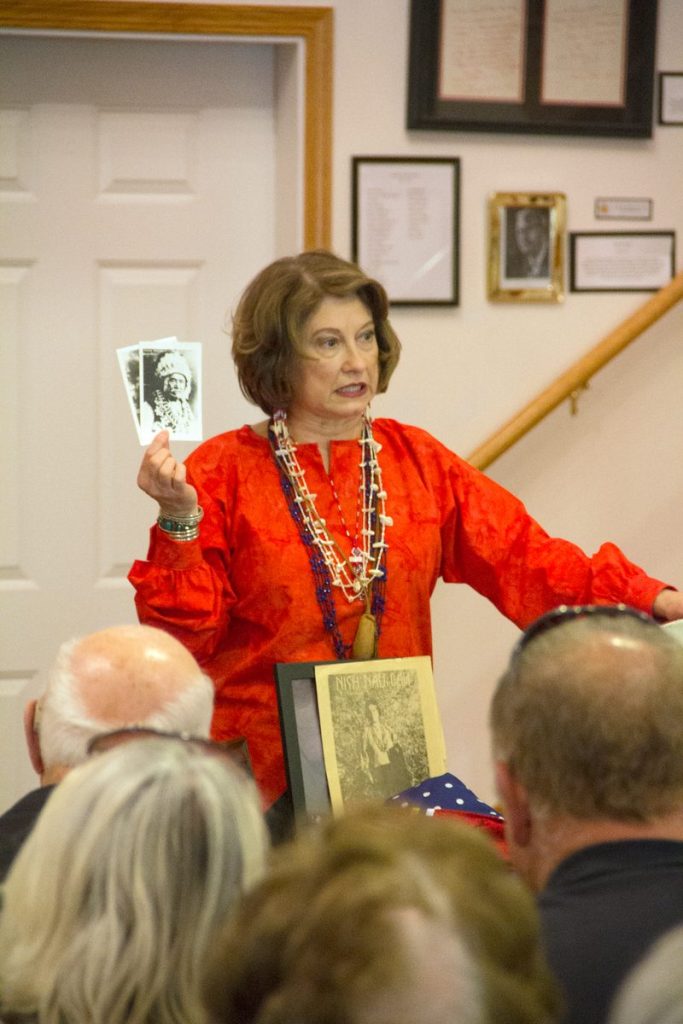
She showed the crowd a photo of Chief White Cloud who in the photo is wearing a famous necklace called a “Bearclaw Necklace.” Over time the necklace was lost. One of the members of the tribe was on vacation and saw it laying in a museum.
“Because all of the chiefs in the tribe have worn this necklace, we were able to petition for that back and it now lays in the museum at the tribal reservation,” Burnsides said. “So that’s one of the things I like to tell kids. It’s important to document history, because if someone had not taken all these pictures of every chief wearing this we would have never gotten that back.”
The program continued with Burnsides keeping the crowd entertained with stories of her life, while also passing along information in keeping with her dad’s belief that they never forget their heritage.
“The Native Americans are a very spiritually driven people and we’re also very superstitious,” Burnsides said. “We have a lot of rituals that everybody else laughs about, but we do not sweep the floor we do not use a broom after dark it brings sorrow to your heart. We just do not do it.
“That’s just the ritual. Those are the rituals we are taught and that I taught my children,” she said. “We have a thing about owls if an owl hoots three times for three consecutive nights there will be a death in your family and that happened when my father died. So, trust me when I hear an owl I’m awake instantly.”
She said another superstition is when moving they don’t take the broom. She said she helped her son, Miles, and his roommate move once and told him he had to leave the broom.
Several years later, the roommate happily texted Burnsides’ after another move to let her know he left his broom behind.
“Those are just our rituals, but sometimes they affect other people too,” she said.
The Native Americans are known not by their wealth — by how much they have, but by how much they give away,” Burnsides said.
She told the story of her grandmother who used to take care of their community members who needed a meal on Sundays. She would cook — whether in her indoor kitchen with a wood-burning stove, or her outdoor summer kitchen under a grove of trees — much more food than she could eat herself.
“Every Sunday, she would cook like she was feeding an army of people,” Burnsides said.
She said her mother would ask her why she was doing this and Burnsides’ grandmother would reply that she would make food and someone would drop by who needs a meal.
“And she would offer them food,” Burnsides said. “And by the end of the day all that food would be gone.”
Burnsides told story after story involving her family, the Ioway tribe and northwest Missouri. Members of the crowd asked questions about the types of food they would eat.
Burnsides told them the specialties were Indian corn soup and Indian fry bread. “My grandmother was an amazing cook, she said. “We were very fortunate. Every tribe has their own fry bread.”
She used to help her make the fry bread when her friends were off playing, but she says she’s glad now, because she continues to make it when her family gets together.
She spoke about Indian Tobacco and how it is different from the tobacco sold today. That it is special to the tribes and used in ceremonies.
Sharing her heritage is what Burnsides is hoping to do. She told a story about her brother Robert, who was looking for a place to stay for the week in Kansas City.
He answered an ad, and when he was told by the owner the minute he got out of the car, “You’ll never do. You’re Native American. You’ve got the braids long hair and the whole works.”
Burnsides said, “Here it is 2017, and he still has to deal with the fact that he’s Native American. We should live in a society where it does not make any difference what the color of our skin is, but unfortunately that is not the story even today. I hope and pray that my grandkids don’t have to face that.
“Even my nieces when they play basketball they get called names on the court,” she said. “But the more you educate people, the more you share with them about what your heritage is about and what is honor to you, people have nothing but respect,” Burnsides said.
SKYE POURNAZARI/DAILY FORUM
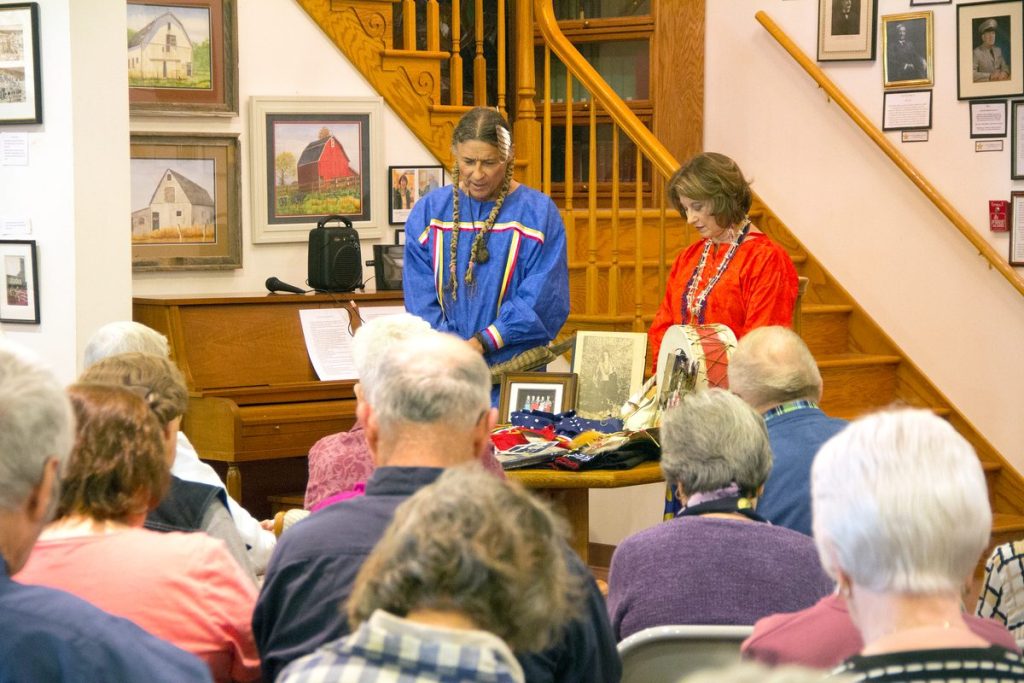
Robert Keiffer stands with his sister Marla Keiffer Burnsides and leads a prayer to open the event Sunday at the Nodaway County Historical Society Museum. Burnsides made several references that people upon first glance don’t often link the two as brother and sister. She said her looks were more like her father’s side of the family than her mother’s. “So, I did not have to grow up with any of the hardships of being Native American, my brother, he would tell you a whole different story.”
SKYE POURNAZARI/DAILY FORUM
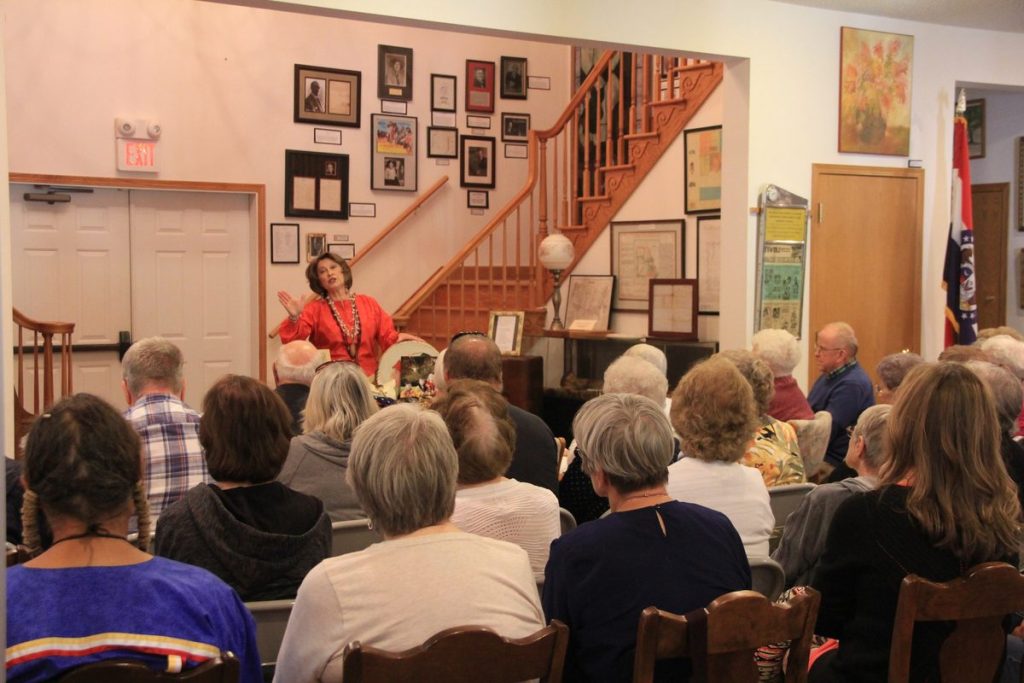
Attendees at the Nodaway County Historical Society Museum asked Marla Keiffer Burnsides questions about her Native American heritage including what her grandmother used to cook for the community on Sundays.
SKYE POURNAZARI/DAILY FORUM
Marla Keiffer Burnsides told the story of a long-lost necklace, found in a museum by a tribe member who was on vacation. It ended up being that of Ioway Chief White Cloud. Because the member recalled the historic photographs taken throughout the years of the tribe’s chiefs wearing it, the tribe was able to petition to get it back.
SKYE POURNAZARI/DAILY FORUM
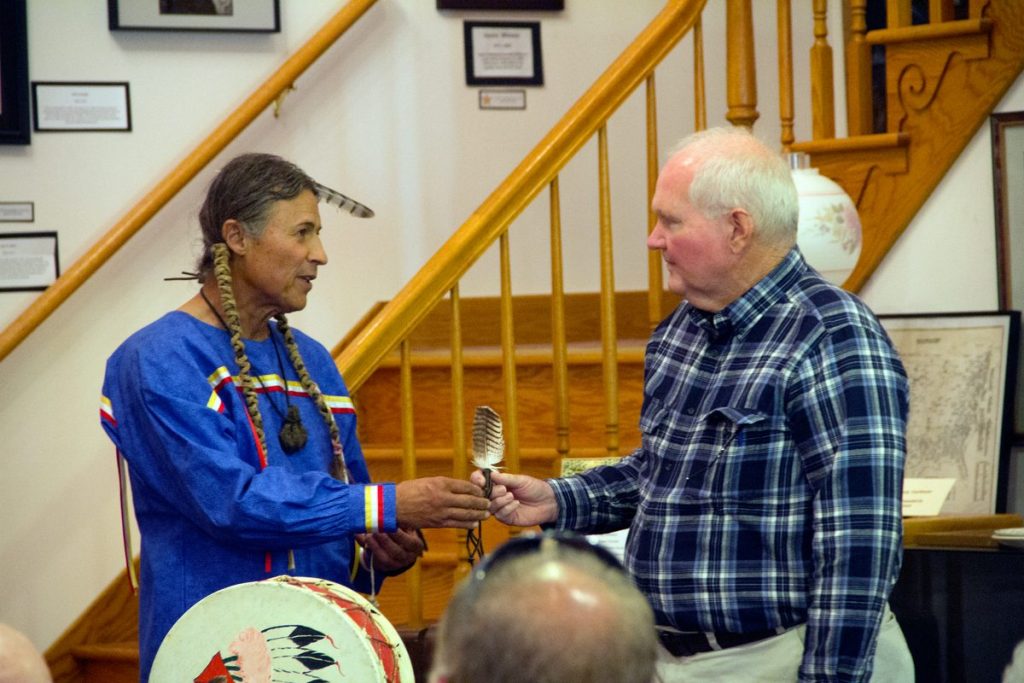
Robert Keiffer gives a red-tailed hawk feather to Bill Scott of the Nodaway County Historical Society Museum. “A small token, a symbol of your faith and work here,” Keiffer said. Marla Keiffer Burnsides told the group that she and her brother said that Keiffer’s spirit animal must be the red-tailed hawk and that one followed him in California and even back to northwest Missouri.