Gathering celebrates town-gown partnership
TONY BROWN/DAILY FORUM
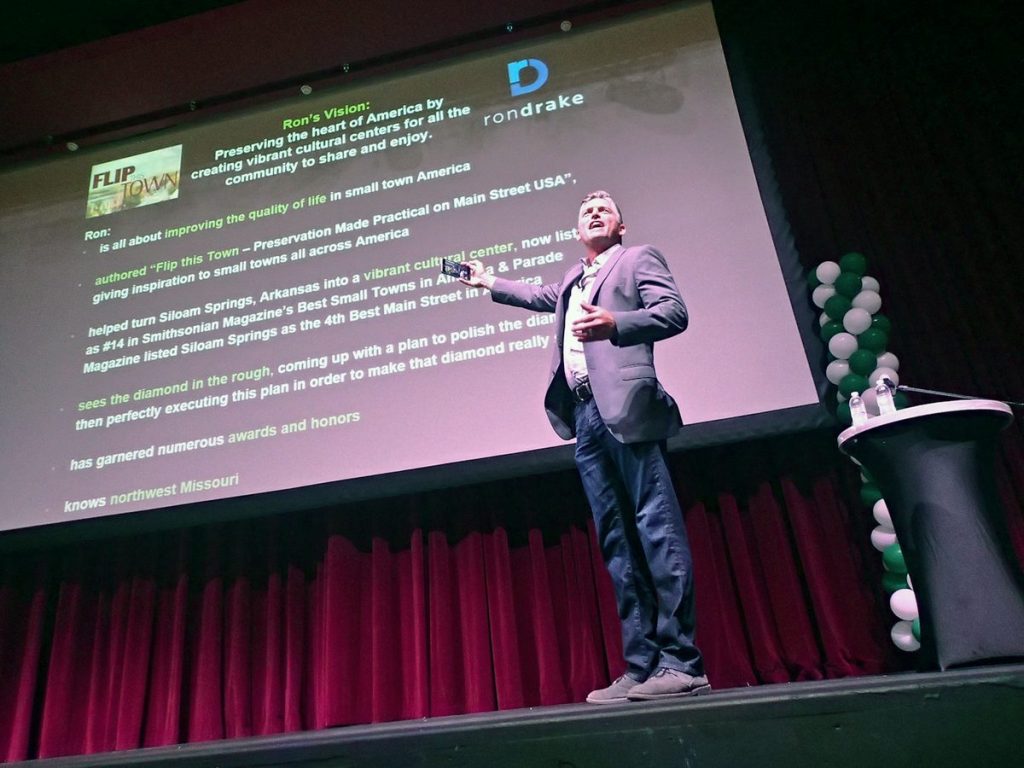
Downtown renewal expert Ron Drake speaks from the stage Wednesday morning during the All-Employee and Community Meeting in the Houston Performing Arts Center on the campus of Northwest Missouri State University. In working toward the creation of a growing, vital central business district, Drake called on local leaders to form strong partnerships with Northwest while embracing the community’s identification as a “college town.”
On the day before students start moving back to campus for the start of a new fall term at Northwest Missouri State University, a large crowd consisting of university employees and local community leaders filled the Houston Center for the Performing Arts during what amounted to a rally dedicated to town-and gown unity and a strengthened commitment to shared progress.
Generally referred to as the All-Employee Meeting, the traditional start-of-semester gathering was renamed this year to the All-Employee and Community Meeting and included presentations by Northwest President John Jasinski, City Manager Greg McDanel and keynoter Ron Drake.
Drake, a consultant based in Siloam Springs, Arkansas, is an authority on the renewal and redevelopment of small-town downtowns and spent three days here last February meeting with Maryville officials, economic development professionals and business owners during a tour hosted by the Community Foundation of Northwest Missouri.
Invited back for a similar visit this week by City Hall and Northwest, Drake once again laid out a future for downtown Maryville that envisions a vibrant college-town commercial district filled with loft apartments, boutiques, clothing stores, restaurants and public gathering spaces.
To accomplish this, Drake called on local residents to work together with the campus community in an effort to think and act creatively while taking advantage of existing buildings, repurposed materials and an emphasis on what he likes to call “the cool factor.”
In Siloam Springs, Drake said, derelict buildings were transformed through adherence to a “work with what you’ve got” ethic used to carve creative spaces for living, socializing and doing business that feature bare brick walls, open ductwork, rustically preserved tin ceilings and restored hardwood floors.
The key, he said, is to “figure out how to do cool stuff for the least money.”
In just a few years, Drake said, Siloam Springs’ downtown went from a 30 percent building occupancy rate to nearly 100 percent and was declared America’s fourth-best downtown by Parade Magazine.
He said he is helping lead a similar effort in Okmulgee, Oklahoma, which, like Maryville, is a college town of around 12,000 people.
The Oklahoma State University Institute of Technology is proving a key partner in the initiative, Drake said, and has committed to purchasing downtown property for redevelopment into student housing.
As things stand now, he said, Okmulgee is working toward restoration of about 20 downtown structures through total investment of more than $15 million.
In working toward a full downtown revitalization in Maryville, Drake told his listeners it was essential to establish a core group of advocates and prime movers plus a second group made up of community leaders and officials.
Another crucial step, he said, was to encourage alliances and cooperative efforts involving city government, businesses, the campus and local organizations.
All of these groups and individuals, he said — to general laughter — should make it a point to “restore” the community’s “CAVE people,” an acronym standing for “citizens against virtually everything.”
“Maryville has an amazing downtown,” said Drake, who then posed the question, “But when you go downtown do you see blighted buildings or amazing opportunities?”
One of the central priorities for a vital central business district, he said, is the development of loft housing for students, young adults and even families.
“Do you want students to stay here after they graduate?” Drake asked. “Well, give them a place to live. … The best way to bring life to downtown is to bring lives to downtown.”
Other recommendations by the author of “Flip This Town” included creating gathering spaces that can be enjoyed by people from all social and income levels and an overall design that encourages pedestrians over automobiles.
He also said local businesses should recruit university students as interns and employees and set them to work doing everything from designing attractive restaurant menus to taking on marketing and social media projects.
Such relationships can only strengthen Maryville’s relationship with Northwest Missouri State, said Drake, who urged business and civic leaders to forge connections with the university at every possible opportunity.
“You have to determine your identity,” he said. “Maryville is a college town.”
During remarks earlier in the meeting, both Jasinski and McDanel spoke to a number of cooperative ventures undertaken by the city and the university over the past few years, including completion of the Fourth Street pedestrian corridor and ongoing construction of Hughes Fieldhouse, a massive indoor athletics complex on the west side of campus.
Northwest paid for signage and other features incorporated into the Fourth Street project, and the city is contributing $3.45 million over 23 years in transient guest tax revenues that will be used to help build and maintain the $20 million fieldhouse.
“Our partnership has never been so strong,” said Jasinski, who added that it was time to take cooperation with the city and organizations like the Chamber of Commerce, Downtown Maryville and Nodaway County Economic Development “to the next level.”
For his part, McDanel, a Northwest alumnus, said city managers often struggle to come up with a formula for “what makes a city special enough to call home.”
But in Maryville, he said, the answer seems obvious.
“To me, that is Northwest Missouri State University,” he said.