
Webber talks strategy with Nodaway County Dems
TOM PINNEY/DAILY FORUM
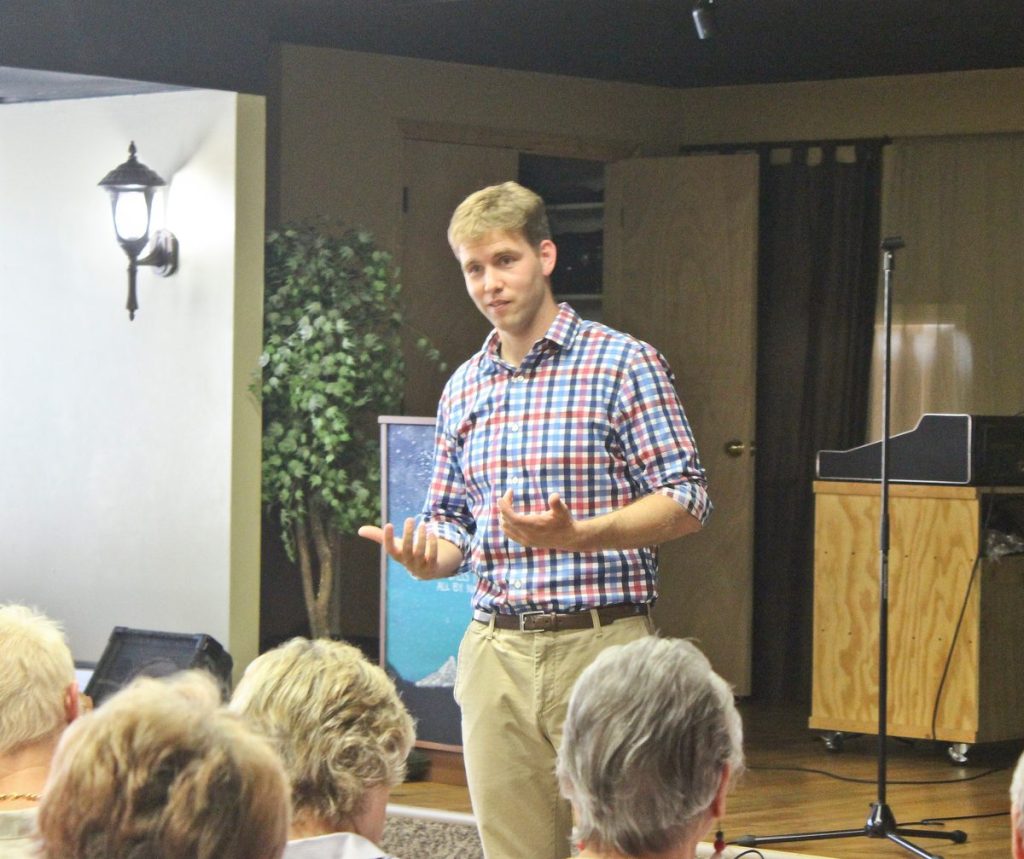
Missouri Democratic Party chair Stephen Webber talks about the party’s strategy moving forward after the 2016 election at the monthly meeting of the Nodaway County Democrats. More than 50 people from Nodaway County and neighboring areas attended the meeting Monday night.
While some may see the Democratic Party scrambling to find a new message after a sound defeat nationwide in November, Missouri Democratic Party chairman Stephen Webber said all democrats can agree on one thing: progress.
Such was the theme of Webber’s presentation to the newly-reformed Nodaway County Democrats during the group’s monthly meeting Monday night at the Wesley Student Center. Around 53 people came from throughout Nodaway County and neighboring counties to see Webber speak about the state party’s next step following an election where Missouri’s legislature and governor’s mansion turned decisively Republican.
“Sometimes this happens, but in Missouri, Democrats bounce back,” Webber said. “In 1988, Jay Nixon ran for U.S. Senate and didn’t win a single county, but in 1992, Missouri voted overwhelmingly for Bill Clinton as President, Mel Carnahan won the governor race, and we took a total sweep. Two-thirds of the state was blue that year.
“In 2004, Matt Blunt won the race for governor, and everyone said that was the final bell for Missouri Democrats. But again, we bounced back, and in 2006, Claire McCaskill not only won her election to the U.S. Senate and became the first woman from Missouri to serve in the Senate, she beat an incumbent Republican for it. In 2008, Jay Nixon was elected Governor, and we won every down-ballot race except Lieutenant Governor. The same was the case in 2012, including McCaskill’s re-election. In Missouri, the pendulum always swings back.”
Webber was invited to speak to the Nodaway County Democrats on the plan going forward. To that end, Webber presented the audience with three concrete Democratic plans statewide that he insisted are better than their Republican alternatives.
Webber started out talking about healthcare, a national hot-button issue. In acknowledging the Republican side of the issue, Webber noted that the only “plan” in place was tax cuts for the wealthy.
“Republicans want to pay for those tax credits by limiting the amount of credits that Missourians get for buying plans on the marketplace,” Webber said. “Credits are determined by the cost of healthcare in your state and your personal income, and if they limit the credits people can get on their healthcare, the prices increase.
“You have to ask your friends, ‘Is it fair that rural communities have to bear the brunt of paying for tax cuts for the wealthy by getting their premiums raised? Should we be paying for tax cuts at all?’ Because that’s what the Republicans are suggesting we do.”
Webber then moved on to education, which became quite a popular issue in Missouri earlier this year when the Republican plan to provide public funding vouchers for private schools and drop the boundaries of charter schools failed in the House of Representatives. While Allen Andrews (R-Grant City) voted against the measures and helped them to ultimately fail, Webber noted that those were still core principals of the Republican plan.
“They want to drain the pot of money meant for public education and send it to private schools,” Webber said. “That’s a bad deal for everyone, but especially for rural Missouri.
“When you redistribute those funds, you drain resources from community schools. Ask your Republican friends if it’s fair to take funding from public schools or to raise property taxes to offset tuition costs in Kansas City.”
Webber then moved to infrastructure, which he noted would become a central part of the Trump administration come fall. Webber did note, however, that Trump’s potential plan, valued at $1 trillion, would come at a massive cost to rural communities.
“The $1 trillion plan they have right now doesn’t actually build $1 trillion worth of roads and pipelines, it’s $1 trillion in tax cuts to private sector builders,” Webber said. “And they have quotas to fill, so they aren’t going to build or fix roads, bridges, or anything else in rural areas.
“They would much rather build in areas that have a high volume of traffic, so that money and those projects will go to places like Chicago, St. Louis, and New York City. You have to ask if it’s fair that we pay local taxes but that money goes to fix roads in Kansas City, because that’s the Republican plan.”
Webber then moved to the next steps for the Missouri Democratic Party, noting that it revolved around participation in general. The most important step, one that Webber said the party is paying special attention to in the coming months, is recruiting candidates.
Webber was himself a candidate before becoming the party chair, serving through his term limit in the Missouri House of Representatives before mounting an unsuccessful campaign for his district’s seat in the Missouri Senate in 2016. He said that it was impossible to convince people to be Democrats and vote for Democrats if there were no Democrats on the ticket.
“We have started out well, protesting and holding our government accountable for its actions, but if we’re still doing that in October of 2018, we’re not evolving enough,” Webber said. “We need to have candidates start to come forward and make themselves known.
“In 2006, out of 163 available seats in the House of Representatives, Democrats were competing for 140 of them. In 2016, there were still 163 seats, but Democrats were competing in only 97 races. That means 44 percent of the House is currently made up of people who didn’t win elections; they were brought in by default after filing in March.”
There’s a lot of change for the Democratic Party’s message going forward, but it’s a prospect that excites Webber. As he put it, if there is still a need for progress, that’s a great sign for up-and-coming Democrats.
“I feel sorry for places like Connecticut, which has been blue for so long and made a ton of progress,” Webber said. “There’s not much else for them to do. But for Missouri, there’s still so much to be done … and that’s awesome.”