
Lawmaker lays out MoDOT funding options
TONY BROWN/DAILY FORUM
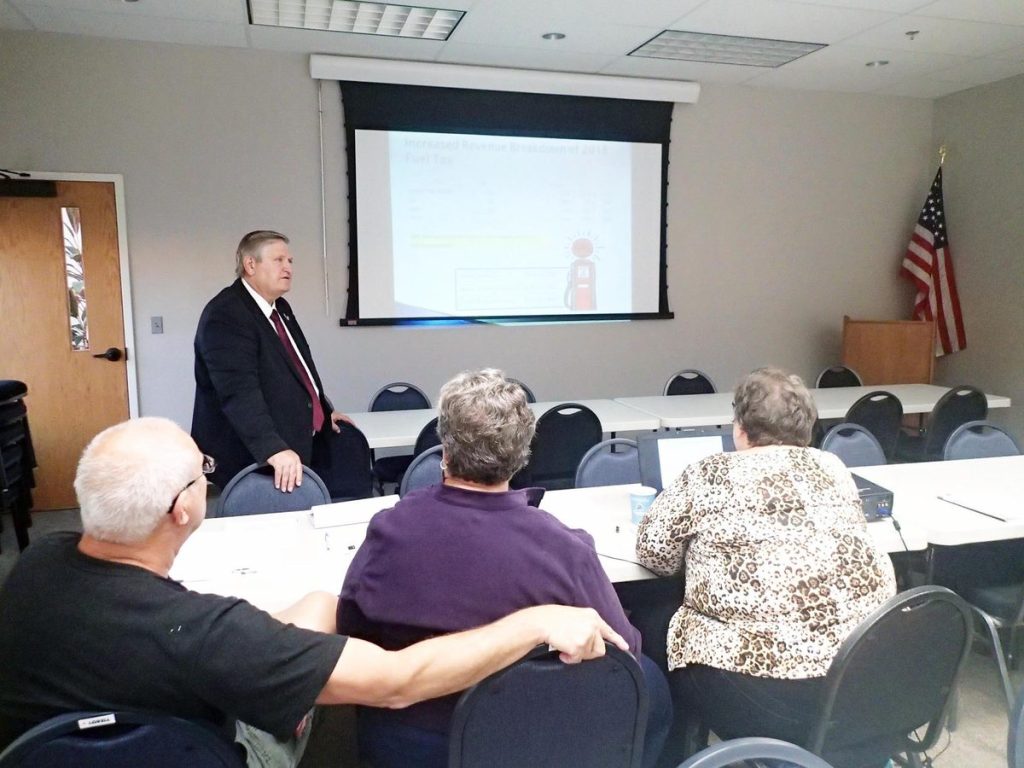
State Rep. Jeff Messenger, R-Republic, standing in front of members of his staff, speaks before a sparsely attended public meeting early Tuesday designed to elicit input on how to increase revenue for the Missouri Department of Transportation. MoDOT has identified $825 million in high-priority unfunded transportation needs, mostly having to do with the state’s aging network of roads and bridges.
State Rep. Jeff Messenger, R-Republic, who serves as chairman of the House Policy Development Caucus, was in Maryville Tuesday seeking public input on ways to generate additional revenue for the Missouri Department of Transportation.
Over the past couple of years, MoDOT has identified what it describes as $825 million in high-priority unfunded transportation needs, mostly having to do with maintaining the state’s aging network of roads and bridges.
The funding gap has grown over 15 years of reduced appropriations, budget cuts and falling gas, diesel and gasohol tax revenues tied to an increasing number of fuel-efficient vehicles on Missouri highways.
While the purpose of the session was to gauge public support for a series of revenue-producing proposals, only a couple of private citizens were in attendance. Of the dozen or so people who showed up, most were officials from such entities as the City of Maryville, the Greater Maryville Chamber of Commerce and Nodaway County Economic Development.
Matt Barry, a staff member from the office of U.S. Rep. Sam Graves was on hand as well.
Efforts to generate more funding for Missouri’s roads and bridges have languished for years, with voters proving unwilling to support an increase to the state’s 17-cent motor fuels tax, unchanged since 1996 and one of the lowest in the nation.
Other fees, such as those charged for vehicle registration and driver’s licenses, have not been raised since 1984. Some vehicle-related charges go back even further, Messenger said.
In April, the Missouri House scrapped an amendment that would have raised the state’s gas tax by nearly six cents per gallon in 2018 pending voter approval.
Messenger said Missouri has the seventh-largest highway system in the country, but ranks 47th in revenue per mile.
He added that Missouri ranks 12th nationwide in terms of highway performance compared to dollars spent, despite being forced to maintain many more miles of state-owned roads, 33,873, than any of its neighbors.
The closest comparison is Kentucky, with 27,620 miles. But the other seven neighboring states are well below the 20,000-mile mark, and two, Nebraska and Iowa, have fewer than 10,000 miles of state-maintained highways.
Messenger said MoDOT currently has a budget of around $2.4 billion, with $1.5 billion coming from fuel taxes and other transportation-related state revenue and $911 million appropriated by the federal government.
Quoting figures from MoDOT’s “Citizen’s Guide to Transportation Funding,” Messenger said the average Missouri driver pays $30 a month in state and federal transportation taxes and fees and would have to pay another $16 a month to bridge MoDOT’s $825 million funding gap.
The caucus, Messenger said, hopes to produce legislation calling for the adoption of some combination of eight strategies designed to return MoDOT’s budget to a level capable of meeting identified transportation priorities.
These include a motor fuels tax increase; a general sales tax increase; creation of a motor fuels sales tax; raising the sales tax on motor vehicles; the transfer of “low-volume” roads to city or county ownership; turning Missouri’s interstate highways into toll roads at points where those highways cross state lines; and passage of a state open-container law, which would allow Missouri to apply an additional $21.4 million in federal funding to its road and bridge maintenance and construction budget.
Messenger’s caucus is also proposing indexing increases to the fuels tax and fees charged for driver’s licenses, license plates, trailers, titling and alternative fuel decals by tying them to the Consumer Price Index.
Applying the inflation index to motor fuels, Messenger said, could produce an additional $46 million in MoDOT funding over the next three years.
The move would be legal without voter approval, he said, because under a 2011 decision by the Missouri Supreme Court, state motor fuel taxes are classed as user fees, meaning they are not subject to Missouri’s tax-limiting Hancock Amendment.
In his view, Messenger said, linking motor fuels taxes and other transportation fees to the CPI would produce the most revenue, at least over time, and inflict the least pain on taxpayers.
Raising the state’s 17-cent motor fuels excise tax 5 cents would produce $205 million in added revenue, he said, about a quarter of what MoDOT says it needs.
“I think one of the problems we’ve had in the past has been that we go for all or nothing,” Messenger said, “and then it doesn’t pass.”
A better strategy, he suggested, might be to seek a variety of smaller-scale revenue increases that will adequately fund MoDOT over time.
CPI indexing, Messenger said, carries the potential for growing MoDOT revenue by as much as $150 million a year over the next three years.
Those attending Tuesday’s meeting included Bob Wollenman, a St. Joseph businessman who sits on the Governmental Affairs Committee of the National Association of Truck Stop Owners.
Wollenman said that, with gasoline prices at their lowest level in years, the “timing is perfect” to move forward with a transportation tax increase of some kind.
“We’ve got to do a superior job of educating the public as to why this is essential,” said Wollenman, who described an adequate road and bridge network as “the engine that drives the whole economy” by allowing business people and farmers to deliver goods and services.
“We need to get our heads out of the sand and get something done,” he said.
The House Policy Development Caucus hopes to complete its transportation funding report by the end of September with an eye toward proposing legislation prior to the start of a new General Assembly session in January.




