
Lunch and Learn seminar teaches mindful eating
TOM PINNEY/DAILY FORUM
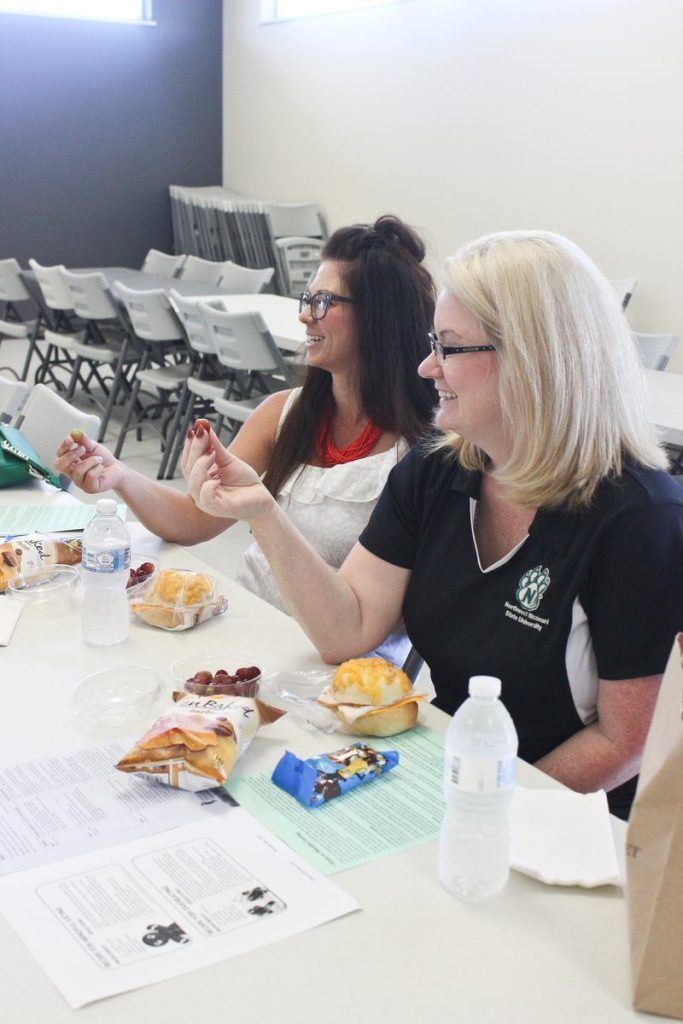
Ashley Turner, left, and Kelly O’Riley inspect their grapes during Friday afternoon’s Lunch and Learn session. Sponsored by SSM Health St. Francis Hospital in Maryville, this month’s seminar was on mindful eating.
Part of what contributes to the obesity crisis in America is that people aren’t paying attention to what they’re eating. But it’s not about the health contents of the meal; rather, it’s about the meal itself.
SSM Health St. Francis dietitian Julie Livengood explained as much during the hospital’s monthly Lunch and Learn seminar Friday, held at the Maryville Community Center.
Her seminar was on the habit of mindful eating, which she noted was an important part of what she suggests to patients who are directed to her office.
“I don’t suggest diets as much because that kind of thinking adds shame to the equation,” Livengood said. “The most important thing to remember when you’re eating is to pay attention to what you’re eating, when you’re eating it.
“Any food can be good for you in the right amount, but you have to take the idea of ‘bad food’ out of your vocabulary if you want any sort of eating and exercise plan to be successful. Having a food carry the distinction of ‘bad’ creates shame, and that shame leads to punishment.”
That punishment, Livengood noted, sometimes takes the form of incentivized workout plans. In other words, some workout harder because they enjoyed a treat that was “bad” for them, and others workout harder so that they can enjoy a treat that is “bad” for them as a result.
It’s all part of Dr. Michelle May’s writings on the “Am I Hungry?” cycle. Particularly, incentivized workouts fall under the category of “Where do I spend my energy?”
Other parts of the cycle include “Why am I eating?”, “When am I eating?”, “What am I eating?”, and “How much am I eating?”
The “Why” question involves several categories, Livengood explained. Some people eat because of their emotions or stress, some eat because of social events, some because it’s “time” to eat, and others eat out of boredom, when people should only be eating when they’re hungry.
“If you don’t eat when you’re hungry, then you’re not entirely sure when you should stop eating,” Livengood said. “You have to judge whether you eat on your level of hunger and nothing else.
“That also contributes to how much you’re eating; you should let your body dictate when you should stop eating, not your plate. It’s okay to have leftovers.”
The “what” question is one of the most important when it comes to mindful eating, according to Livengood. To illustrate the point, she directed the seminar’s attendees to eat their lunch, but in a certain order and in a specific way.
She started with a grape, telling everyone in attendance to pull out a grape from their provided meal to inspect it.
“How does it look?” Livengood asked. “How does it feel? Can you notice your mouth starting to produce saliva to get ready to receive the grape?”
She then directed the group to take a bite, but to chew very slowly and savor the entire grape before swallowing. Not only did this have to do with her point on mindfulness, but it also had a helpful digestive hint.
“The more you chew, the quicker it goes down,” Livengood said. “Food particles are harder to digest than fully-chewed food, so make sure you’re chewing it for longer to not only savor it more, but to help your digestion.”
Livengood’s other tips for mindful eating included eliminating all distractions, including eating in front of the television or while doing work. “If you’re multitasking, then your plate will tell you when you’re done, not your body,” LIvengood noted.
In order to make sure that you’re being mindful about your eating habits, Livengood suggested asking yourself one question:
“Could I write an article about what I just ate for a gourmet food magazine?” Livengood asked. “If the answer is no, then you need to change to some more mindful eating habits.”