Austere Northwest budget driven by state cuts
TONY BROWN/DAILY FORUM
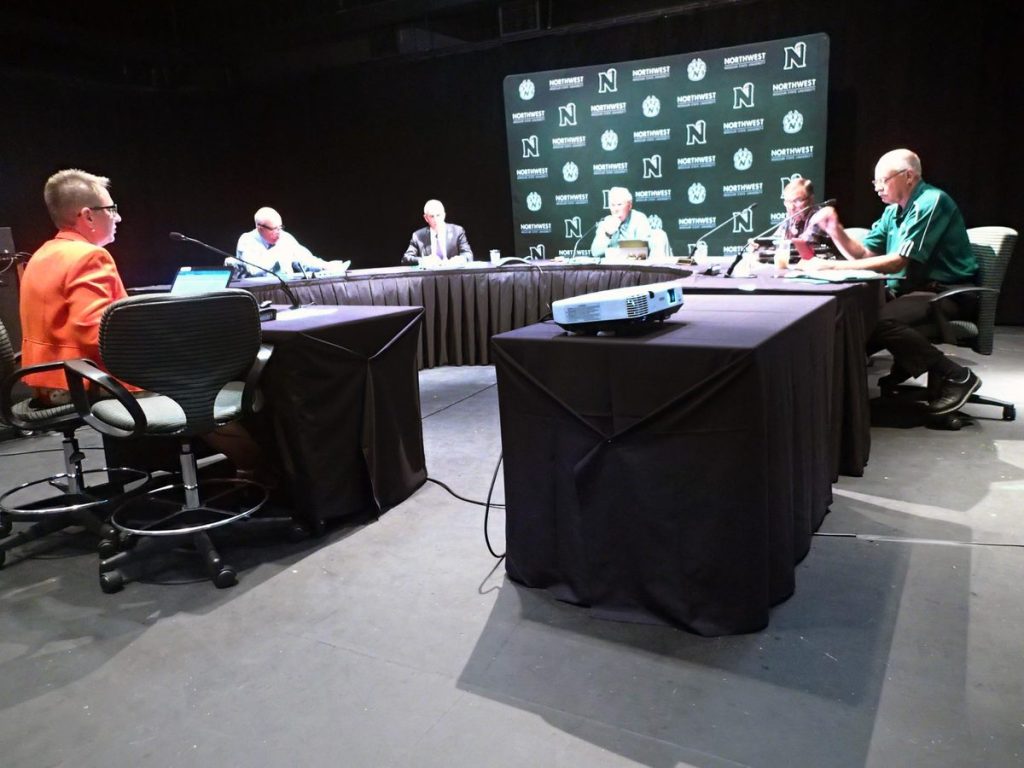
Stacy Carrick, vice president of finance for Northwest Missouri State University, addresses the school’s Board of Regents during Friday’s regular session. Following her presentation, the governing board approved Northwest’s fiscal 2018 budget, a spending plan reflecting a number of austerity measures tied to deep cuts in state spending for higher education.
Northwest Missouri State University’s Board of Regents during its final regular meeting of the current fiscal year on Friday unanimously approved the institution’s 2017-2018 budget.
Steep cuts to higher education by the Missouri General Assembly made this year’s budget process extremely challenging as university officials faced the school’s most serious fiscal crisis since the 2008 recession.
Falling enrollment, linked in part to federal policies that have discouraged international students from attending Northwest, contributed to the bleak fiscal outlook. But the hammer blow came in the form of a 6.6 percent reduction in state appropriations.
That translates to a $2.1 million cut in core state spending.
And it might get worse. Should he choose to do so, Gov. Eric Greitens could reduce Missouri’s higher education budget by a total of 9 percent, a cut that would decrease state spending at Northwest by about $2.9 million during the coming fiscal year, which begins July 1.
Stacy Carrick, Northwest’s vice president of finance, said the legislatively approved reduction as it now stands shrinks the state’s share of the university’s budget to around 33 percent, with 67 percent coming from tuition other sources.
That’s practically a mirror image of 1990, when state funds accounted for a little less than 67 percent of Northwest’s revenue.
Carrick added that if state spending were to keep pace with inflation, Northwest would have received approximately $37 million for the coming year rather than the $30 million appropriated by the Legislature.
In balancing its budget for fiscal 2018, Northwest is raising tuition by 2.8 percent, a figure tied under state law to the rate of inflation.
The university has worked throughout the past year to cut costs by offering early retirement packages to veteran employees and leaving open positions unfilled.
Additional economies include closure of the campus-based Missouri Academy of Science, Mathematics and Computing, a two-year residential early college program for gifted high-school students, at the end of the spring 2018 term. Operations are also ceasing at the Northwest-St. Joseph learning center.
According to a Northwest release, ending those initiatives will save the institution about $1 million a year.
Other austerity measures embrace shutting down the English as a Second Language program and repurposing the Dean L. Hubbard Center for Innovation and Entrepreneurship, which will become the new home of the university’s School of Agricultural Sciences.
Salary increases, both market-based and cost-of-living, weren’t even on the table this year, though Carrick said the regents have voiced support for raising wages in the future, citing concerns about morale and retention.
Faculty, staff and student employee reductions will lower the university’s payroll in fiscal 2018 from $40.5 million to $38.4 million.
Projected education and general spending by Northwest during the coming fiscal year totals $92.4 million, which compares to $98.8 million in 2016-2017.
However, the current year’s figure is somewhat inflated due to funds set aside for construction of the Hughes Family Center athletics complex, a line item that includes alumni donations and other funding unrelated to general university operations.
Northwest’s auxiliary services budget, which is essentially self-funded through room and board fees paid by students, is projected at $25.1 million in 2017-2018, down from $28.4 million for the current year.
The difference is due to an anticipated 1.2 percent decline in enrollment from 6,186 to 6,110, which Carrick said reflects the combination of fewer international students plus a declining population of college-age teens across Northwest’s traditional recruiting area.