Northwest Missouri State cuts ESL program
Todd Weddle | Northwest Missouri State Univeristy
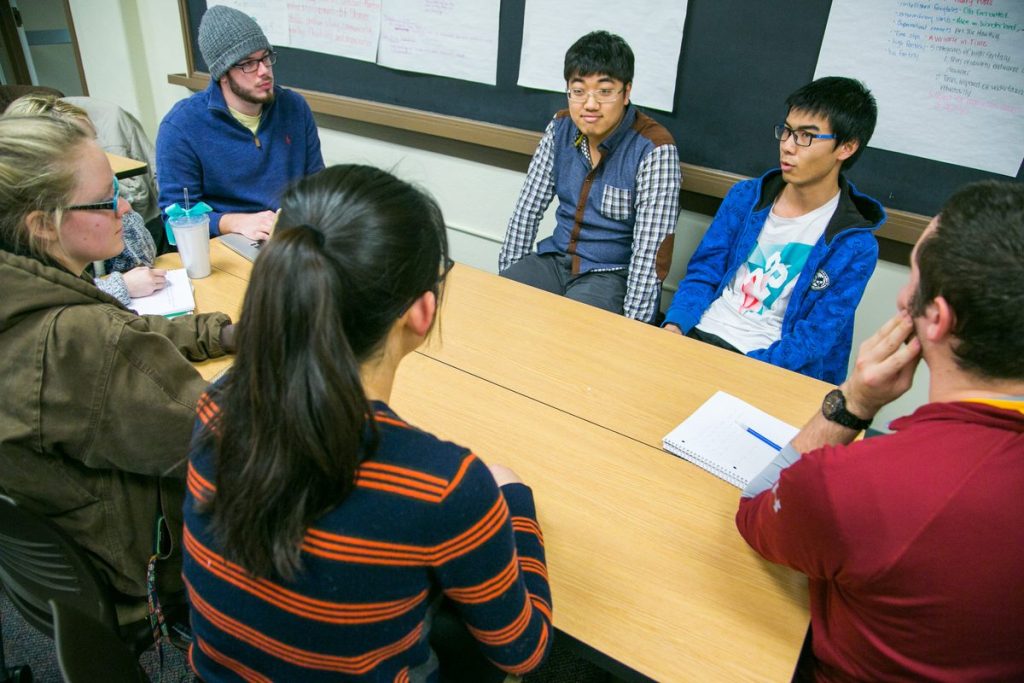
Bearcat English as a Second Language ESL program students interact with Dr. David Kiene’s Multiculturalism class Feb. 8, 2016.
During a time of growing budget challenges, a long-standing program at Northwest Missouri State University will close June 30.
Northwest’s English as a Second Language program is one of a number of programs that is falling victim to cuts in state funding.
As announced earlier, Northwest is also shuttering its St. Joseph learning center; repurposing the Dean L. Hubbard Center for Innovation and Entrepreneurship into the new home of its expanding School of Agricultural Sciences; and closing the Missouri Academy of Science, Mathematics and Computing at the close of the spring semester in 2018.
“ESL has been with us a long time and served a need,” Northwest Provost Timothy Mottet said. “What is changing is the ESL market. There is a variety of competition going after those students. To compete in that marketplace on the level of other agencies of instruction puts us at a competitive disadvantage.
“It takes more work and it is harder to get them, and when you do the math, the math wasn’t adding up. It was just becoming more and more difficult to be a competitor in the marketplace.”
According to the most recent Northwest ESL newsletter, the school had a record class of 51 during the second fall session, including 21 students from Mexico.
The first fall session contained 30 students: 23 from Niigata, Japan and the rest hailing from South Korea, China and Saudi Arabia.
Mottet noted that Northwest had a contract with an organization in Japan to provide students with ESL instruction.
The program aimed to help students learn English so they could enroll in a university, improve job prospects and better understand American culture. Each session lasted eight weeks.
The fall sessions included field trips to the Henry Doorly Zoo and Aquarium in Omaha, Nebraska, and the Nelson-Atkins Museum of Art and Country Club Plaza in Kansas City.
Mottet said one issue that figured into the decision to end the program was retention. Many students, he said, either went back home to attend college or stayed in the United States but chose not to attend Northwest.
“They are here for a reason, and we fulfill that obligation and they leave,” he said.
A similar situation existed with regard to the Missouri Academy, a two-year early college program for gifted high-school-age students who frequently went elsewhere to complete their undergraduate degrees.
“If more of those students would matriculate into the university, that changes things,” Mottet said of both ESL and the academy. “If they would come, then we created a pipeline with enrollment management. The resources and all of that, we were at a point where we had to make a decision.”
Also, while ESL sessions were relatively heavy in the fall, numbers for the spring term tended to drop significantly.
Another consideration was that while some of the university’s international students took ESL classes to boost their English skills, most were already fluent enough to meet Northwest admissions standards.
According to the website www.esldirectory.com, there are only a handful of universities in Missouri offering ESL courses. They include the University of Missouri-St. Louis, Missouri State University, Harris-Stowe University and Southeast Missouri State University.
Closing the ESL offering at Northwest eliminates two staff positions, though one of those employees has accepted an early retirement package.
Mottet said that is still one lost job too many.
“We didn’t come to this lightly or just, ‘Hey, let’s do this,’” he said. “These are decisions we think through. What are the implications? What are the implications on the students? What are the implications on the community? What are the implications on the mission of the university? What is the impact on the bottom line?”
Mottet said there have been 52 hours invested in budget meetings since January that resulted in decisions leading to cuts and closures.
“I had to bring a considerable amount of money to the table,” Mottet said. “I looked at ancillary programs. We looked at the financials. We looked at the importance of the strategic plan of the university and the finances. When your margins are thin, the financials play a bigger role. That is tough messaging.”