
KCP&L trainers travel to demonstrate potential power problems
TOM PINNEY/DAILY FORUM
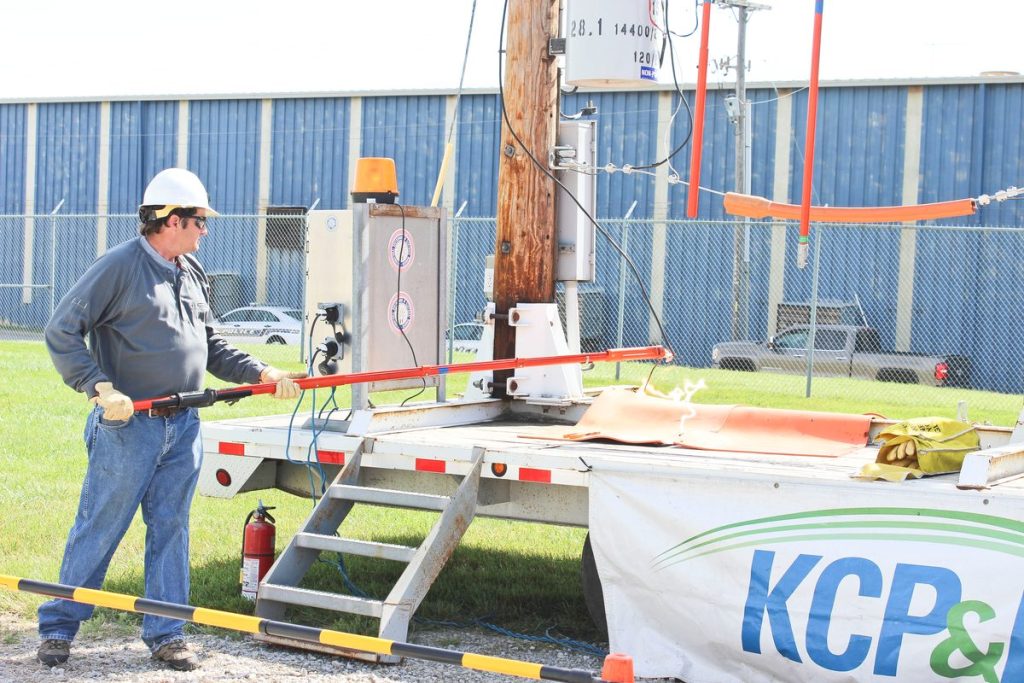
KCP&L representative Glen “Clifford” Maughmer creates an electricity arc to demonstrate the power which is in power lines. The demonstration is part of a traveling training program put on by Maughmer and field training specialist Shawn Spiwak, who lost an arm and a leg in an electrical accident in 2008.
Kansas City native Shawn Spiwak was a victim in a power line accident. Now he travels and trains others to make them aware of the dangers of downed power lines.
In 2008, while responding to a power outage north of Worlds of Fun in Kansas City, the Kansas City Power & Light employee came in contact with a line that was still powered. The electricity traveled a path from his right elbow to his right knee, which was resting on the pole.
The result was fifth-degree burns, meaning his bones were irreparably damaged, and to put a stop to the internal burning, he had to have his right arm removed at the shoulder and his right leg at the hip. Since he was wearing his wedding band, he also had to have his left ring finger removed.
“The ring finger was what they were worried about the most,” Spiwak recounted. “In order for the electricity to get there, it would have had to go through my heart.
“They opened it up, and luckily, they found no damage.”
His partner, Glen “Clifford” Maughmer, also from Kansas City, said he had seen plenty worse than what happened to Spiwak.
“In my 32 years (working for KCP&L), I’ve buried five friends,” Maughmer said. “One guy was ‘cooking,’ which is what we call it when they’re still burning on the inside, for five days, and he didn’t make it.”
Spiwak stopped burning internally after three days, and after a 10-week stay in the hospital, he returned home. Around a year later, he returned to work for KCP&L, but this time, as a trainer.
Now, he and Maughmer travel around the region with a truck they use to demonstrate the dangers of electricity.
“We mostly do this demonstration for fire departments, police, and schools,” Spiwak said. “There are a few other companies who have similar trucks and demonstrations, so we got our idea for our truck from them.”
On Monday, the pair brought their demonstration to Maryville, setting up outside the KCP&L building just east of Maryville. The main purpose of the training seminar was to illustrate how much electricity is flowing at any given moment if a line is powered up.
Spiwak started out explaining what happens if someone gets in a car accident with a pole, and there are lines on the ground.
“The safest place to be if you get in an accident like that is to stay in the vehicle,” Spiwak said. “If you get out, you could become a conductor, but in the car, you’re like a bird on a wire because there’s no path to ground.
“But sometimes, you have to get out of the car, and if you do, you should open your door as far as possible, then jump as far as you can from your car. Try to land with your feet together, and get at least 10 feet away from the scene.”
Spiwak noted that it was bad to run with big strides, as in that situation, electricity has “rings of power” that act much like ripples on water. The further away someone gets from the accident, the less electricity there is.
However, if a person has one foot in one ring of power and the other in a different ring, they can and will get electrocuted. As such, Spiwak suggested small steps or bunny hops, keeping both feet together as much as possible until the person gets 10 feet away from the accident.
Spiwak explained several other situations while Maughmer demonstrated by creating arcs of electricity using an aluminum ladder, a tire, and a rope. Throughout the demonstration, the pair kept mentioning the importance of staying aware when power lines were involved.
The assembled attendees, which consisted of KCP&L workers, Maryville Public Safety, the Missouri State Highway Patrol, and others agencies, also learned about removing meter cans from residential meters to cut power. Spiwak also discussed the type of oil in transformers marked with a “Non-PCB” sticker, noting that it was mostly harmless but could still cause damage if it leaked.
Editor’s Note
This story is part of a weekly series highlighting “Everyday Heroes.” In this weekly segment, the Daily Forum takes a look at people who work tirelessly to make Maryville a great place to live. If you have a suggestion for someone who you feel should be featured, please contact us via email at [email protected] or call the Forum at 660-562- 2424.