
Police, firefighters host open house
TONY BROWN/DAILY FORUM
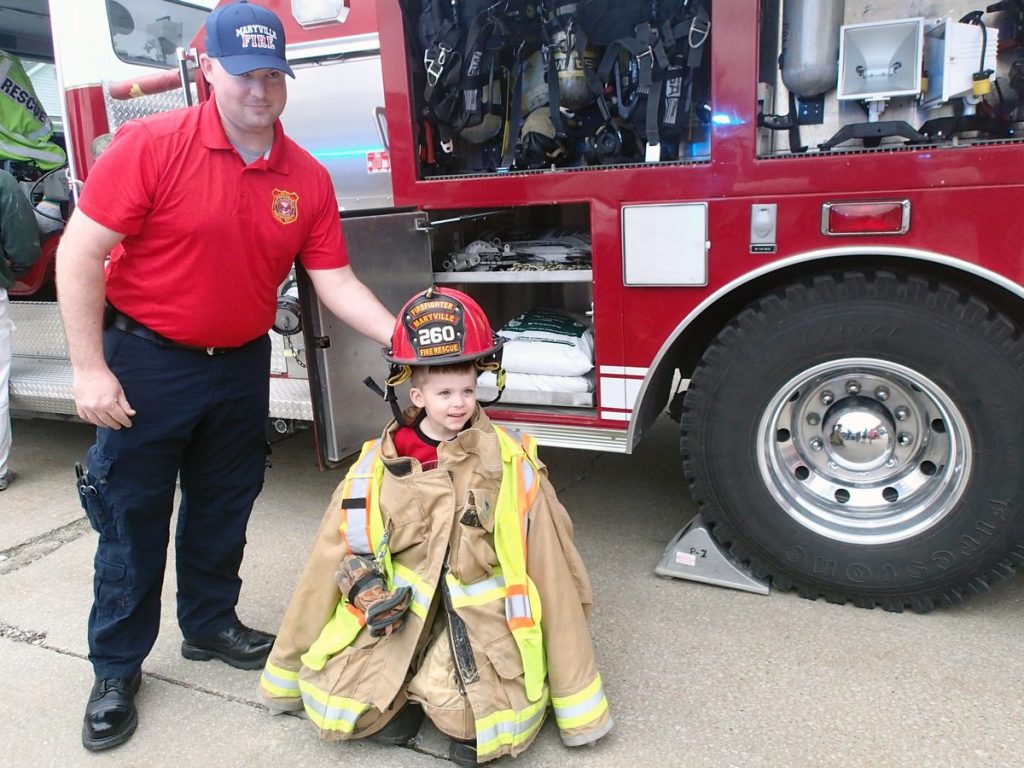
Aydyn Fish, 3, tries on a firefighter turnout suit during an open house hosted this week by Maryville Public Safety. The event was designed to acquaint citizens with what city officials see as the need for a new fire/police headquarters. Standing at left is MPS volunteer firefighter Bryan Williams.
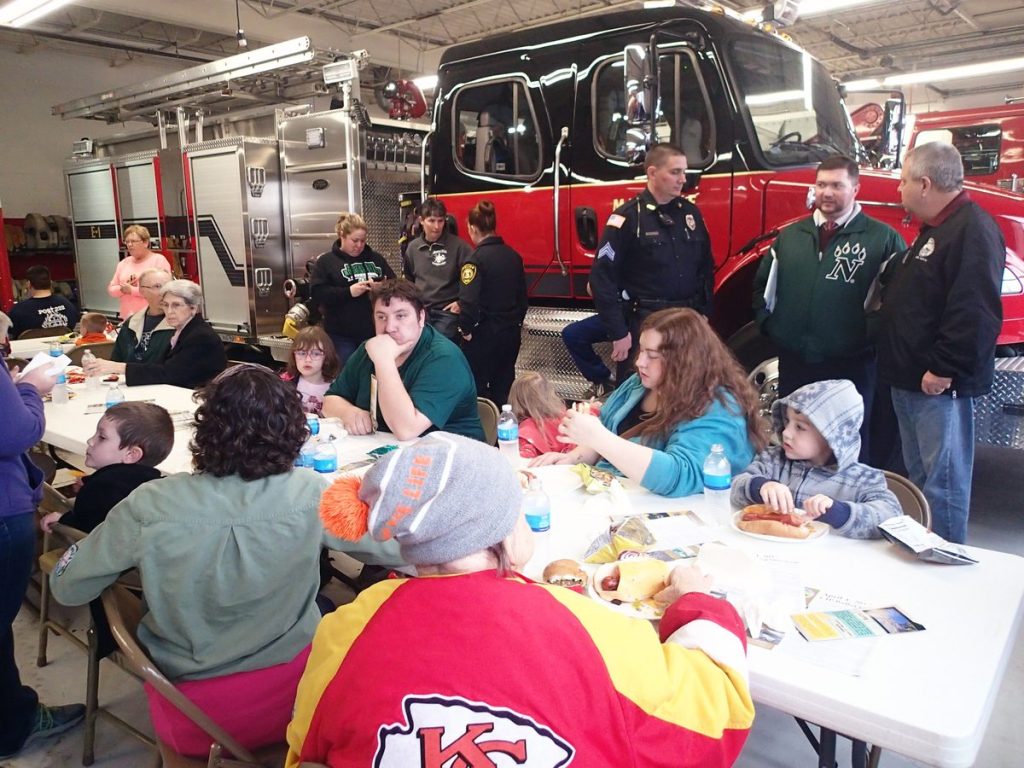
Firefighters and police officers heated up the grill and hosted about 300 local residents Tuesday evening during an “open house” at Maryville Department of Public Safety headquarters.
While a lot of open houses are designed to show off someone’s gleaming new business or redecorated home, this one was an attempt to give citizens a chance to experience what city officials view as the fire-and-police station’s deficiencies.
After reviewing a needs-assessment survey completed last year by the design firm of Williams, Spurgeon, Kuhl & Freshnock, the city has been looking into the possibility of building a new police/fire facility to replace the current building, a former grocery store built in the 1960s and converted to its present function nearly 40 years ago.
However, financing a new headquarters, which would likely cost between $3 million and $4 million, is dependent on voter renewal of an existing half-cent capital improvements sales tax in Tuesday’s municipal election.
Thus this week’s open house, which offered free hot dogs and hamburgers along with facility tours and opportunities for children to explore fire trucks and police cars while dressing up in firefighter gear.
Maryville Public Safety Director Keith Wood said the primary shortcoming of the existing headquarters is lack of space, a problem that has increased over the years as fire trucks have gotten bigger and the security and operational needs of law enforcement have become more complex.
Currently MPS fire and law enforcement divisions share a total of about 6,500 square feet of space, and Wood said a new headquarters would at least triple that.
In addition to cramped vehicle bays and equipment storage areas on the fire side, Wood said a small number of rooms housing multiple functions is cause for investigative and security concerns for police.
For example, officers must often interview victims, suspects and witnesses using the same room and have no real way to keep those waiting their turn to be questioned isolated and secure.
Another problem is a dispatch area separated from the station’s main entryway by a single pane of glass on one side and an easily accessible door on the other.
Wood said the area, usually late at night, can quickly become the scene of a “rolling disturbance” involving suspects and victims, and that officers can’t easily separate parties in conflict who may be violent, impaired, upset, angry or all four at once.
In such instances, he said, dispatch personnel are inadequately shielded.
Other issues include lack of storage for both evidence and the expanding volume of equipment — including computers and cameras — modern officers need to do their jobs.
Among other things, there isn’t enough properly equipped space for video viewing and storage, electronic documentation of statements and interviews, and the examination of evidence.
For example, Wood said, officers are sometimes forced to process illegal drugs seized from suspects at the same table where their colleagues eat brown-bag lunches.
Other problems include no dedicated facilities for officer and firefighter training, though limited exercises are sometimes held in the multi-function squad room or in the fire bay after moving a truck or two outside.
On other fronts, cramped quarters long ago forced MPS to convert a couple of holding cells into storage areas, and a new station would likely contain one or two cells in which suspects could be securely held until being transferred to the county jail.
Fire division deficiencies, according to the needs-assessment, revolve around a lack of proper storage for turnout gear and other equipment, which can be degraded by diesel fumes produced by the trucks.
Fumes lingering in the station can also contaminate compressed air used to fill firefighter breathing tanks.
Another failing compared to modern fire station standards is limited vehicle access through a single set of six overhead doors, which means trucks must be backed into their respective slots across a fairly shallow concrete apron, an operation that blocks the street.
Modern firehouses, city officials say, generally have two sets of overhead doors — one on each side of the bay — that allow trucks to be driven out one side and in the other.
TONY BROWN/DAILY FORUM
Maryville residents enjoy a hot dog and hamburger meal Tuesday night at Maryville Public Safety headquarters, which houses the department’s fire and police divisions. Those attending the free public feed included MPS Director Keith Wood, standing at right, and Nodaway County Prosecuting Attorney Robert Rice, standing second from right.




